Many creation stories begin with a god speaking, or a great light. The Norse version begins with an empty gap, a frozen land, a burning land and a cow licking salt. It is one of the strangest and most original cosmologies in the world, and it comes down to us almost entirely through Snorri Sturluson’s Prose Edda, written in Iceland around 1220, with some help from the earlier poem Völuspá.
Before there was anything
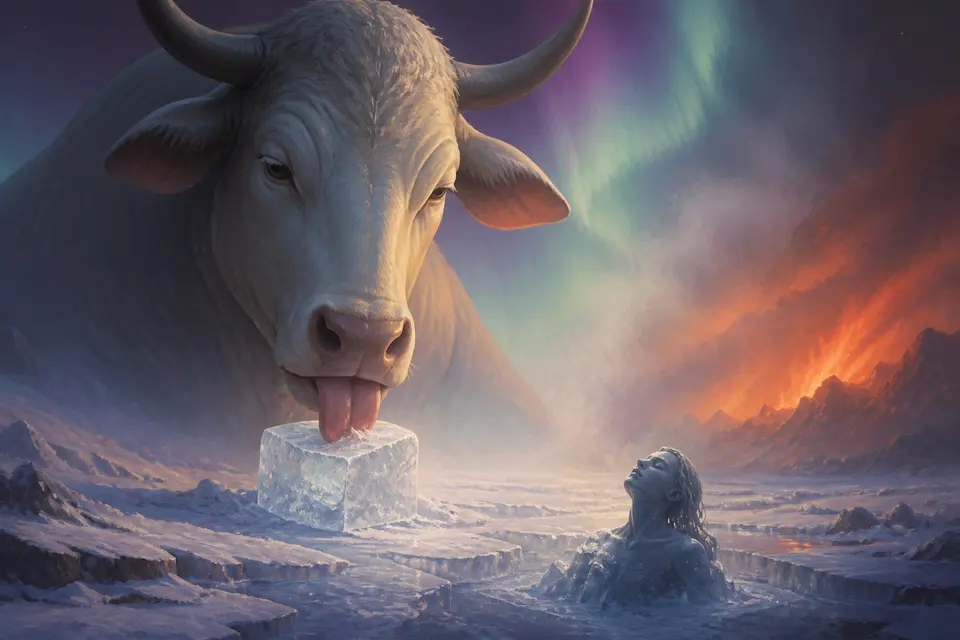
In the beginning, the sources say, there was neither earth nor sky, only a yawning void called Ginnungagap. To the north of it lay Niflheim, a realm of ice, fog and darkness, and to the south lay Muspelheim, a realm of fire, guarded by a giant with a flaming sword. In Niflheim there was a spring, Hvergelmir, from which eleven rivers flowed. They froze as they ran, and layers of ice built up in the void. Where the cold from the north met the warmth from the south, the ice melted, and out of the drops, life appeared.
Ymir
The first being was Ymir, a giant. In some versions, his name is related to the word “twin,” and scholars have noted that it matches the Sanskrit Yama, which also means “twin,” another primeval being. He was nourished by four rivers of milk that flowed from a cow, Auðumbla, who had also come from the melting ice.
While he slept, Ymir sweated, and under his left arm grew a man and a woman. One of his feet begat a son with the other. From this brood came the race of frost giants.
The cow
Auðumbla, the primeval cow, lived by licking the salty ice blocks. On the first day, as she licked, a man’s hair appeared. On the second day his head. On the third the whole body emerged: Búri, handsome, big and strong. His son Borr married the daughter of a giant, and they had three sons: Odin, Vili and Vé. These three would become the first gods.
It is a modest and charming image, a world’s first family tree that begins with a cow licking a block of salt.
The murder
The three brothers disliked the giants and killed Ymir. His blood poured out in such floods that all the frost giants except two were drowned, a flood story in the middle of a creation story. The two survivors, Bergelmir and his wife, escaped in a hollowed tree trunk, or a boat, and became the ancestors of the giants who remained.
The world made from a body
Odin and his brothers carried Ymir’s body into the middle of the void and made the world from it:
- His flesh became the earth.
- His blood became the sea and the lakes.
- His bones became the mountains, and his teeth and broken bones became rocks and gravel.
- His hair became the trees.
- His skull became the dome of the sky, held up at the four corners by four dwarves: Nordri, Suðri, Austri and Vestri, North, South, East and West.
- His brains were flung into the air and became the clouds.
- His eyebrows became the wall around Midgard, the world of humans, to protect it from the giants.
Sparks from Muspelheim were placed in the sky as stars, the sun and the moon. The first humans, Ask and Embla, were made from two trees, an ash and an elm, by Odin and his brothers, who gave them breath, thought and warmth.
A common idea
The idea of a world made from the body of a giant is not uniquely Norse. It appears in several Indo-European traditions. In the Indian Rigveda, the world is formed from the dismembered body of Purusha, a cosmic being. In China, the creation story of Pangu tells of a giant who held the sky apart from the earth for 18,000 years, and whose body became the mountains, rivers and sun after he died. And in Mesopotamia, the god Marduk makes the world from the split body of the sea goddess Tiamat. Scholars have wondered whether these are related, or whether the image of a body as a model of the world is simply a natural one.
The remarkable thing
What stands out in the Norse version is the dark note. The world is not the product of benevolent creation. It is made from a corpse, and the gods who made it are killers. It is a creation story with a murder in it. The Norse apparently saw nothing odd in that. They lived in a world of ice and fire, where life was precarious, and saw the cosmos as a thing that had to be won.
It is also, in an odd way, a very physical story. The earth is flesh, the sea is blood, the sky is bone. When you look at a mountain, you are looking at a giant’s bone.