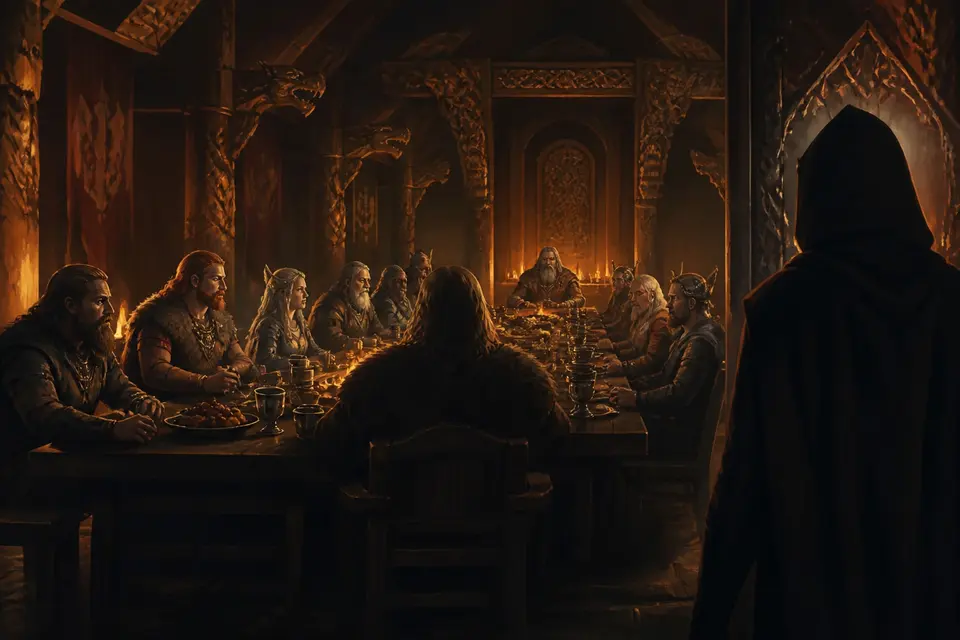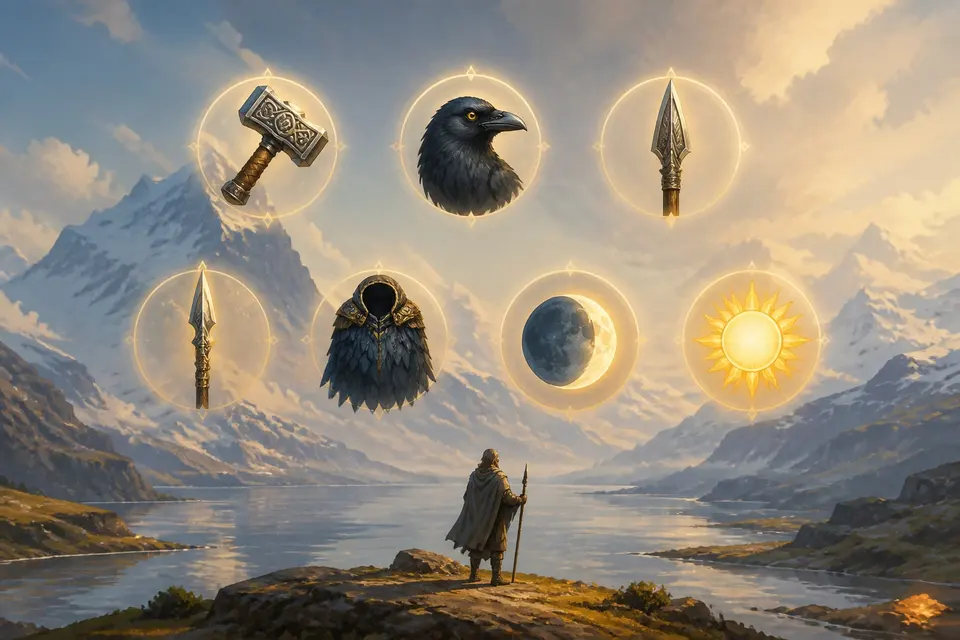
You have said the names of Norse gods roughly a billion times this year. Tuesday, Wednesday, Thursday and Friday are all named, in English, for a god or goddess of the old Germanic peoples, and the story of how they got there is a story about how languages borrow from each other when nobody is looking.
The Roman week arrives
The seven-day week is not Germanic. It started in the ancient Near East, reached the Greeks and Romans through astrology, and was well established in the Roman world by the first or second century CE. Each day was named for one of the seven “wandering stars,” which were also gods: the Sun, the Moon, Mars, Mercury, Jupiter, Venus and Saturn. In Latin the days were dies Solis, dies Lunae, dies Martis and so on.
When the Germanic peoples of northern Europe came into contact with the Roman empire, they took the week along. But they did not simply borrow the Latin names. They translated them. Each Roman god was matched to the Germanic god who seemed the closest equivalent, and the day got that name instead. Scholars call this practice interpretatio germanica, “the Germanic interpretation.” The Roman historian Tacitus had already noticed the habit, in his book on Germany around 98 CE, when he said the Germans identified Hercules, Mercury and Mars with their own gods.
The match-ups
- Tuesday. The Roman dies Martis, “Mars’s day,” became the day of Týr, whom the English knew as Tiw. Týr was the god of war and justice. He is best known for a story in which the gods wanted to bind the monstrous wolf Fenrir. The wolf agreed to be tied up only if one of them put a hand in his mouth as a pledge. Týr did it. When Fenrir found he could not break free, he bit the hand off.
- Wednesday. The dies Mercurii became “Woden’s day,” Wōdnesdæg in Old English. Woden is the English form of Odin, the chief god, who gave up an eye for wisdom and hung himself on the world tree to learn the runes. Mercury, as the god of messages, travelers and the dead, was a fairly good fit: Odin was a wanderer and a guide of souls.
- Thursday. The dies Iovis, Jupiter’s day, became “Thunor’s day” in Old English, Thor’s day in Norse. Both were gods of thunder. Thor’s hammer is the Norse answer to Jupiter’s thunderbolt.
- Friday. The dies Veneris, Venus’s day, became the day of Frigg (Old English Frīg), Odin’s wife, a goddess of marriage and foresight. Some scholars think the original goddess might be Freyja, the Norse goddess of love, and the two names might be dialect variants of the same figure. The evidence does not settle it.
What the other languages did
You can see the two systems side by side in Europe. French, Spanish and Italian kept the Roman gods: in French, mardi (Mars), mercredi (Mercury), jeudi (Jove) and vendredi (Venus). The Germanic languages swapped them out. In Swedish, the days are tisdag (Tyr), onsdag (Odin), torsdag (Thor) and fredag (Frigg or Freyja). Dutch has dinsdag and woensdag, with “Woden” still visible in the second one. German is the odd one out: Mittwoch means “mid-week,” and was introduced in the tenth century, possibly to get rid of a pagan name.
The other three
Saturday is the exception. It comes from Saturn, the Roman god, and the name of the Germanic peoples’ own deity did not take. Sunday and Monday are the days of the Sun and the Moon, and in the Germanic languages they translate directly.
Why it matters
Why Saturday comes before Sunday
There is a puzzle in the Roman week that most people never notice. The seven “planets” were ordered by the ancients according to how fast they seemed to move across the sky, from slowest to fastest: Saturn, Jupiter, Mars, the Sun, Venus, Mercury and the Moon. Yet the days of the week do not go in that order. They go Saturn, Sun, Moon, Mars, Mercury, Jupiter, Venus. Why?
The answer, according to the Roman writer Cassius Dio, is hours. The Romans assigned each of the 24 hours of the day to a planet, in the order above, repeating the cycle. The first hour of a day belonged to the planet that gave the day its name. If the first hour of Saturday belongs to Saturn, then the hours go Saturn, Jupiter, Mars, Sun, Venus, Mercury, Moon, and then Saturn again, and so on. Twenty-four hours is three full cycles plus three extra hours. So the first hour of the next day falls on the fourth planet down the list after Saturn: the Sun. Then, three steps later, the Moon. And so on. The result is the order we use today.
The same idea in India and Japan
The idea of naming days after the sun, the moon and the planets turns up far from Rome. In India, the days of the week in Hindi are Ravivar (the Sun), Somvar (the Moon), Mangalvar (Mars), Budhvar (Mercury), Guruvar (Jupiter), Shukravar (Venus) and Shanivar (Saturn), the same sequence as in Europe. In Japan, the names are a mixture of the Sun, the Moon and the five elements, which also correspond to the visible planets: Monday is Getsuyōbi (moon day), Tuesday Kayōbi (fire day, Mars), Wednesday Suiyōbi (water, Mercury), Thursday Mokuyōbi (wood, Jupiter), Friday Kin’yōbi (metal, Venus) and Saturday Doyōbi (earth, Saturn). The week reached Japan through Chinese and Buddhist astrology, and the names of the days belong to a shared system. In every case, the days are named for the same seven lights in the sky.
It is a quiet reminder that religious change does not erase language. The Anglo-Saxons were converted to Christianity in the seventh century, and the church objected to many pagan customs, but the days of the week kept their old names. A few weeks after a new school term starts, someone in every office says “Thank Thor it’s Friday” at least once. Nobody has to know why it works.