Around the year 1220, an Icelandic politician and poet named Snorri Sturluson sat down to write a handbook for young poets. He was worried that the old verse, with its coded names for things, was being forgotten. To explain it, he had to explain the myths behind it, and so he wrote down the Norse story of how the world ends. A few decades earlier, or perhaps much earlier, an anonymous poet had already told the same story, in a poem called the Völuspá, “the prophecy of the seeress.” Between them, those two texts are almost everything we know about Ragnarök.
The word
Ragnarök is usually translated as “the fate of the gods,” from regin (the powers, the gods) and rök (fate, reckoning). There is a variant, ragnarøkkr, which would mean “the twilight of the gods,” and it was this version that Richard Wagner used for the last opera of his Ring cycle, Götterdämmerung. Scholars still argue about which is older. For most readers the difference hardly matters: both mean that the gods’ story has a last chapter.
The signs
The Völuspá paints the beginning in terrible strokes. First comes a killing: Baldr, the best-loved of the gods, is dead, and nothing the gods have done can bring him back. Then comes the winter, Fimbulvetr, “the mighty winter.” Snow falls from every direction. Frost is hard. Winds are cruel. The sun gives no warmth. There are three of these winters in a row, with no summer in between. Brothers begin to kill each other and kinsmen break the bonds of kinship. The poem says that ax-age, sword-age, wind-age and wolf-age come before the world goes down.
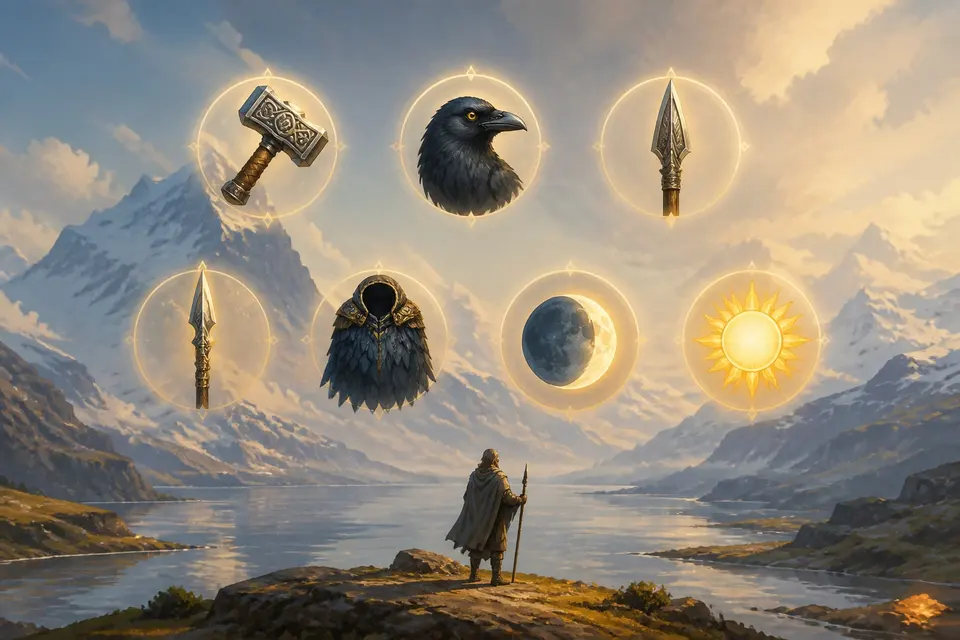
A wolf swallows the sun. Another swallows the moon. The stars fall from the sky. The earth shakes and mountains tumble. Every bond and chain snaps, and the wolf Fenrir, whom the gods had bound with a magical ribbon, runs free.
The last battle
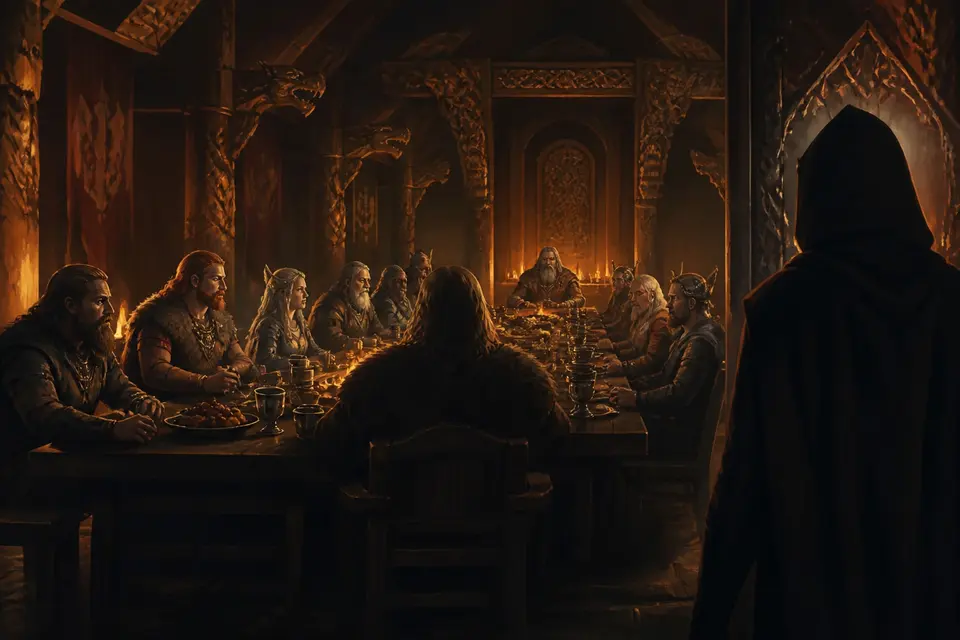
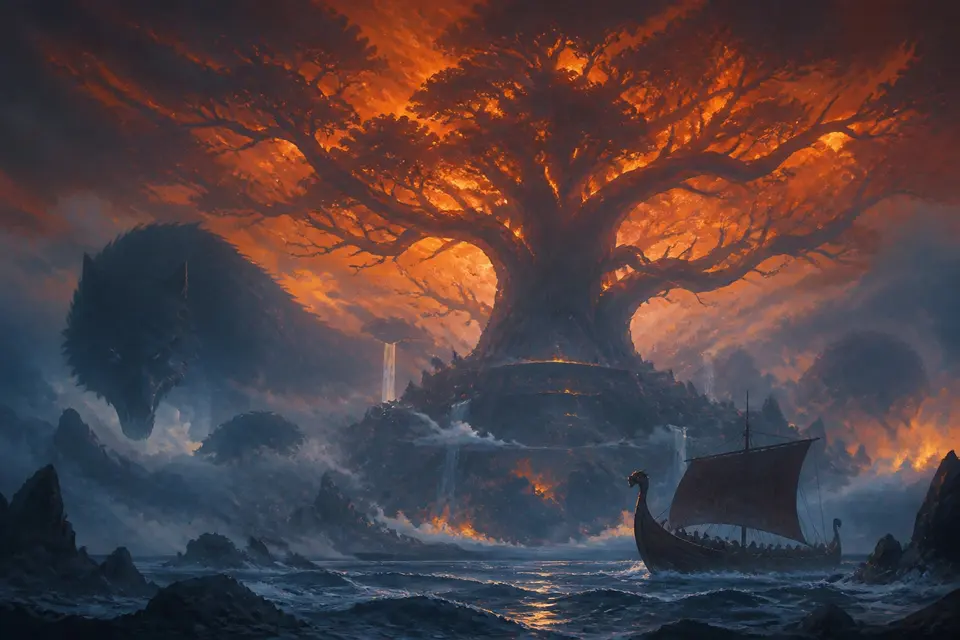
A cock crows on a hill and a red rooster wakes the dead in the hall of Hel. A ship made out of the fingernails of the dead, Naglfar, sails from the east carrying giants, and Loki leads the people of Hel in another. The sea rises as the world serpent Jörmungandr, the great snake that coils around Midgard, writhes in fury. The fire giant Surtr comes from the south with a sword that outshines the sun. Heimdall, the watchman of the gods, raises his horn Gjallarhorn and blows.
Odin rides out to fight the wolf Fenrir. The wolf swallows him, and then Odin’s son Víðarr tears the beast’s jaws apart and kills it. Thor fights the world serpent and kills it, but he can only take nine steps before he falls dead from its venom. Freyr, who gave away his sword for love, fights Surtr without a weapon and loses. Tyr and the hound Garm kill one another. Heimdall and Loki do the same. Then Surtr sets fire to the whole world.
And then, not the end
This is the part that people often skip, because the destruction is so vivid. The Völuspá does not end with the fire. The seeress says that she sees the earth rise a second time from the sea, evergreen. Waterfalls flow. An eagle flies over the mountains, hunting fish. In the grass, the gods’ golden game pieces, the ones they had played with at the start of the world, are found again. Fields grow without being sown. Baldr comes back from the dead, and with his brother Höðr, who had killed him, he lives in peace.
A small number of gods survive: Víðarr and Váli, two of Odin’s sons, and Thor’s sons Móði and Magni, who inherit his hammer. Two humans, Líf and Lífþrasir, who had hidden in the wood of Hoddmímir, “Mímir’s holt,” repopulate the earth.
Pagan, or Christian, or both?
Scholars have debated for generations how much of this ending is old. Both main sources were written down in Iceland in the thirteenth century, after the country had become Christian in the year 1000. Some of the poem’s images, like the rebirth after destruction and the return of a good god, may have come from Christian ideas of the Last Judgment. Others look unmistakably older. The fact that the gods lose is unusual in world mythology, and some think it reflects a very old Germanic idea that fate is stronger than the gods. Most researchers think the truth is a mixture.
Why it hasn’t gone away
Ragnarök has found a way into pop culture again and again, from Wagner’s opera to the Marvel film Thor: Ragnarok (2017), from the video game God of War Ragnarök (2022) to the Norwegian Netflix series Ragnarok (2020), in which a teenager in a Norwegian town discovers that he carries the power of Thor.
It lasts because it is an unusual kind of apocalypse. The gods know it is coming. They fight anyway. They go down fighting, and the story ends with a green world. It is a story about courage without hope of victory, and about the idea that an ending can also be a beginning.