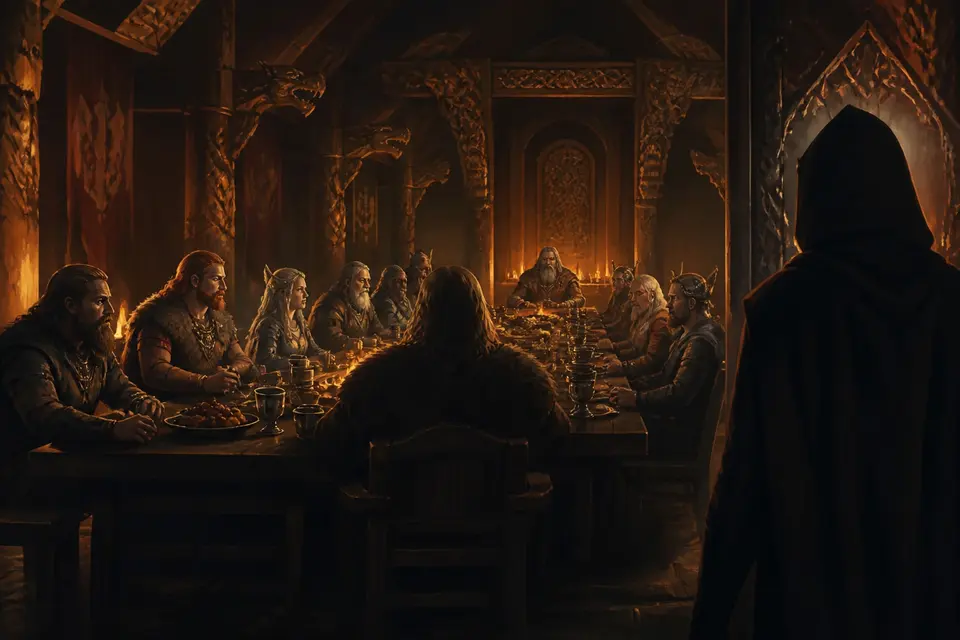
Every year, around the time a Friday falls on the thirteenth, the same story goes around online. Twelve gods were having dinner in Valhalla. Loki, the trickster, showed up uninvited as the thirteenth guest. He tricked the blind god Höðr into killing Baldr, the best-loved of the gods, and the world has been cursed with bad luck ever since. It is a nice little origin story. There is only one problem: you will not find it in any Norse source.
What Norse sources actually describe
There is a feast crashed by Loki. It is the subject of a poem in the Poetic Edda called the Lokasenna, “Loki’s quarrel.” In it, the gods are having a party in the hall of Ægir, a sea giant who brews ale for them. Loki enters, kills one of the servants and is thrown out. He comes back in and proceeds to insult every god in the hall, one after another, with a mixture of accurate accusation and invention. He tells Odin that he has been unfaithful, tells Freyja that she has slept with every god and elf in the room, and tells Sif that he has been in her bed. Thor eventually arrives and drives him off with the threat of his hammer.
That is the dinner party. But the gods in the hall are not twelve, but at least a couple of dozen, since the poem’s prose introduction lists many of them. Baldr is not killed. In fact, his death is told in a different place altogether: in the Prose Edda by Snorri Sturluson, where Loki finds out that the gods have made everything in the world swear not to harm Baldr, except mistletoe, which seemed too young to ask. Loki makes a dart out of mistletoe and gives it to the blind Höðr, who throws it in sport. Baldr falls dead.
The two stories are separate. Neither mentions Friday. Neither mentions the number thirteen. And no Norse text counts twelve gods plus Loki.
Where Friday and thirteen come from
Fear of the number thirteen has a long history, and the best known strand of it is Christian. At the Last Supper, thirteen people sat down to dinner: Jesus and his twelve disciples. The thirteenth to sit, or the thirteenth to rise, according to different versions, was Judas. Friday carries its own weight. By tradition, Jesus was crucified on a Friday. By the fourteenth century, Friday was already regarded as an unlucky day, and Chaucer, in The Canterbury Tales, makes a joke about the ill-fated day of Venus.
A modern superstition about Friday the thirteenth, as a specific date, is surprisingly young. Historians have not found a clear example before the nineteenth century. One biography of the composer Gioachino Rossini, who died on Friday the 13th of November, 1868, mentions the date as an unlucky one. In 1907, an American financier named Thomas W. Lawson published a novel called Friday, the Thirteenth, in which a broker uses the superstition to manipulate the stock market. That helped fix the idea in popular culture. The 1980 horror film Friday the 13th made it a franchise.
The Norse legend seems to have been added to this story much later, probably in the twentieth century, as a way of giving a modern superstition a colorful ancient origin.
So why does the legend stick?
Because it is good. The story brings together an unwanted guest, a death and a thirteenth seat, and it sounds exactly like the sort of thing the Vikings would do. It also gives people a villain. Folklorists call this a “folk etymology” or a “retrofitted origin”: a story that explains why something is, even though it came later.
The part of the Baldr story that matters
If you want to know what the Norse actually said about the death that is supposed to have started it all, the story is worth telling properly, because it is better than the legend. Baldr, the son of Odin and Frigg, was the most beloved of the gods, so fair and bright that he seemed to shine. He began to have bad dreams about his own death, and the gods grew anxious. His mother Frigg went around the world and made every living thing, every stone, metal, disease and animal, swear not to harm him. The oath seemed to work, and the gods made a game of it: they would take turns throwing weapons at Baldr, and watch everything bounce off.
Loki, disguised as an old woman, visited Frigg and asked whether everything had really sworn. She said that only the mistletoe, which grew west of Valhalla, had been left out, because she thought it too young to swear. Loki found it, made a dart, and put it in the hand of the blind god Höðr, who had not been able to join the game. Höðr threw it. Baldr fell dead.
The gods sent a messenger, Hermóðr, to Hel to plead for his return. Hel agreed on one condition: that everything in the world weep for him. Everything did, except a giantess named Þökk, who said she had no use for Baldr, alive or dead. The gods suspected she was Loki in disguise. Baldr stayed in Hel until the end of the world.
Mistletoe and a kiss
The mistletoe in that story, the plant that killed a god, is also why we kiss under it. The custom is first recorded in England in the eighteenth century, and Washington Irving described it in 1820: a young man could kiss a girl under the mistletoe, and pluck a berry each time, until the berries ran out. Whether anybody was thinking of Baldr is unknown, but the plant carried its mysterious reputation along with it.
Other unlucky days
Different countries have different bad days. In Spain and Greece, the unlucky day is Tuesday the 13th, because Tuesday belongs to Mars, the god of war, and Constantinople fell to the Ottomans on a Tuesday in 1453. In Italy, the unlucky number is 17, because in Roman numerals XVII can be rearranged into VIXI, Latin for “I have lived,” which sounds like what you would write on a tombstone. Many hotels and hospitals skip the thirteenth floor, which in practice means the number never appears on the elevator buttons, although the floor is, of course, still there.
There is an irony in this. Loki was already the most blamed figure in Norse myth, and the one whom everyone, including the gods, needed in a pinch. It seems that more than a thousand years after he was written down, he is still taking the fall.