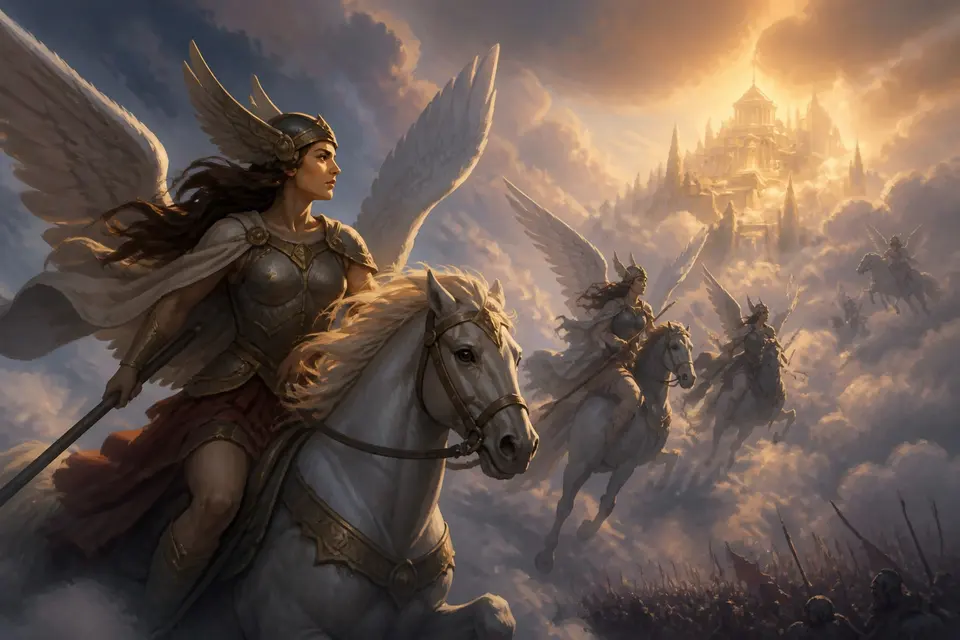
If you only know the Valkyries from opera, you probably picture a soprano in a metal bra and a winged helmet, shrieking on a horse. That image dates to 1876, and has very little to do with how the Vikings described them. In the old poems, they are more complicated and in some ways more chilling: they are the ones who decide who is going to die.
What the word means
The Old Norse word valkyrja means “chooser of the slain,” from valr (the slain on a battlefield) and a verb meaning “to choose.” In the poems, they ride over battles on horses, or sometimes wolves, and they are sent by Odin to select which warriors will fall and be brought to Valhalla, Odin’s great hall, where they feast and train all day, preparing for Ragnarök. In another poem, half the slain go to Freyja’s hall, Fólkvangr, not to Odin’s.
In the poem Grímnismál, Odin lists their names, and they read like a battlefield: Hild means “battle,” Göll means “screaming,” Skögul is “shaker,” and one is called Axe-Time. Their job is to determine the outcome of battle, and to pour mead for the dead heroes afterward.
Half goddess, half woman
In some stories, the Valkyries are closer to human women. In a poem about the hero Helgi, a Valkyrie named Sváva protects him in battle. In the Völsunga saga, Brynhildr is a Valkyrie who disobeys Odin by giving victory to the king he had chosen to lose. As a punishment, Odin pricks her with a thorn of sleep and she must sleep inside a ring of fire until a man who knows no fear can ride through. The hero Sigurd does, and wakes her. It is the origin of the “sleeping beauty” image that Wagner later used.
The Wagner effect
Richard Wagner’s opera Die Walküre, first performed in 1870, is where the image that most of us carry comes from. In it, Valkyries are Odin’s warrior daughters, riding on winged horses and wearing helmets with horns or wings. The “Ride of the Valkyries” is one of the most recognizable pieces of music in the world. It has been used in cartoons, commercials and, most famously, in the 1979 film Apocalypse Now, where American helicopters attack a village while the music blares.
Neither has much to do with the poems. In the poems there are no horned helmets, and no singing.
Were there real warrior women?
This is one of the most debated questions in Viking studies. In the 1870s, a grave in Birka, Sweden, was excavated and found to contain a richly furnished burial with weapons, including a sword, a spear, arrowheads and a pair of horses. It was assumed to be a male warrior. In 2017, a DNA analysis showed that the skeleton was female.
That was big news, and it set off a heated argument. Some scholars said that the grave must belong to a female warrior, perhaps a leader. Others argued that the weapons might have been symbolic, or that the grave might hold both a woman and the possessions of a man, or that it might not be what it seems. A follow-up paper in 2019 supported the original interpretation. The debate continues.
It is important to say that the sagas also mention skjaldmeyjar, shield-maidens, but these are mostly in legendary tales, not historical accounts, and nobody knows how many were real.
The name today
The word has had a long second life. It has been given to an American experimental bomber (the XB-70 Valkyrie), a car model, a Marvel comic character and countless video game heroines. It means a kind of warrior woman, fierce and free.
Weavers of battle
The most unsettling image of the Valkyries is not in the epics. It appears in Njáls saga, a long Icelandic saga from the thirteenth century. On the morning of the Battle of Clontarf in Ireland, in 1014, a man named Dörruðr in Caithness, Scotland, looks through a window of a woman’s hut and sees twelve women sitting at a loom. The loom is made of human parts. The weights are men’s heads, the weft and warp are human intestines, the shuttle is an arrow and the beater is a sword. The women are chanting a poem, now known as the Darraðarljóð, “the song of Dörruðr,” about the battle being fought far away, and as they sing, they rip the cloth apart and ride off in different directions.
The poem names several of them with the same names as the Valkyries in the older verse, and it describes them deciding who will win and who will lose. It is a remarkable picture: war as a kind of weaving, with fate on the loom. It is also a reminder that the “choosers of the slain” were not romantic maidens. They were something much closer to the three Fates.
What the chosen did
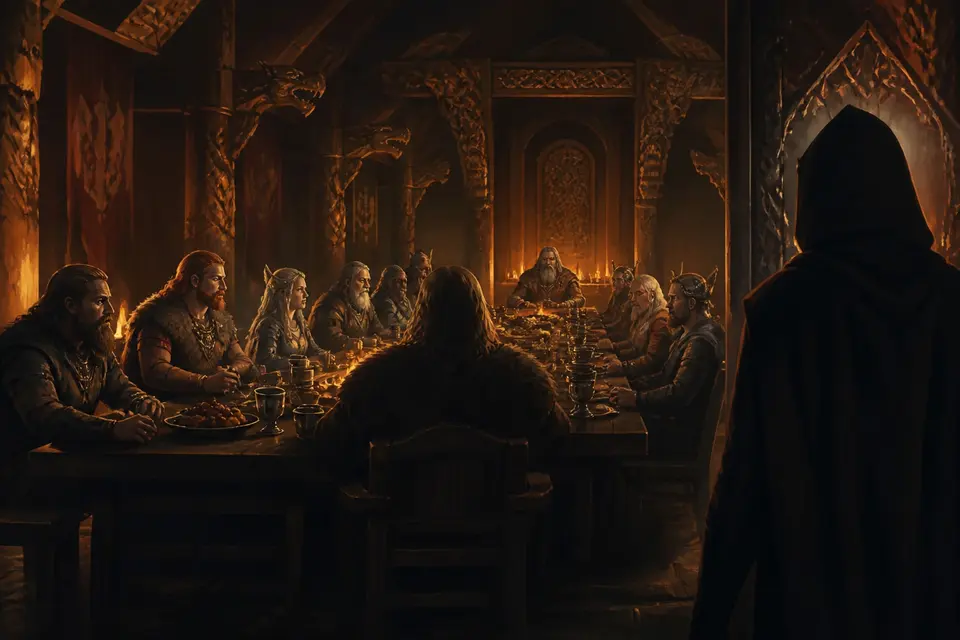
Those who were chosen for Valhalla were called the einherjar, “the lone fighters.” According to the poem Grímnismál, the hall had 540 doors, and from each of them 800 warriors would march out to fight the wolf at Ragnarök. In the meantime, they trained. Every morning the einherjar put on their armor, went out to the courtyard and fought each other to the death. By the evening they were whole again, sat down to feast and were served by the Valkyries.
The food never ran out. A boar named Sæhrímnir was cooked every day in a cauldron by the cook Andhrímnir, and was alive again the next morning. A goat named Heiðrún stood on the roof and ate the leaves of a tree, and from her udder came mead enough for all. It was a vision of an afterlife that was exactly what a Viking warrior might want: a good fight, a good meal and good company.
The old idea underneath is worth remembering. Before the helmets and the music, the Valkyries were something more disturbing. They were the ones who stood at the edge of a battle and decided which warriors would live. It was a world in which luck was not random. Someone, somewhere, was choosing.