Marvel’s Thor first appeared in 1962, in a comic called Journey into Mystery, written by Stan Lee and his brother Larry Lieber and drawn by Jack Kirby. He was blond, noble, and sometimes pompous, the son of Odin and a more or less dignified king of Asgard, and his brother was Loki. All of that is different from the Norse tradition, where Thor is red-haired, loud, hungry and, by modern standards, delightfully bad at keeping out of fights.
The appearance
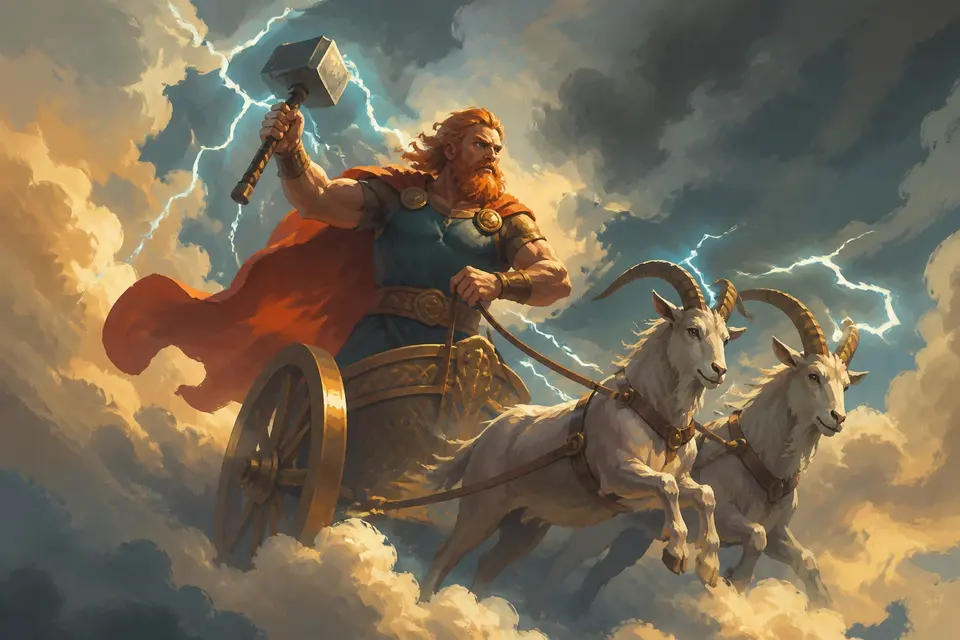
Norse sources agree on a few things. Thor had a red beard, a fierce stare and a huge appetite. He wore a belt that doubled his strength and iron gloves so he could handle his hammer. He did not fly. He traveled by chariot, pulled by two goats, Tanngrjóstr and Tanngnjóstr, whose names mean something like “Tooth-gnasher” and “Tooth-grinder.” In the Prose Edda, when the gods are traveling and Thor is hungry, he kills the goats, cooks them, and eats. After dinner, he waves his hammer over the bones and the skins, and the goats get up, alive again. The only rule is that nobody must break a bone. In the story, a boy named Þjálfi cracked one to get at the marrow, and one goat was lame forever after. Thor demanded the boy and his sister as servants as compensation.
The family
In the myths, Loki is not Thor’s brother. Loki is a half-giant who has sworn blood-brotherhood with Odin. He is something like a very unreliable uncle to Thor, and the two of them frequently travel together, with Loki providing ideas and Thor providing hitting. Thor’s mother is Jörð, the earth, a giantess whose name just means “earth.” His wife is Sif, whose golden hair was famous. In one story Loki cut it off as a prank, and when Thor discovered it, he grabbed Loki and threatened to break every bone in his body. Loki promised to get new hair made of real gold from the dwarves, and he did.
The hammer
The hammer, Mjölnir, was made by two dwarf brothers, Sindri and Brokkr, as part of a bet. Loki had wagered his head that they could not make a better set of treasures than another team of dwarves. While they were working, Loki turned himself into a fly and bit the smith on the eyelid to disturb him. The hammer turned out almost perfect. The one flaw was that the handle was too short. Thor could still use it fine.
The giant’s wedding
The best Thor story is a comic poem called the Þrymskviða, “the lay of Thrym.” One morning Thor wakes up and finds his hammer missing. He calls Loki, who borrows the goddess Freyja’s feather cloak and flies to the land of the giants to find out what happened. The giant king Thrym has stolen it and will give it back only if Freyja is brought to him as a bride.
Freyja refuses with a rage that makes the whole hall tremble, and her necklace bursts. The god Heimdall suggests that Thor dress up as the bride. Thor refuses, saying that people will call him unmanly. Loki points out that unless he does, the giants will take over the world. So Thor puts on a bridal veil, a necklace and a wedding dress, and Loki goes along as his bridesmaid.
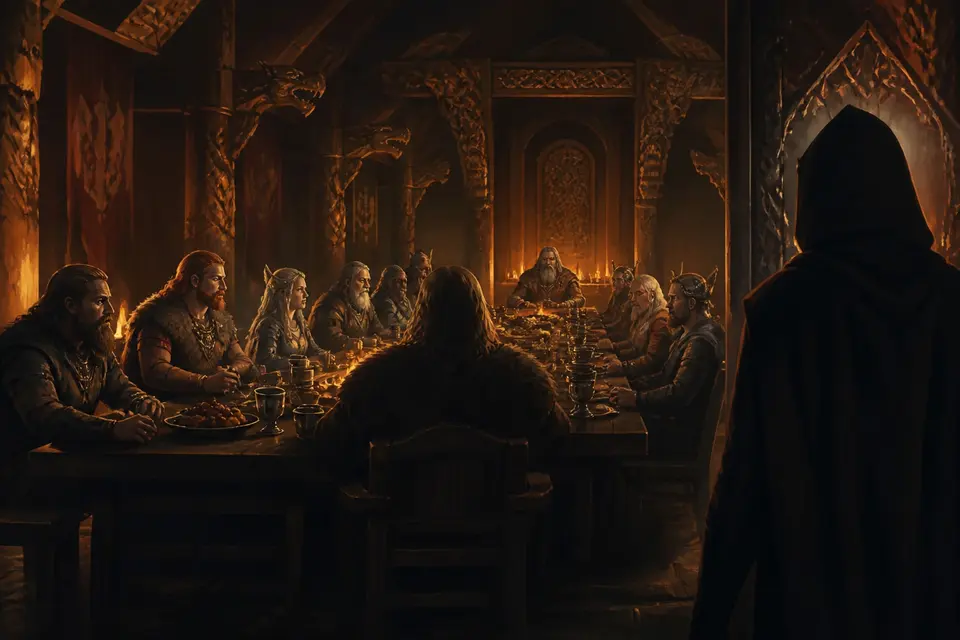
At the feast, Thor eats a whole ox, eight salmon and all the delicacies for the women, and drinks three barrels of mead. Thrym is astonished, and Loki says that the bride has not eaten for eight days out of excitement. When Thrym lifts the veil and sees fiery eyes, Loki says she has not slept for eight nights. Finally the giants bring out the hammer to bless the bride, and Thor grabs it and kills them all.
A god for ordinary people
Archaeologists have found many small silver and iron hammer pendants in Viking Age graves, from Iceland to Russia. Some of them are tiny. They suggest that Thor was a popular protector, a god of farmers and travelers as much as of warriors. A tenth-century runestone at Glavendrup in Denmark carries a blessing to the god: “May Thor hallow these runes.”
That is why Thor’s popularity is no surprise. He is strong, funny, not too clever, loyal to his friends, and always willing to go to the aid of the world when it needs him. If you want a better movie than the movies, go back to the myths. They are funnier.