Most mythologies give their chief god a throne. The Norse gave theirs a walking stick, a cloak and a wide-brimmed hat. Odin is the god of war and poetry, of the dead and of magic, and the one thing everybody agrees on is that he is a wanderer. He travels in disguise, he asks questions and he pays, again and again, with pieces of himself for the sake of knowing more.
The eye
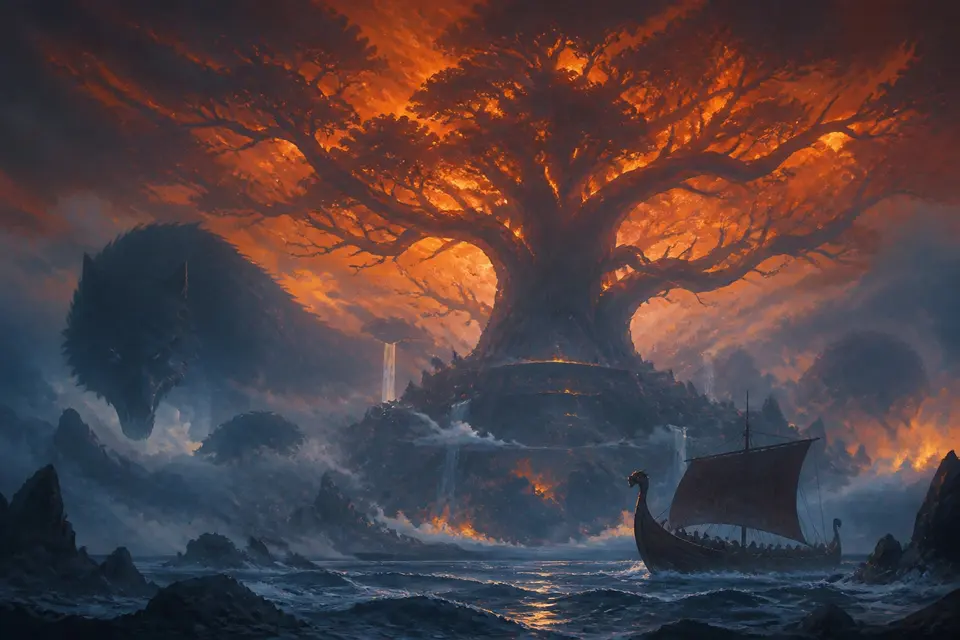
At the foot of the world tree, Yggdrasil, a spring called Mímisbrunnr, the well of Mímir, held all the wisdom of the world. Its guardian was the giant Mímir, who drank from it every morning, and he was the wisest being alive. Odin came to ask for a drink. Mímir named his price: an eye. Odin paid it. The Völuspá, the great poem of the Norse seeress, says that Odin’s eye lies hidden in the well, and that every morning Mímir drinks from it.
That is why Odin is often shown with one eye. It is not a wound. It is a payment.
Nine nights on the tree
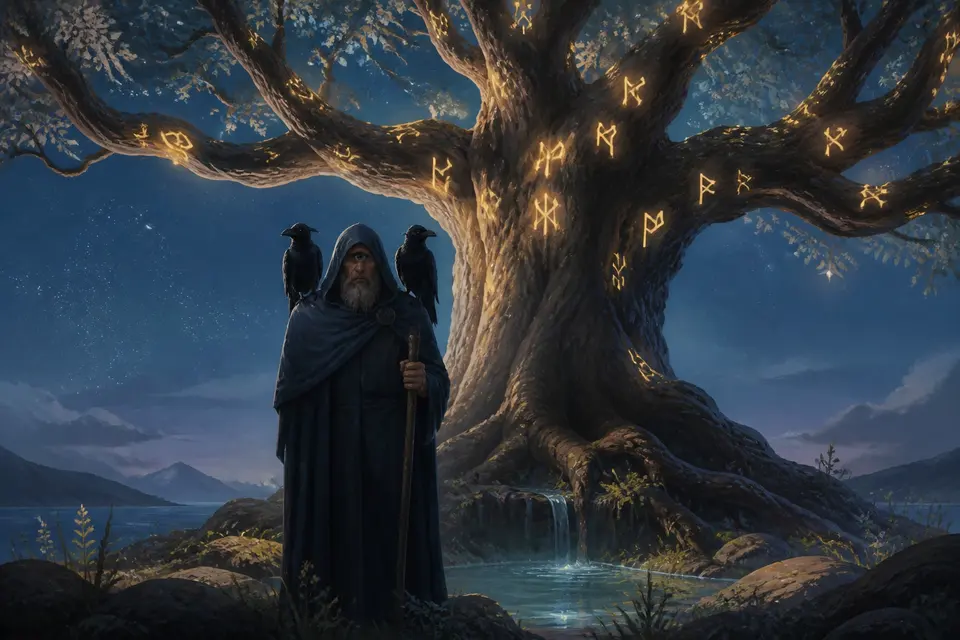
The second sacrifice is described in the Hávamál, “the sayings of the High One,” a collection of verses in the Poetic Edda attributed to Odin himself. In a passage of extraordinary intensity, Odin speaks in the first person: “I know that I hung on a windy tree, nine long nights, wounded with a spear, given to Odin, myself to myself, on that tree of which no man knows from what roots it springs.”
No one offered him bread or a drink. He looked down, he says, and “took up the runes, screaming I took them,” and then he fell. The runes were the secret of writing and magic, the signs that could carve fate itself into wood and stone. Odin gave himself to himself: the god sacrificed to the god, on the tree. It is one of the strangest and most powerful images in any mythology, and scholars have debated for a century whether it was influenced by the Christian story of the Crucifixion or reflects older shamanic practices.
The runes
The runes were real. The oldest runic alphabet, called the Elder Futhark, with twenty-four signs, was used across Germanic Europe from around the second century CE. Each rune had a sound and a name, which often meant something: fehu, “cattle, wealth”; uruz, “aurochs”; thurisaz, “giant”; ansuz, “a god.” They were carved on stones, weapons, jewelry and wood, and we have thousands of inscriptions, from memorials to everyday messages. Whether runes were also used for magic is debated, but the Norse clearly thought they could be.
Thought and Memory
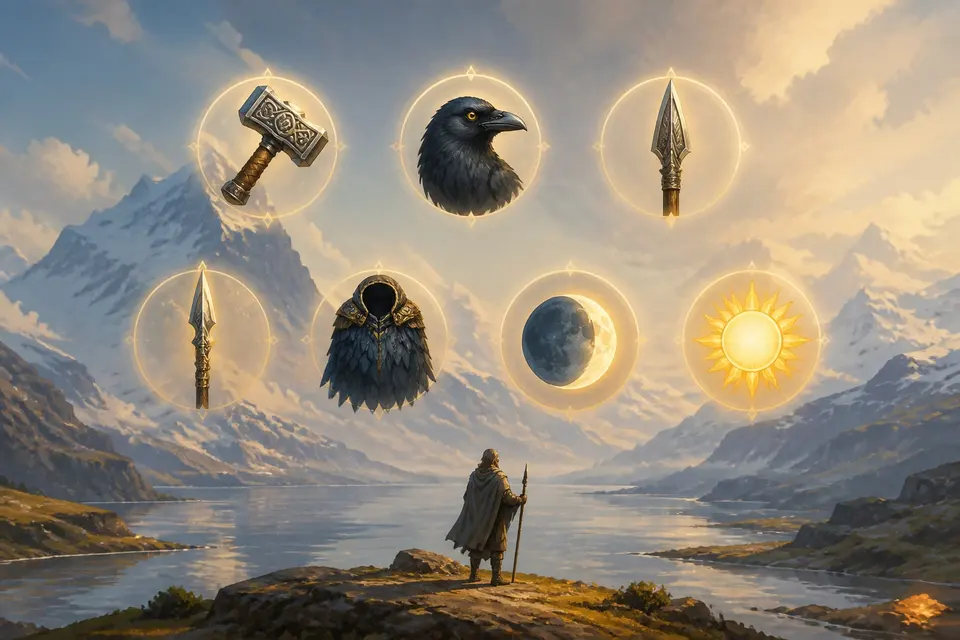
Odin’s two ravens, Huginn and Muninn, whose names mean “Thought” and “Memory,” fly across the world every day and return at breakfast to whisper what they have seen in his ears. In the poem Grímnismál, Odin says that he fears for Huginn that he might not return, but even more for Muninn. Memory, to the Norse, was more fragile than thought.
He also has two wolves, Geri and Freki, whose names both mean “greedy.” He gives them all the meat from his table, because he himself lives on wine alone.
The theft of the mead of poetry
One of the best Odin stories is told in Snorri Sturluson’s Prose Edda, and it is a comedy of burglary. Two dwarves murdered a wise man named Kvasir, whose blood, mixed with honey, made a mead that turned anyone who drank it into a poet or a scholar. A giant, Suttungr, got hold of the mead and hid it inside a mountain, guarded by his daughter Gunnlöð.
Odin disguised himself, got a job as a farmhand by doing the work of nine men for Suttungr’s brother, who bored a hole through the mountain, turned into a snake and slithered through. He spent three nights with Gunnlöð, in exchange for three sips from the vats. Odin, who never did anything by halves, drank all three vats dry in three gulps, turned into an eagle and flew for Asgard, with Suttungr, also in the form of an eagle, in pursuit. As he came over the walls, he spat the mead into jars the gods had set out. But he was so closely chased that some of it escaped from the other end.
That portion, Snorri says, is the share of bad poets, anyone can have it. The good poetry is the part that went into the jars.
The names
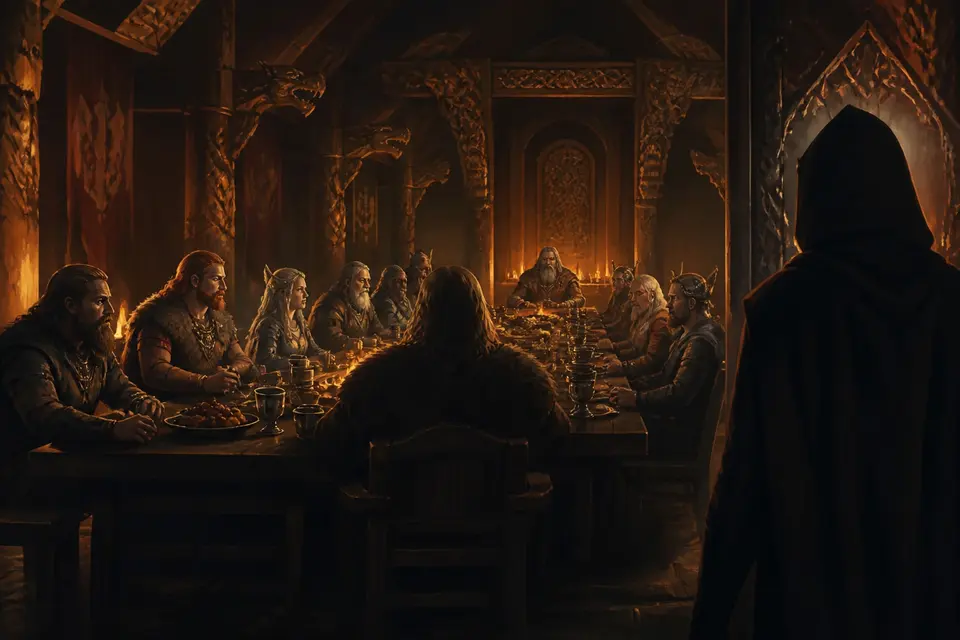
Odin has more names than any other Norse god, over 150, and many of them describe his appearance or his habits. He is Allfather, the Hanged One, the Wanderer, Grim (the masked one), Gagnráðr (“he who wins the game”) and Bölverk (“worker of evil”). When he travels in the world, he does not tell anyone who he is.
Odin in later times
The English Woden, the German Wotan and the Norse Odin are all the same figure, and his name survives in Wednesday. Richard Wagner made him Wotan in his Ring cycle, a god who gives up a great deal and loses control of his own plan. J. R. R. Tolkien said that his wizard Gandalf was modeled on “the Wanderer,” an old man with a hat, a staff and a cloak, based on a picture postcard he owned. A very Odin-like idea.
What Odin tells us
For a chief god, Odin is oddly vulnerable. He is always searching, always lacking, always paying. He knows that Ragnarök is coming and cannot stop it. The poems, written by people who lived in a harsh world, seem to say something about wisdom: it is not something you are given. You go and look for it, and it costs you.
That is why the one-eyed wanderer has been such a lasting figure. He is a ruler who, in the end, would rather be a student.