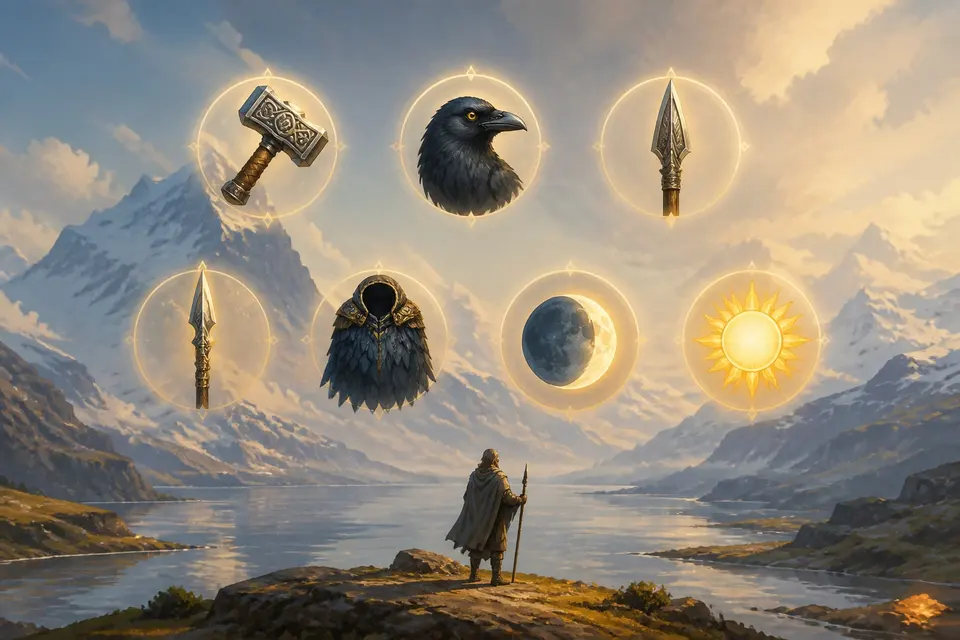
In Snorri Sturluson’s Prose Edda there is a short passage that describes the strongest rope ever made. It was fashioned by dwarves, and its ingredients were: the sound of a cat’s footfall, the beard of a woman, the roots of a mountain, the sinews of a bear, the breath of a fish and the spittle of a bird. Then Snorri adds a line that is a gift to anyone who likes a good puzzle: “And you will find that this is true, because there is nothing left of any of these things.” That is why you never hear a cat walk, women have no beards, mountains have no visible roots, and so on. The dwarves used them all up.
It is one of the most delightful bits of Norse mythology, and it comes at a terrible moment in the story.
A wolf in the house
Fenrir was one of the three monstrous children of Loki and the giantess Angrboða. The other two, the world serpent Jörmungandr and Hel, the ruler of the dead, had already been dealt with: one thrown into the sea, the other sent to the underworld. Fenrir was a wolf, and the gods decided to keep him in Asgard, where they could keep an eye on him. Only one god dared feed him: Týr, the god of war and justice.
But the wolf grew. Every day he got bigger, and the prophecies said that he would one day be the death of Odin. The gods agreed that he had to be bound.
Testing the chains
They first made a huge iron chain called Lœðingr and proposed a game: let’s see how strong you are. Fenrir agreed, let them tie him, and burst it with a single stretch. They made a second chain, twice as strong, called Drómi. The wolf let himself be bound again, strained and broke it, and the pieces flew far. After that, the gods realized that no ordinary metal would do. They sent a messenger to the dwarves in the land of the dark elves.
Gleipnir
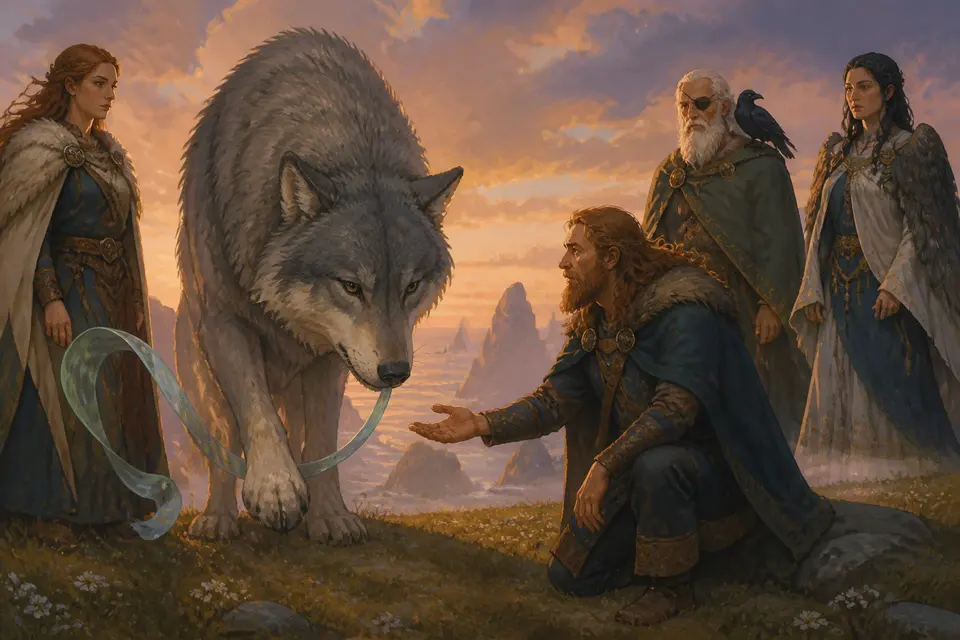
The result was Gleipnir, which looked like a silk ribbon, smooth and soft. When the gods showed it to Fenrir, he was suspicious: it looked too thin to be a test of strength, and he guessed there was some magic or trickery in it. “If it is made with craft and cunning,” he said, “I will not let you put it on me.”
The gods told him that if he could not break it, he had nothing to fear, since they would obviously set him free afterward. Fenrir was not convinced. He made a counter-offer: he would let them tie him with the ribbon, but only if one of them put a hand in his mouth as a pledge of good faith.
Týr’s hand
No one was willing. They all looked at one another. Finally, Týr stepped forward, put his right hand between the wolf’s jaws and said nothing. The gods bound Fenrir with Gleipnir. The more he struggled, the tighter it became. When he realized the trap, he bit down, and the hand was gone at the wrist. According to the Prose Edda, the point where the jaws closed is called the “wolf-joint,” the wrist.
All the gods laughed except Týr. They fastened the end of the ribbon to a rock sunk deep in the earth, and when Fenrir opened his mouth, they thrust a sword between his jaws, with its hilt in the lower and its point in the upper, to keep it open. Saliva ran from his mouth, forming a river called Ván, “hope.” There he lies until Ragnarök.
The god who lied
The story is more uncomfortable than it first looks. The gods promised to release Fenrir if he could not break the ribbon. They did not. Týr’s hand was a pledge of good faith, and the gods knew they were going to betray it, and he knew it too. Týr is the god of oaths and law. His sacrifice, to cheat a wolf, is one of the founding betrayals of the cosmos.
And in the end, the trick creates what it was trying to prevent. Fenrir, bound unjustly and in torment, becomes the monster the prophecy predicted. At Ragnarök, he will break free and devour Odin. Readers have long noted that the gods’ own dishonesty helped to cause their destruction.
The wolf’s afterlife
Fenrir has become a pop-culture staple, appearing in video games, comics and films. There is even a moon of Saturn named Fenrir, discovered in 2004 and named in 2007 as part of a group named after Norse giants and monsters. It is a tiny, irregular body, only a few kilometers across, circling the planet far from home.
What the ribbon teaches
The Gleipnir passage works on two levels. As a joke, it explains why some things are absent from the world. As a story, it says that the strongest bonds are not iron chains. They are made of intangible things: the silence of a footfall, the shadow of a root, a breath, a promise. And that is, in the end, what the gods used to bind a monster.
It also suggests that a promise is the strongest thing you can make, and the easiest thing to break.