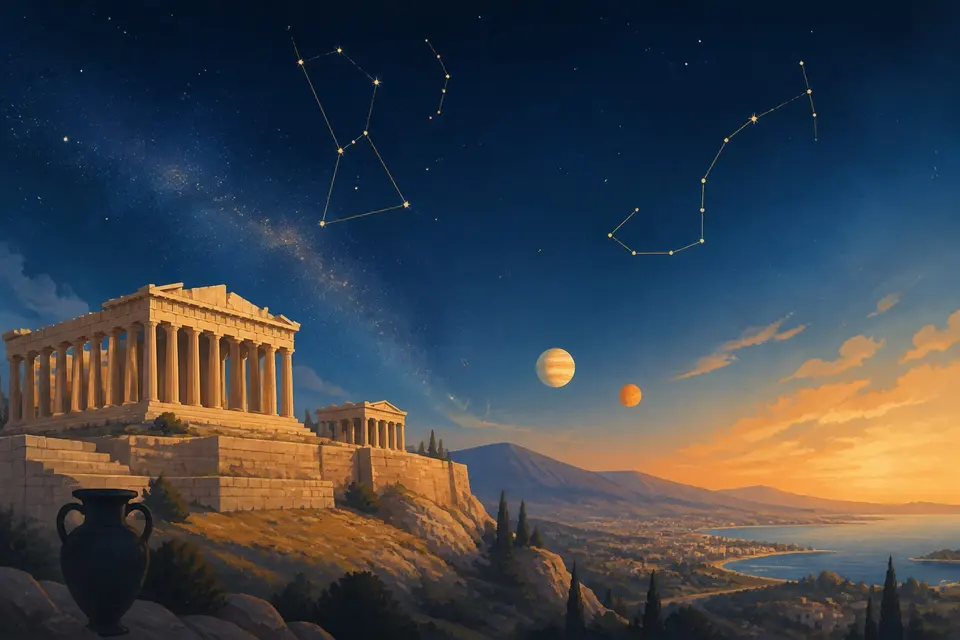
The ancient Greeks, who had nothing better to do in the evenings than look up, saw hunters, kings, a queen on a chair, a sea monster and a horse with wings in the stars. Many of those figures are still in the sky, and the planets that wander through them still carry the names of Roman gods.
Wandering stars
The word planet itself is Greek: planetes means “wanderer.” The ancients noticed that five bright points moved against the background of fixed stars. Babylonian astronomers had already linked them to their gods. The Greeks adapted the system and named them for their own: Hermes, Aphrodite, Ares, Zeus and Kronos. When the Romans took over Greek astronomy, they substituted their own equivalents. That is how we got Mercury, Venus, Mars, Jupiter and Saturn.
Each name fits, loosely. Mercury moves fastest across the sky, hence the messenger god. Venus is the brightest, hence the goddess of love. Mars is red, the color of blood. Jupiter is the largest and most majestic. Saturn is the slowest, and Saturn was an ancient god of time.
The ones that came later
Uranus, discovered by William Herschel in 1781, was almost named “George’s Star” for King George III. Johann Bode, a German astronomer, proposed Uranus, the Greek sky god and the father of Kronos, and the name stuck. It is the only planet named for a Greek god rather than its Roman equivalent. Neptune, found in 1846 after mathematical prediction, took the name of the Roman sea god.
Pluto, discovered by Clyde Tombaugh in 1930, was named by an eleven-year-old schoolgirl in Oxford, Venetia Burney. She suggested it to her grandfather, a retired librarian at the Bodleian, who passed the idea on to astronomers. She liked the idea of a god of the underworld for a faraway, dark world. It also happened that the first two letters were the initials of Percival Lowell, who had predicted its existence.
A myth in the autumn sky
The constellations are best treated as a family drama. On an October evening, look high in the sky for a large W: that is Cassiopeia, a queen who bragged that she or her daughter was more beautiful than the sea nymphs. Her husband Cepheus is nearby. Their daughter Andromeda was chained to a rock as a sacrifice to appease the sea god, and the sea monster Cetus is in the sky as well. Rescuing her is Perseus, the hero who killed Medusa. Close by is Pegasus, the winged horse born from Medusa’s blood.
That is the entire myth, laid out in order. If you know the story, the sky becomes a comic strip.
The hunter and the scorpion
Orion is the most recognizable constellation, thanks to the three stars of his belt. There are several versions of his story. In one, he boasted that he would kill every animal on earth, and the earth goddess sent a scorpion to sting him. Both were placed in the sky, on opposite sides. That is why Scorpius rises in the east as Orion sets in the west. The two never appear above the horizon together.
The moons
When Galileo turned a telescope to Jupiter in 1610, he found four small points of light circling it. The names we use today, Io, Europa, Ganymede and Callisto, were suggested by the German astronomer Simon Marius at about the same time, and they come from the lovers of Zeus (Jupiter). Galileo disliked them and used numbers. They were not widely adopted until the nineteenth century.
The names go on
Today, the tradition continues. The International Astronomical Union names features on other worlds, and dwarf planets, after myths: Eris, Makemake, Haumea. Spacecraft carry names such as Juno, Cassini (a mortal), Artemis and Hermes.
Asteroids with a story
The tradition did not stop at the planets. On the first night of the nineteenth century, January 1, 1801, the Italian astronomer Giuseppe Piazzi found a faint moving point between Mars and Jupiter and named it Ceres, after the Roman goddess of grain and harvest, who was also the patron of Sicily, where he worked. It was the first asteroid ever found. Since then, astronomers have named thousands more, and the old gods are well represented: 433 Eros, 4 Vesta, 2 Pallas. One of them, 16 Psyche, is named for the heroine of a love story told by a Roman novelist, and it is now the target of a NASA mission.
The most elaborate naming scheme belongs to the Trojan asteroids, thousands of rocks that share Jupiter’s orbit, in two clouds, one ahead of the planet and one behind. By agreement among astronomers, the ones in the leading cloud are named after Greek heroes of the Trojan War, and the ones in the trailing cloud after Trojan heroes. It is a battlefield in the sky. A few exceptions, called “spies,” sit in the wrong camp, such as the asteroid named for Hector, a Trojan, hanging out with the Greeks. NASA’s Lucy spacecraft, launched in October 2021, is on a twelve-year tour of several of these asteroids, including a pair named Patroclus and Menoetius that orbit one another. The spacecraft is named for a fossil, but its targets are all from the Iliad.
Mars is red for a reason
It may be a coincidence, but the ancient choices fit the sky better than you might expect. Mars looks red because of iron oxide in its soil, and red was the color of blood and of war. Jupiter, the largest planet, has the most majestic motion. Mercury hurries around the sun in only 88 days, and to an ancient eye it was the fastest wanderer. It is easy to believe that the old observers were not simply assigning names. They were describing personalities.
People need names that are easy to remember, and a story is easier to remember than a catalog number. That, as much as anything, is why the sky still speaks Greek and Latin.