Everyone has said “that would be opening Pandora’s box,” and almost everyone who says it is picturing a small wooden chest with a latch. There was no chest. There was a jar, and the person who turned the jar into a box was a Dutch priest in 1508.
To see how that happened, you have to start with the oldest version of the story, which is a lot meaner than the modern idiom suggests.
A punishment, wrapped as a gift
Hesiod tells the story twice, in the Theogony and the Works and Days, both written around 700 BCE. In his version, humanity’s trouble begins with a theft. The Titan Prometheus steals fire from the gods and gives it to people. Zeus is furious, and he decides that people should receive something in return that looks wonderful and is not.
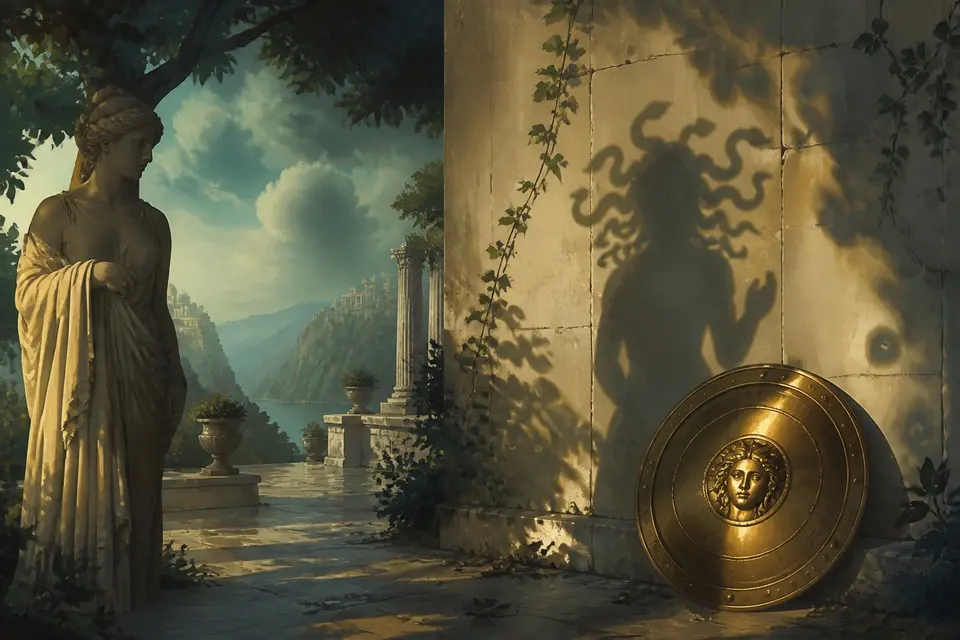
So he orders Hephaestus, the smith god, to mold a woman out of earth and water. Athena dresses her and teaches her to weave. Aphrodite pours charm over her head. Hermes gives her a shameless mind and a deceiving tongue. The poem is blunt about it: she is a “beautiful evil,” made to be a trap. Her name is Pandora, which Hesiod explains as “all gifts,” because every god gave her one.
Zeus sends her to Epimetheus, the brother of Prometheus. Prometheus had warned his brother never to accept anything from Zeus. Epimetheus, whose name means “afterthought,” accepts her anyway, and understands the mistake only afterward.
The jar
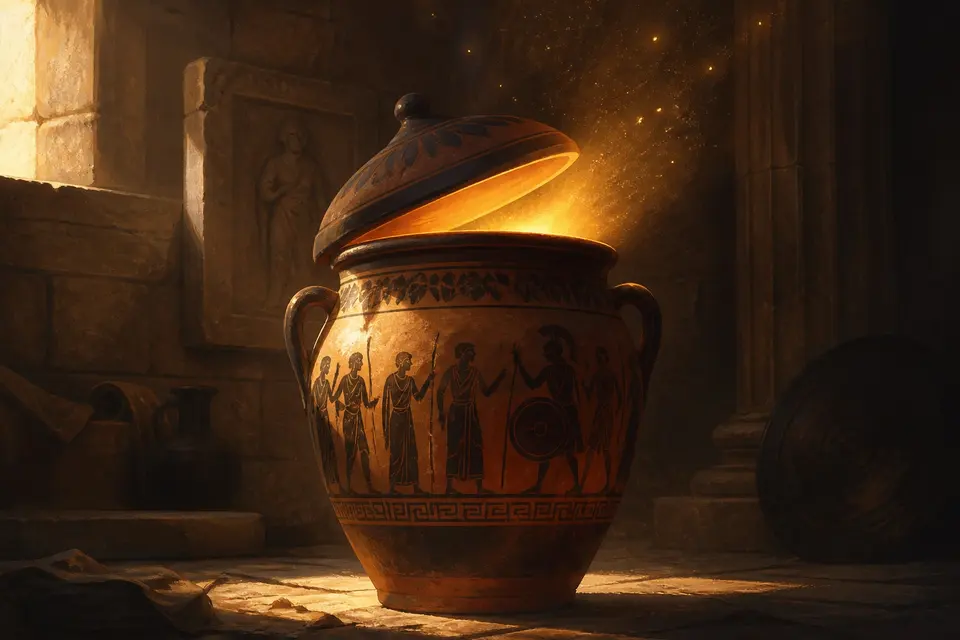
Here is the passage that matters. Before Pandora arrived, Hesiod says, people lived on earth free from hard labor and the sicknesses that bring death. Then Pandora took the great lid off a pithos, a huge ceramic storage jar of the kind Greeks used for oil and grain, and scattered the troubles inside. Only one thing stayed under the rim: elpis. Pandora put the lid back before it could escape, on the orders of Zeus.
A pithos can be taller than a person. It is not something you hold in your lap. Archaeologists have dug up plenty of them, and some are decorated with the kind of scenes you imagine on the cover of a myth book. If you ever visit the palace of Knossos on Crete, the big jars in the storerooms are exactly what Hesiod had in mind.
Erasmus and the box
So where did the box come from? From a translation. In 1508 the great scholar Erasmus of Rotterdam collected proverbs for his Adagia and told the Pandora story in Latin. He wrote pyxis, which means a small box, instead of pithos. It was probably a slip, made while working fast on a book of proverbs that was one of the most read in Europe. The box stuck, and by the time painters in the seventeenth and nineteenth centuries came to illustrate the scene, a box was what they drew.
Greek vase painters, meanwhile, preferred a different Pandora altogether: a woman rising out of the ground, with a hammer-wielding Epimetheus waiting to greet her. The standard literary tale, the one that moved the poets, is about the jar.
What is hope doing in there?
Now for the part nobody can settle. If the jar was full of evils, and elpis stayed inside, is hope a good thing that was saved for us? Or is it one more evil, kept inside as if it were too dangerous to let out?
The word elpis does not simply mean hope. It means expectation, and Greek writers use it for both good and bad outcomes. Some ancient readers took it as a comfort: the one thing the gods left us to get through the troubles. Nietzsche, in the nineteenth century, argued the opposite: hope is the worst of the evils, because it prolongs human torment. The truth is that Hesiod does not say, and scholars still argue about it.
If you want to see why the story lasted, notice its structure. A gift that is also a trap. A warning ignored. A lid left slightly open and one thing still inside. It is odd and a little unfair, and it is more interesting than a box with a latch.
So what do you say instead?
The jar as a coffin
A pithos was not only a container for olive oil and grain. In the Greek world, large jars were also used for burials. Archaeologists have found numerous pithos burials from the Bronze Age to the classical period, in which the body was placed in a crouched position inside the jar, which was then buried upside down or on its side. The jar was a womb and a tomb at once. Seen in that light, Hesiod’s story, about a woman who opens a great jar and releases suffering into the world, may carry an echo of a much older idea: that the thing that holds life also holds death.
Pandora today
The name keeps turning up. In the 2009 film Avatar, the moon where the story takes place is called Pandora, and the planet is an imaginary paradise whose exploitation unleashes disaster. In 2021, a massive leak of financial documents exposing the hidden offshore wealth of world leaders was called the Pandora Papers. And in debates about artificial intelligence, gene editing and nuclear weapons, the phrase “you can’t put it back in the box” is a staple. It is, ironically, a bad metaphor for the original story, in which the lid is put back in time to keep one thing inside. The jar was never empty.
Honestly, keep saying “Pandora’s box.” Language does not care about Hesiod. But when you say it, you can now picture the huge clay jar, the oily storeroom, the smith-made woman holding the lid, and one small thing that never got out.