Try to get through a normal day in English without using a Greek myth. You will lose before lunch. Someone is on a mentor, a project is a Herculean effort, a rival turns out to be your nemesis, and by evening you are tantalized by something in a shop window. We keep these words so close that we have stopped hearing the stories inside them. Here are fourteen of the best, in no particular order, with the story that got there first.
- Panic. Pan, the goat-legged god of shepherds and wild places, was supposed to be fond of sleeping at midday and furious when woken. The Greeks blamed him for the sudden, irrational terror that could hit a herd or an army in lonely country, a fear with no visible cause. They called it panikon deima, “Pan’s fear.” Our panic is exactly that: fear that arrives before the reason does.
- Echo. In Ovid’s version of the story, the nymph Echo had talked so long to the goddess Hera that Hera’s husband Zeus could slip away from his latest affair unnoticed. As punishment Hera took away Echo’s ability to start a conversation. She could only repeat the last words she heard. The physical phenomenon is named after the girl.
- Narcissism. From Narcissus, the young man who fell in love with his own reflection in a pool. Freud used the word in a famous essay in 1914 and it has been in the dictionary of psychology ever since. (There is a longer story, and it is sadder; we tell it in another article.)
- Hypnosis. Hypnos is the Greek god of sleep, and the twin brother of Thanatos, Death. The word was coined in the nineteenth century by a Scottish surgeon, James Braid, who first called it “neuro-hypnotism.”
- Chaos. In Hesiod’s Theogony the very first thing that comes into being is Chaos, and the word means something like a gaping void or chasm, not a mess. The idea that chaos means disorder is a later development.
- Mentor. In the Odyssey, Mentor is an old friend whom Odysseus left in charge of his household when he sailed to Troy. Athena, the goddess of wisdom, borrows his shape so she can give Odysseus’s young son Telemachus the advice he needs. The first mentor was a goddess in disguise. A French writer, Fénelon, popularized the word in a 1699 novel in which Mentor is the hero’s guide.
- Odyssey. Homer’s poem is about the ten years it took Odysseus to get home from Troy. The word has meant “a long and eventful journey” in English since at least the nineteenth century.
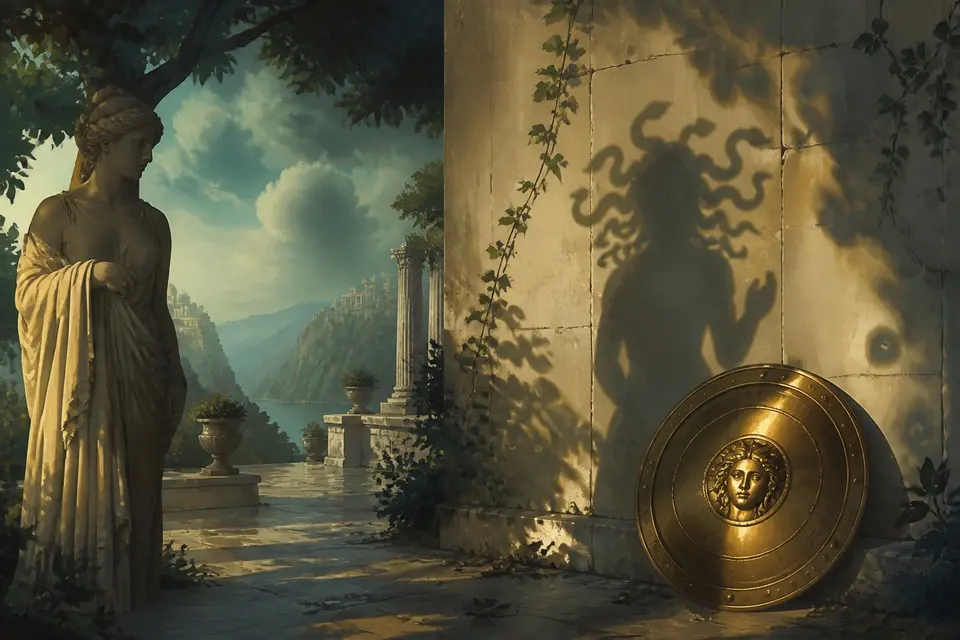
- Nemesis. Nemesis was the goddess who dealt out just punishment, especially to people whose pride had grown too big. The modern word narrowed to mean a personal enemy, but the original sense, the opponent who is fate’s way of evening the score, still hangs around it.
- Tantalize. Tantalus was a king who was invited to dine with the gods and misused the honor, and he ended up in the underworld standing in water up to his chin under a tree full of fruit. Whenever he bent to drink, the water drained away; whenever he reached for a pear, the wind blew the branch out of reach. We still say we are tantalized by what we can see and cannot have.
- Siren. In the Odyssey the Sirens are creatures whose singing lures sailors onto the rocks. Odysseus plugs his crew’s ears with beeswax and has himself tied to the mast so he can hear it and survive. Warning devices on emergency vehicles borrow the name because they are meant to be impossible to ignore.
- Titanic. The Titans were the generation of giants who ruled before Zeus. When the White Star Line named a ship Titanic in 1911, the word already meant enormous. The ship’s story added a layer of irony the Greeks would have recognized: the Titans, too, lost to something that was supposed to be smaller than them.
- Herculean. From Hercules, whose twelve labors (killing a lion with an impenetrable hide, cleaning a stable of three thousand cattle in a day) set the standard for a task that is almost impossible.
- Museum. The Mouseion was a “place of the Muses,” the nine goddesses of the arts and learning. The most famous, at Alexandria in Egypt, was a research institute with a library attached.
- Achilles’ heel. According to a later tradition (it is not in Homer), the hero’s mother held him by the heel when she dipped him in the River Styx to make him invulnerable. The part she held stayed dry, and that was where he finally got hit. We now use it for any single weakness in an otherwise strong person.
Once you start, you cannot stop noticing. Volcano comes from Vulcan, the Roman equivalent of the smith god Hephaestus, who was said to work his forge under Mount Etna. Cereal is named for Ceres, the Roman goddess of grain. Iris is the Greek rainbow goddess, which is why the same word names the colored ring in your eye. Morphine comes from Morpheus, the god of dreams. A labyrinth is the maze that held the Minotaur. Even the word atlas for a book of maps comes from the Titan Atlas, and the connection is a story all by itself.
What is remarkable is not that the Greeks made up so many stories, but that the stories turned into vocabulary. A myth is only really alive when people stop knowing they are quoting it. The list above is the proof: millions of people say these words every day without knowing they are retelling a two-and-a-half-thousand-year-old story.