In the animated film, Hercules wants to be a hero so he can go home to the gods. In the Greek myths, he becomes a hero because he does something unforgivable and has to work it off. The twelve labors are not a quest. They are a sentence.
The name that is a joke
His Greek name, Herakles, means “glory of Hera.” That is a cruel irony, because Hera, Zeus’s wife, hated him from birth. He was the child of Zeus and a mortal woman, Alcmene, and Hera never forgave the affair. She sent two serpents to his cradle (the baby strangled them) and spent the rest of his life making things worse. The Romans call him Hercules. The Greeks sometimes seem to be hinting that the name should be read as “the one whose life Hera defines.”
The crime
In the best-known version, which comes from the tragedy Heracles by Euripides (written around 416 BCE), Hera drives the hero mad. In his madness he kills his wife Megara and their children, mistaking them for enemies. When he wakes and finds them dead, he is ready to kill himself. His friend Theseus talks him out of it.
In other versions, including the one given later by Apollodorus, the labors are given to him as penance. He goes to the oracle at Delphi to ask how to purify himself. The Pythia gives him a new name, Heracles, and tells him to serve his cousin King Eurystheus of Tiryns for twelve years, performing whatever labors he is given. Then, she says, he will become immortal.
So the labors are the price of a crime and also the ticket to a kind of redemption.
The labors
The canonical list was set by about the fifth century BCE and has been repeated ever since. The tasks, in the usual order:
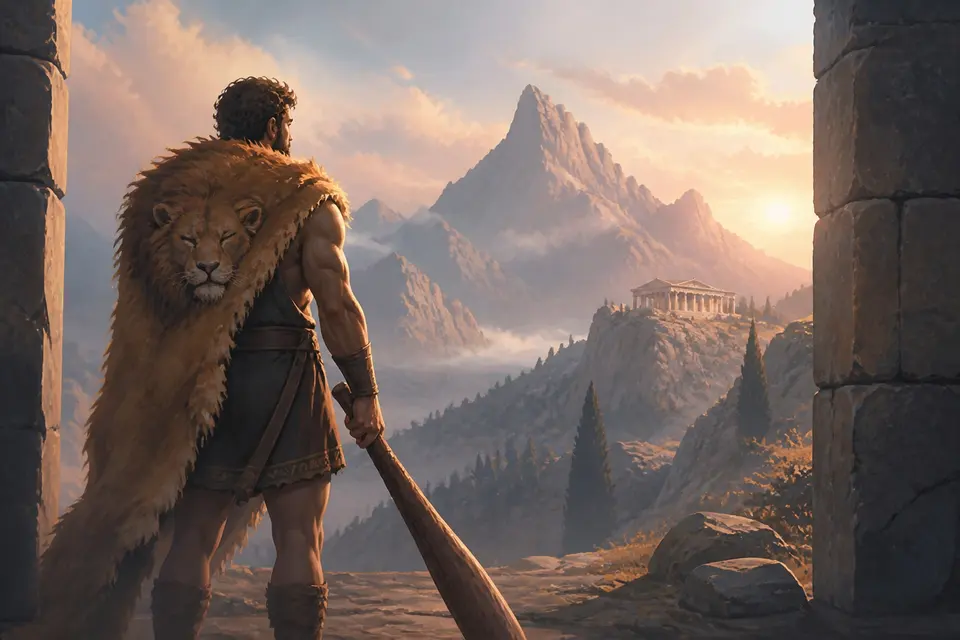
- Kill the Nemean lion, whose hide no weapon could pierce. Heracles strangled it and used its own claws to skin it, and wore the pelt from then on.
- Kill the Lernaean Hydra, a many-headed water serpent that grew two heads for every one cut off. His nephew Iolaus helped by burning each stump.
- Capture the Ceryneian Hind, a deer with golden antlers sacred to Artemis, alive. It took a year.
- Capture the Erymanthian Boar, alive.
- Clean the stables of King Augeas, thousands of cattle’s worth of dung, in one day. He diverted two rivers through them.
- Drive away the Stymphalian birds, man-eating birds with bronze feathers, using a rattle given by Athena.
- Capture the Cretan Bull.
- Steal the man-eating mares of Diomedes.
- Fetch the belt of Hippolyta, queen of the Amazons.
- Bring back the cattle of the three-bodied monster Geryon from the far west.
- Steal the golden apples of the Hesperides, which grew on a tree guarded by a hundred-headed dragon.
- Bring Cerberus, the three-headed dog of the underworld, up to the living world.
Why twelve?
There is a neat story about the number. Eurystheus originally set ten labors. But he disqualified two. The Hydra did not count, he said, because Iolaus had helped. The stables did not count because Heracles had been promised a reward for them. So two more were added to make up the number.
That is a very Greek detail. Even the hero’s punishment comes with a bureaucrat looking for loopholes.
Eurystheus the coward
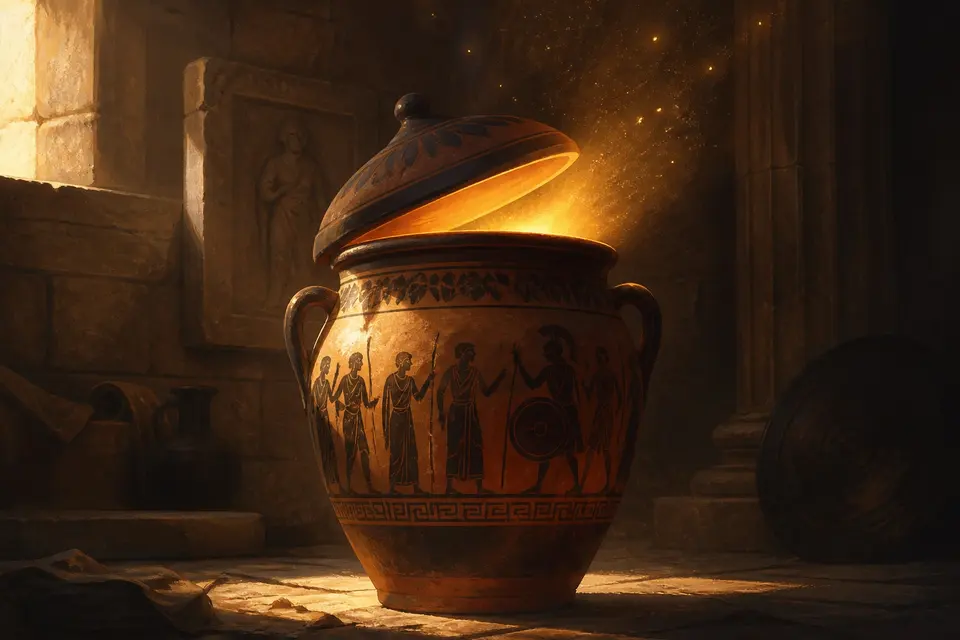
Eurystheus is one of the great comic figures of the myths. According to the tradition he was so frightened of Heracles that he hid in a bronze jar buried in the ground and gave his orders through a messenger. The picture of the king cowering in a pot while the hero fetches monsters is visible on Greek vases.
The ending
The labors did not end Heracles’s suffering. He later died in agony, wearing a shirt soaked in the poisoned blood of a centaur, which his wife Deianira had given him by mistake, believing it was a love charm. On Mount Oeta he built his own funeral pyre. As it burned, Zeus took him up to Olympus, where Hera finally made peace with him and gave him her daughter Hebe as a wife.
Words left over from the labors
The labors have left a rich deposit in English. A hopelessly dirty or corrupt place is an “Augean stable,” and cleaning it up is an “Augean task.” A problem that grows two new heads for each one you solve is “hydra-headed,” and in biology, a small freshwater animal that can regenerate lost parts was named Hydra by Linnaeus in the eighteenth century after the monster. The Strait of Gibraltar was known in antiquity as the Pillars of Hercules, because he was said to have set up two great pillars at the edge of the world during his trip for the cattle of Geryon. When Spain’s Habsburg rulers wanted a motto, they put a pair of pillars in their coat of arms with the words Plus Ultra, “further beyond,” a boast that they had gone past the limit that Hercules set. A popular theory holds that the dollar sign, $, descends from the two pillars and the banner on the Spanish silver coins. That is debated, but it is a nice story.
A hero in the sky
Hercules is also the name of a constellation, the fifth largest in the sky, which the Greeks pictured as a kneeling man. The Romans took over the hero, and he was one of their favorite gods: at the Ara Maxima, “greatest altar,” in the Forum Boarium, merchants and soldiers made offerings to him for luck.
That is the story the Greeks told. It is much less cheerful than the cartoon, and it is more honest: strength is not an excuse for anything, a crime follows you, and the people most stuck with a name that mocks them sometimes become the heroes everybody sings about.