Walk into a bookshop today and look at the front tables. Somewhere among the thrillers and the cozy mysteries there is almost certainly a novel about a woman from the Odyssey. This is not a coincidence, and it did not start last year. The current wave of Greek retellings has been building for about fifteen years, and it has produced bestsellers, a Broadway hit, video games, a streaming series and the most dedicated online fandoms of any ancient text.
A short timeline
Madeline Miller’s The Song of Achilles came out in 2011 and won the Orange Prize (now the Women’s Prize for Fiction) the following year. It retells the Iliad from the point of view of Patroclus, Achilles’s companion, as a love story. It became a surprise hit years later, helped by readers sharing it online.
In 2018 Miller followed it with Circe, which takes the witch who turns Odysseus’s men into pigs and gives her an entire life: a childhood in the court of the sun god, a lonely exile on an island, an unexpected talent for herbs and spells. In the same year Pat Barker published The Silence of the Girls, told partly by Briseis, the captive woman whose seizure by Agamemnon starts the quarrel at the start of the Iliad. Natalie Haynes’s A Thousand Ships (2019) gives voices to dozens of the women of the Trojan War, from Hecuba to Penelope.
On stage, Hadestown, a musical by Anaïs Mitchell that combines the Orpheus myth with a New Orleans jazz sound, opened on Broadway in 2019 and won eight Tony Awards, including Best Musical. The video game Hades, released in full in 2020 by Supergiant Games, turned the Underworld into a place you try to escape from, again and again, with the gods helping you along. And the Percy Jackson books, which began in 2005, introduced a whole generation to the Olympians; a television series followed in 2023.
Why women, and why now
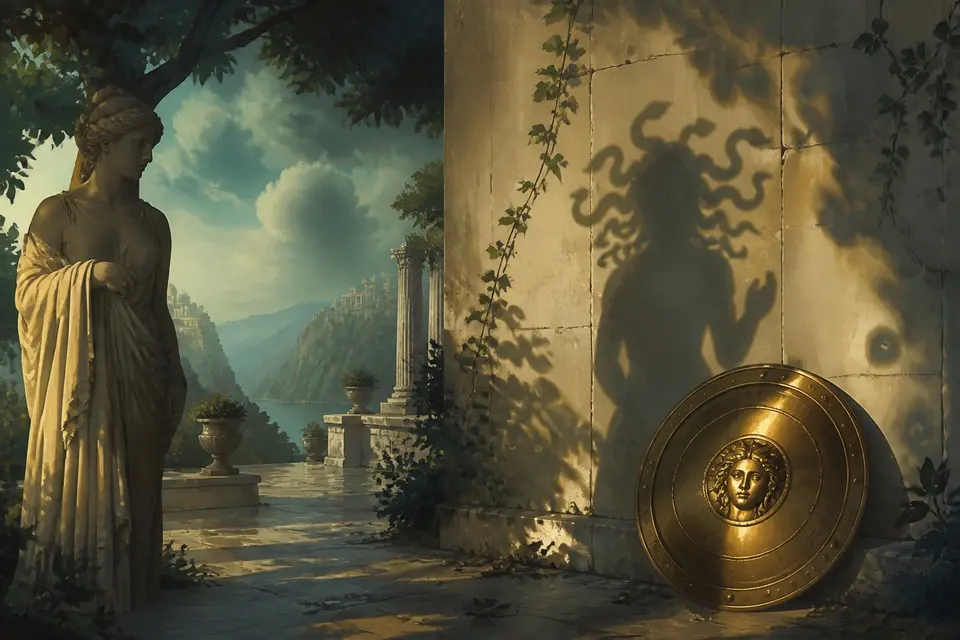
It is striking how many of these retellings center on figures who barely speak in the original. Briseis has few lines in the Iliad. Circe appears for a few hundred lines in the Odyssey. Penelope waits. Medusa is a head.
That is partly because the ancient tradition was mostly composed by men, and mostly about men. But the sources leave real gaps, and a modern novelist can see in those gaps the shape of a different story. The retellings often work not by changing what happened but by changing who is telling it. In Circe, the same scene of Odysseus visiting her island that Homer gives from his point of view is told from hers, and it looks very different.
What the stories have that others do not
Greek myths are good raw material for a few practical reasons. They are very old, so there is no copyright. They have no single canonical text, since every poet and playwright from Hesiod to Euripides told them differently, so a modern writer has permission to vary them. And they are about situations that are very easy to relate to: jealousy, grief, ambition, a parent’s love and a child’s defiance.
They are also extremely compact. You can summarize the story of Persephone in a paragraph and then spend three hundred pages exploring what it means.
A very old habit
Retelling is not new. It is what the Greeks themselves did. Euripides wrote a play about Helen in which she never went to Troy at all; a phantom went in her place and she waited in Egypt. Ovid took the whole tradition and made a narrative poem of the transformations. The Romans reworked everything. If you read the originals, you find authors constantly arguing with their predecessors.
A boy who could not read
The most influential retelling of the last twenty years began as a bedtime story. In 2004, the American author Rick Riordan, who was a middle-school teacher in Texas, was asked by his young son Haley, who had been diagnosed with dyslexia and ADHD, for stories about Greek myths. Haley had loved them at school. When Riordan ran out of the myths he knew, he made up a new one: a twelve-year-old boy who learns he is the son of Poseidon. That became The Lightning Thief (2005), the first of the Percy Jackson books. They have sold tens of millions of copies, and the main character is, like Riordan’s son, dyslexic. It is a nice example of how myths work: they are a way of telling a child, “the thing that makes you different may be your strength.”
Gods in the game
Video games have been telling Greek myths for years. Age of Mythology (2002) let players command armies of Greeks, Egyptians and Norse. The God of War series, which began in 2005, has an angry Spartan, Kratos, fighting his way through Olympus. Hades (2020), by the studio Supergiant Games, was widely praised for the way its writing makes the gods feel like a dysfunctional family. For many young people, these games are the first place they meet Zeus, Athena or Persephone, and the characters often send them to look up the originals.
A caution and an invitation
Not every retelling is faithful, and that is part of the pleasure. Madeline Miller’s Circe (2018) was a bestseller and a finalist for the Women’s Prize for Fiction in 2019. It makes choices that differ from the ancient sources, giving her a history that is Miller’s own. A good way to enjoy it, and to enjoy the others, is to read the ancient texts afterward and see what the new authors changed. You may find that the originals are shorter than you expect, and stranger.
So the current trend, in a sense, is just the oldest tradition in the field. The best way to enjoy it is to read a new retelling and then go back to the source. Homer’s Circe is a few hundred lines of cunning and menace. Euripides’ Medea is a good deal angrier than any modern version. The originals are rougher and stranger than the polished novels, and they are still waiting for you.