In 2015, a small clay tablet in the Sulaymaniyah Museum in Iraqi Kurdistan was finally read by scholars. It had been bought some years earlier on the antiquities market. It turned out to contain about twenty new lines of the Epic of Gilgamesh, a passage about the monster Humbaba in the Cedar Forest. That a piece of a four-thousand-year-old poem can still turn up in a museum drawer says something about how little of the ancient world we have read, and how much of it still waits.
A king, then a legend
Gilgamesh really may have existed. The Sumerian King List, a document compiled around 2000 BCE that lists the rulers of the early cities, names him as the fifth king of the first dynasty of Uruk and gives him a reign of 126 years, which is obviously not literal. Uruk was one of the first true cities in history, in southern Mesopotamia, with perhaps forty thousand inhabitants at its height. If Gilgamesh was a real person, he would have lived in the early part of the third millennium BCE.
Within a few centuries, he was a hero. Sumerian poems about him were being written around 2100 BCE, when a dynasty from Ur ruled the region and claimed him as an ancestor. Over the next thousand years, Babylonian poets collected the stories into a long poem in Akkadian. The best-known version, called the Standard Babylonian version, is attributed to a scribe named Sîn-lēqi-unninni, who lived around 1200 BCE. It has twelve tablets.
The story
The poem starts with a king who is too much. Gilgamesh is two-thirds god and one-third human, enormously strong, and he has no equal. The people of Uruk complain that he leaves no son to his father and no girl to her mother. The gods hear their cries and decide to make him a rival.
They make Enkidu out of clay. He is a wild man who lives with the animals, covered in hair, eating grass and drinking at waterholes. A hunter sees him and tells Gilgamesh, who sends a woman called Shamhat to civilize him. After a week with her, Enkidu has lost the animals’ trust, but has gained understanding. He puts on clothes, eats bread and drinks beer. Then he goes to Uruk, and the two heroes fight in the street. Gilgamesh wins, but the fight turns into friendship.
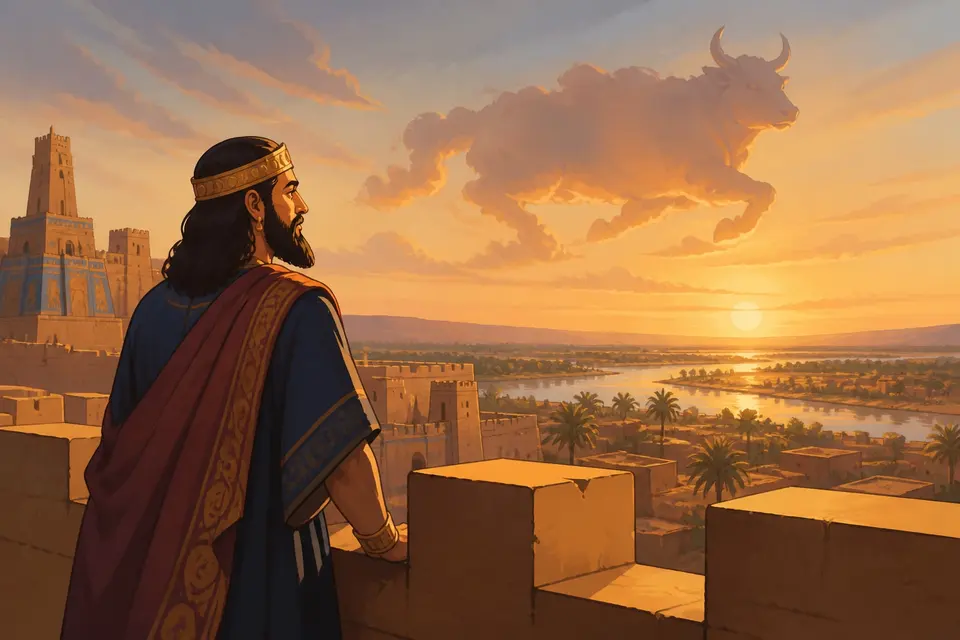
Together they travel to the Cedar Forest, which is guarded by a terrifying monster, Humbaba. They kill him, though he begs for mercy. On their return, the goddess Ishtar proposes to Gilgamesh. He turns her down, insulting her by listing the lovers she has ruined. In fury she sends the Bull of Heaven to destroy Uruk, and the friends kill that too.
Grief
The gods decide that one of them must die for these killings, and it is Enkidu. He falls ill, has a dream of the underworld, and dies after twelve days. The poem’s emotional center is what happens next. Gilgamesh refuses to let the body be buried until a maggot falls from the nose. He wanders into the wilderness in a lion skin, weeping, and says: “Shall I die too? Am I not like Enkidu?” For the first time, a king fears death.
The search
He sets out to find Utnapishtim, the one man who survived the Flood and was given eternal life. He passes through a mountain tunnel guarded by scorpion-people, and finds a tavern at the edge of the sea, kept by a woman named Siduri. When she hears his story, she gives him advice that is often quoted: “Gilgamesh, where are you roaming? The life you seek you will never find. When the gods created man, they set death for mankind and kept life in their own hands. As for you, Gilgamesh, let your belly be full, make merry day and night... Look at the child who holds your hand, let your wife delight in your embrace. This is the work of mankind.”
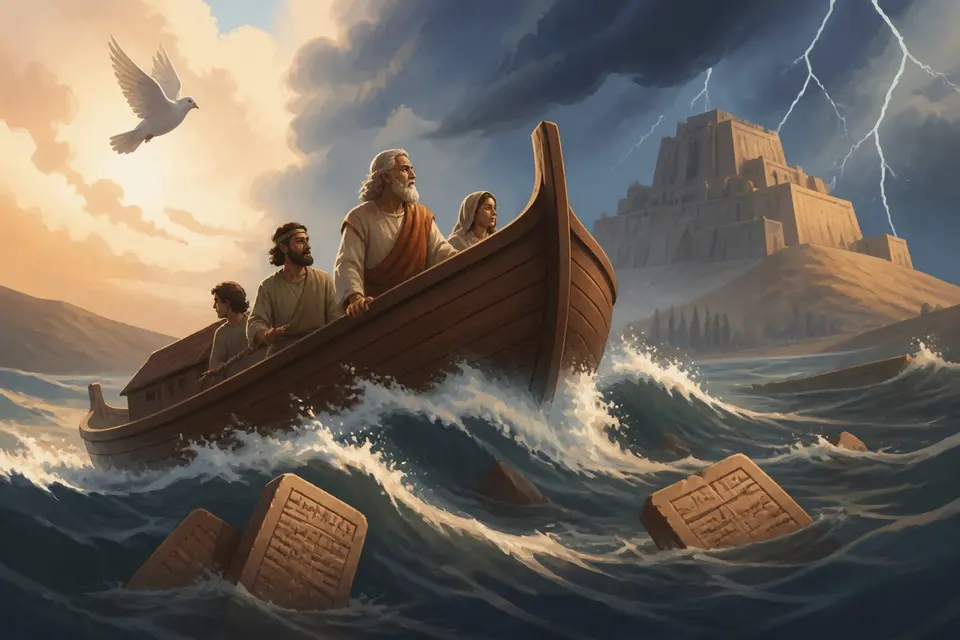
He does not accept it. With the ferryman Urshanabi he crosses the waters of death and reaches Utnapishtim. The old man tells him the story of the flood, and then sets a test: stay awake for six days and seven nights. Gilgamesh falls asleep at once, and Utnapishtim’s wife bakes a loaf of bread for each day to show how long he slept.
Before he leaves, he is told of a plant at the bottom of the sea whose name is “The Old Man Becomes a Young Man.” Gilgamesh ties stones to his feet, dives and picks it. On the way home, he stops to bathe in a pool. A snake smells the plant, steals it and slithers away, sloughing its skin. Gilgamesh sits down and cries.
The ending
The poem ends where it began, in Uruk. Gilgamesh shows the ferryman the great walls of his city, built of baked brick, and tells him to climb them, look at the foundation and see if it was not laid by the seven sages. He has not found immortality. But what he has made will outlast him.
It is an unusually honest ending. There is no miracle, no reward. The hero learns what everyone has to learn and returns to a life that is finite.
Lost and found
The poem was forgotten for more than two thousand years. In the 1850s, British archaeologists excavating the ruins of Nineveh, the Assyrian capital, found the remains of the library of King Ashurbanipal, which contained tens of thousands of clay tablets. Among them were the pieces of the epic. In 1872, a young British Museum assistant named George Smith, who had taught himself to read cuneiform, was sorting through the fragments when he came to a tablet describing a flood, a boat and a dove. He reportedly became so excited that he began to undress. He announced the discovery to the public in December of that year. The flood story, which looked a lot like the one in the Bible, caused a sensation.
Today the epic is translated into dozens of languages and read in schools around the world. It is a poem about friendship, grief and the limits of power. The oldest hero story in the world is, in the end, about someone who learned how to be human.