If you have ever heard of “the seven veils,” you may be thinking of Salome, the dancer in the Gospel story who demanded the head of John the Baptist. The seven veils are not in the Bible. They were added in a nineteenth-century play by Oscar Wilde. Some writers have suggested that the idea was inspired by a much older story about a goddess who removes her clothes at seven gates. That story is real, and it is about something quite different. It is about what you have to give up to go to the place from which no one returns.
The goddess who went down
The story is told in two ancient versions, a Sumerian one, known as “Inanna’s Descent to the Netherworld,” written down around 1900 BCE, and a shorter Akkadian one, “Ishtar’s Descent,” written later. Inanna is the Sumerian name of the goddess of love, war and the planet Venus. Ishtar is the Akkadian form. In the Sumerian poem, she is the queen of heaven, and she decides, for reasons the poem never explains, to visit the underworld, the realm of her older sister, Ereshkigal.
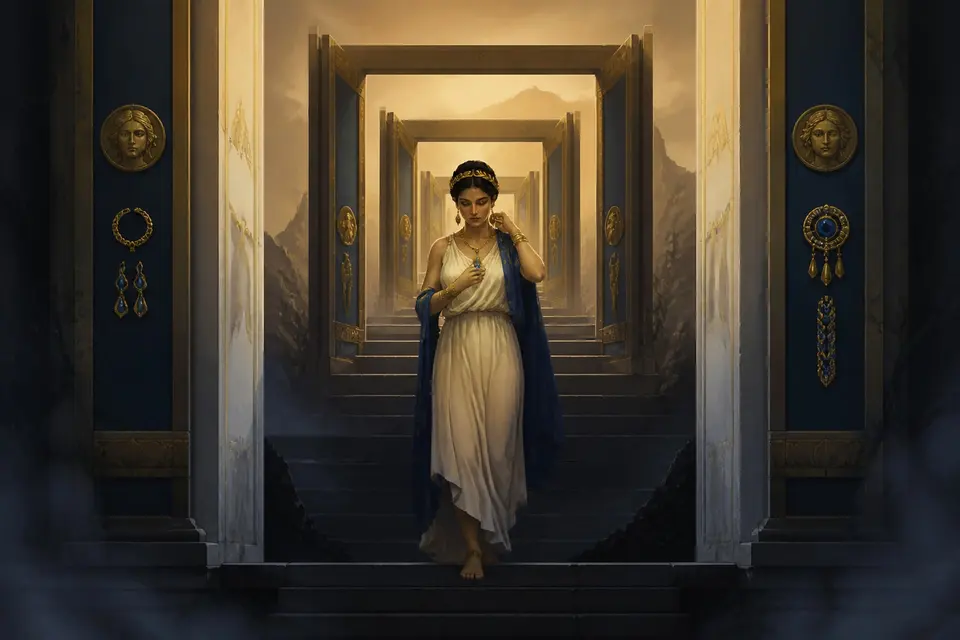
She prepares carefully. She puts on her finest regalia: a crown, a necklace of lapis lazuli beads, a double strand of beads on her breast, a gold ring, a breastplate, a royal robe. These are the me, the divine powers of civilization, the sources of her authority. She tells her faithful servant, Ninshubur, that if she does not return in three days, he must go to the gods and plead for her.
The gates
At the entrance to the underworld, the gatekeeper, Neti, asks who is there and why she has come. She says she has come to attend the funeral rites of Ereshkigal’s husband. Neti tells her to wait, goes to Ereshkigal and reports. The queen of the dead is furious, and gives instructions: bolt the seven gates, and let Inanna in, one gate at a time, as the custom of the underworld demands.
At each gate, Inanna must give up one of her adornments. At the first, her crown. At the second, her lapis beads. At the third, the beads on her breast. And so on, until she has given up everything. Each time she asks, “What is this?” and each time the gatekeeper answers: “Quiet, Inanna. The ways of the underworld are perfect. They may not be questioned.” By the seventh gate, she is naked and bowed low.
Judged and killed
In the throne room, the seven judges of the underworld, the Anunnaki, look at her. They fix on her the eye of death. She is turned into a corpse, and the body is hung on a hook on the wall.
The rescue
After three days and three nights, Ninshubur does as instructed. He goes to the gods one by one, and the first two, Enlil and Nanna, refuse to help. They say she wanted to rule the underworld as well, and she must accept the consequences. But the third, Enki, the god of wisdom, is moved. He makes two small creatures out of the dirt under his fingernails, neither male nor female, and gives them the food of life and the water of life. He sends them down with instructions.
The two creatures slip into the underworld like flies. They find Ereshkigal, who is groaning in distress, like a woman in labor, and they groan with her, as if they shared her pain. Touched by their sympathy, she offers them a gift. They ask for the corpse on the wall. They sprinkle it with the food and water of life, and Inanna rises.
The price
But there is a rule in the underworld: no one leaves without leaving a substitute. As Inanna climbs out, she is accompanied by a band of demons, the galla, who will take anyone she names. She passes first through her city, where her servants are all in mourning, in sackcloth and ashes, and she refuses to hand them over. Then she comes to Uruk, and finds her husband Dumuzi sitting on his throne, wearing fine clothes, not grieving at all. Inanna, in a rage, looks at him with the eye of death and says: take him.
Dumuzi flees and is eventually caught. In the end, the poem arranges that Dumuzi and his sister Geshtinanna will share the sentence, each spending half the year in the underworld.
Seasons, or something else?
Many scholars have noticed the resemblance to Persephone, who is also taken to the underworld and returns for part of the year. The Dumuzi cycle has been linked to the agricultural year, with the shepherd god going down when the pastures dry up in summer and coming up again with the rains. Each year in Mesopotamia there were ceremonies to mourn Dumuzi, a tradition that continued for thousands of years and may be reflected, in the Hebrew Bible, in a prophet’s reference to women weeping for Tammuz.
Others point to the differences. Inanna is not a victim. She chooses to go down, she goes in with her eyes open, and she is not rescued by a mother or a lover but by a clever god and two tiny creatures made of nothing.
What it might mean
It is a story about vulnerability. A goddess at the height of her power goes into a place where power is useless, and is stripped, one piece at a time, of everything she is. She dies. She is brought back by compassion, not by force. And she returns, changed, with a harder understanding of loss.
That may be why it has been read for four thousand years, from the earliest temples to modern poetry. The story does not tell us why she went down. It is more interested in what happens when you get there.