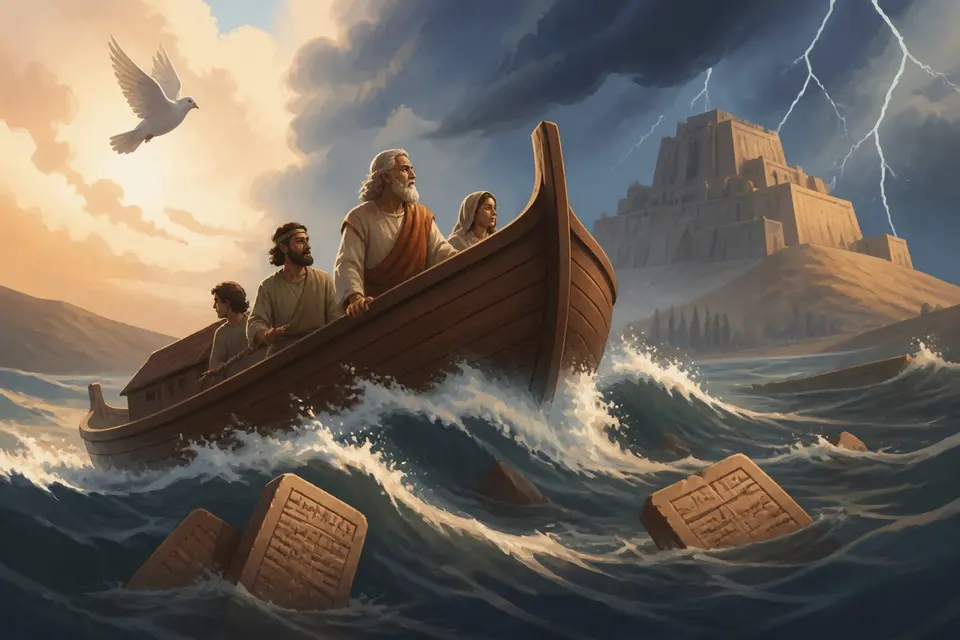
In 1872, the British Museum’s assistant George Smith read a clay tablet that described a man being told by a god to build a boat, load it with animals and ride out a flood. At one point, the man sends out a dove, which comes back, and then a swallow, which also comes back, and then a raven, which does not. Smith was reading about a flood story, and it was not the Book of Genesis. The tablet was far older than the biblical account.
It was Tablet XI of the Epic of Gilgamesh, and it made headlines on both sides of the Atlantic.
The man who survived
In the epic, Gilgamesh, in his search for eternal life, finds Utnapishtim, a man who was given immortality by the gods. He asks how this came to be, and Utnapishtim tells him a story. Once the gods, led by Enlil, decided to send a flood to destroy humankind. The god Ea (Enki), who sympathized with humans, could not tell Utnapishtim directly. So he spoke to the wall of the man’s reed hut: “Reed hut, reed hut, wall, wall! Listen, reed hut, wall, pay attention: tear down the house, build a boat. Give up possessions, seek life.”
Utnapishtim followed the instructions. The boat, in this account, was a cube, 120 cubits on each side, with seven decks and nine compartments, sealed with bitumen. He loaded it with his family, craftsmen and “the seed of all living things.” Then a storm came: black clouds, lightning, the gods of storm and wind. The flood was so terrifying that the gods themselves were afraid and cowered like dogs by the wall of heaven. The goddess Ishtar wept for what she had allowed.
After six days and seven nights, the storm calmed. The boat grounded on Mount Nimush. Utnapishtim sent out a dove, a swallow and a raven, and when the raven did not return, he knew the water had receded. He came out and made an offering, and the gods, who were hungry, gathered around the smell “like flies.”
The version before the version
The Epic of Gilgamesh is not the oldest account. Earlier stories were written about 1700 BCE in a poem called Atrahasis, “exceedingly wise,” which tells of the creation of humans and the flood. In it, the gods first make people to do the hard labor that the lesser gods had grown tired of. But the humans multiply, and their noise keeps the god Enlil awake. He tries to reduce the population with plague, then with famine, and finally with a flood. Each time the clever god Enki finds a way to warn the hero, Atrahasis, and save at least some people. After the flood, the gods put in place measures to keep the human population under control: infertility, infant mortality, and priestesses who do not have children. Even in a myth about survival, there is an uneasy sense that people are a problem.
A Sumerian version is older still. A fragment from about 1600 BCE, the Eridu Genesis, has a flood hero named Ziusudra, a pious king who builds a boat and survives for seven days before sacrificing an ox and a sheep to the sun god Utu.
A very different boat
In 2014, the British scholar Irving Finkel, a curator at the British Museum, published a new Babylonian tablet that had been brought to him in 1985 by a man who had inherited it from his father, who had collected antiquities in the Middle East. Finkel read it and realized that it was a version of the flood story, with the instruction to build a boat. The tablet is about 3,700 years old. What stunned scholars was the boat. It was not a rectangle or a cube. It was round, a huge coracle made of woven reeds, ropes and bitumen, with ribs and a thick coat of pitch. Coracles, round boats of a kind that were still used on the Tigris and Euphrates in the twentieth century, were a familiar form.
What the Bible shares
The similarities between the Mesopotamian stories and the account in the Book of Genesis are too close to be a coincidence. In both, a god decides to destroy humanity. In both, a single righteous man is told to build a boat. He seals it with pitch. He loads it with animals. Birds are sent out, including a dove and a raven. After the flood, he makes a sacrifice, and the god smells it with satisfaction.
The Hebrew Bible was composed over a long period, and many scholars think that parts of Genesis reached their form during or after the Babylonian exile, when the Judean elite lived in Mesopotamia in the sixth century BCE. They would have been surrounded by stories like these. The Genesis author reshaped them, with a single god, a different moral logic and a covenant at the end, but the plot is recognizably the same.
A universal story
Flood stories appear around the world. The Greeks told of Deucalion and Pyrrha. In Hindu tradition, Manu is warned by a fish. Many Indigenous peoples of the Americas have flood myths of their own. Geologists have noted that large floods do happen, and that the Mesopotamian floodplain, between two unpredictable rivers, was particularly vulnerable. It does not need a single cause.
What the Mesopotamian versions add is something older than the Bible and more honest about the gods. In these stories, the gods are not always moral. They send a flood because they are bothered by noise. Afterward they are sorry. The human is saved not by the gods’ justice but by a god’s trick, a secret whispered to a wall.