For most of the nineteenth century, serious scholars thought Troy was fiction. Homer was a poet; a ten-year war over a kidnapped queen was the kind of thing poets made up. Then a German businessman who had made a fortune in indigo and gold-rush banking decided he would prove them wrong. His name was Heinrich Schliemann, and he was not a careful archaeologist. He was, however, right about where to dig.
The hill
In 1870 Schliemann began excavating a mound called Hisarlik, near the Dardanelles in northwestern Turkey. A British expatriate named Frank Calvert, who owned part of the hill, had already suspected it was Troy and had been digging there himself. Schliemann, with more money and a flair for publicity, took the credit. He dug in a hurry, and his trenches sliced through the very layers he was trying to understand. He then announced that he had found the treasure of Priam, photographed his wife wearing the jewelry and smuggled it out of the country. It was real treasure, but it was about a thousand years older than the war.
Still, he had opened a door. Over the next century and a half, successive teams, including Wilhelm Dörpfeld, Carl Blegen in the 1930s and Manfred Korfmann in the 1980s and 1990s, uncovered a sequence of cities on top of each other. Archaeologists now count nine main layers, labeled Troy I through Troy IX, with many sub-phases, from about 3000 BCE to the Roman era.
Which Troy?
The layer most often linked to Homer is called Troy VI or VII, depending on which expert you ask. Troy VI, a grand citadel with limestone walls, seems to have been damaged by an earthquake around 1300 BCE. Troy VIIa, a more crowded, poorer town built on its ruins, was destroyed by fire around 1180 BCE. Skeletons and arrowheads were found in its streets. Those dates fit the traditional timeline for the war.
It is possible to overstate this. A burned city is not the same as an invasion by a Greek coalition. Cities burned for many reasons. But the evidence that a major settlement at Hisarlik was violently destroyed at roughly the right time is solid.
The Hittite angle
The most intriguing evidence comes from texts. The Hittite empire, which ruled most of Anatolia in the Late Bronze Age, left archives of clay tablets. They mention a western kingdom called Wilusa, which linguists have long suspected is the same word as Wilios, an early form of Ilios, the Greek name for Troy. They also mention a people called the Ahhiyawa, who seem to be the Mycenaean Greeks, whom Homer calls Achaeans. One Hittite treaty records a king of Wilusa named Alaksandu, which looks suspiciously like Alexandros, the other name of Paris.
So: a city that matches Troy in a region that matches Troy’s location, in contact with a people who resemble the Greeks. That is a long way from proving the Trojan War as told by Homer, but it is a surprisingly good foundation.
What Homer actually wrote
The Iliad and the Odyssey were composed around the eighth century BCE, centuries after the events. They came from an oral tradition in which singers learned and recomposed enormous poems. Memories of a Bronze Age world, with its bronze weapons and chariots, were preserved in a kind of poetic amber, along with details that clearly belong to Homer’s own time.
It is also worth knowing how little of the war the Iliad covers. It takes place in about fifty days of the tenth year, and it ends with the funeral of Hector. The death of Achilles, the judgment of Paris, the wooden horse and the sack of the city all happen outside the poem. We know them from later poems and from the Aeneid, which was written more than 700 years after Homer.
And the horse?
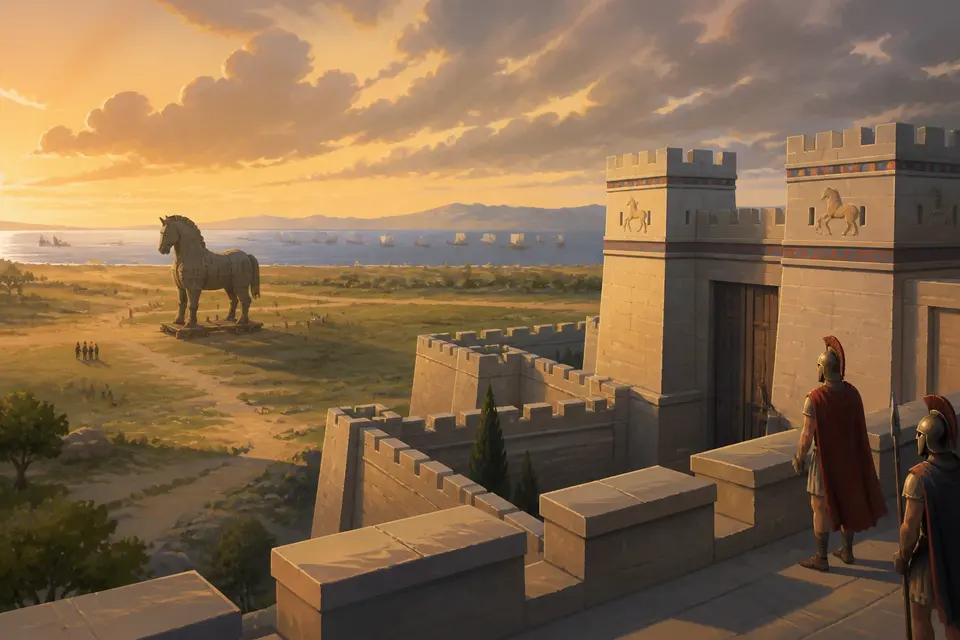
There is no archaeological trace of the horse and no reason to expect one. In the Odyssey, it appears in a few passages. In the Aeneid, it is the center of the sack. Scholars have proposed many explanations. It might have been a siege tower with a horse’s head, or a ship, since ships were sometimes called the horses of the sea. Another idea notes that Poseidon, the earth-shaker, was also the god of horses, and suggests the story preserves a memory of an earthquake that brought down the walls.
No one knows. It may be the most successful single image in Western literature. When we call a piece of malware a “Trojan horse,” we are quoting a story that may never have happened, about a place that certainly did.