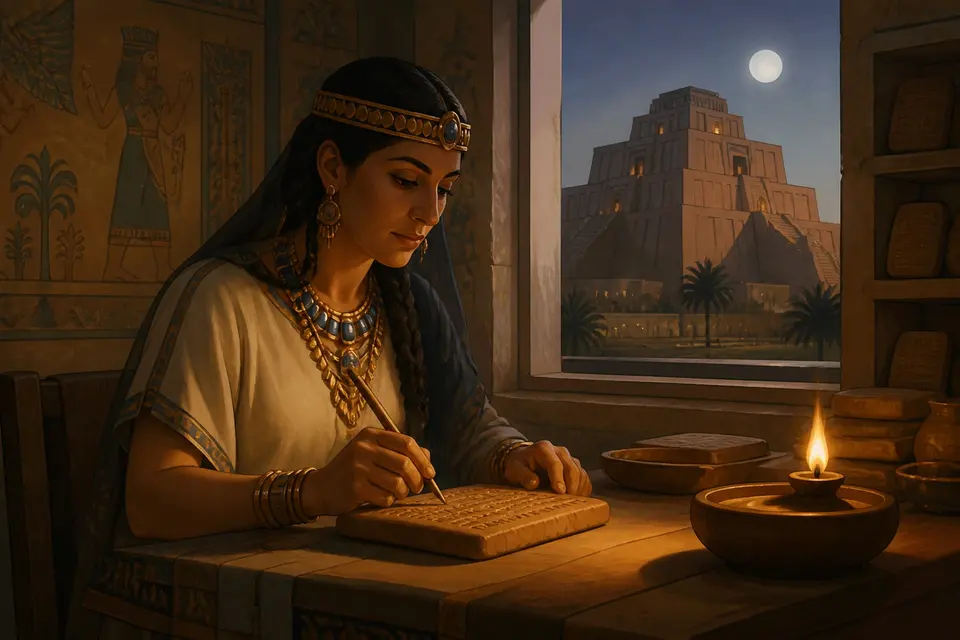
The first line of the Babylonian creation epic is Enūma eliš, “when on high.” That is also the poem’s title. It begins before there was a sky, before there was an earth, before any of the gods had a name. “When on high the heavens had not been named, firm ground below had not been called by name, nothing but primordial Apsu, their begetter, and Mummu-Tiamat, she who bore them all, their waters commingling as a single body.” It is one of the oldest and most dramatic stories of how the universe began, and it was written down on seven clay tablets, probably around 1100 BCE, though it may be older.
Two waters
Apsu is the fresh water, the underground ocean. Tiamat is the salt water, the sea. When they mingled, the first gods were born, and then their children, and their children’s children. But the young gods were noisy. They danced and shouted and they disturbed Apsu’s rest. He could not sleep. He wanted to destroy them, and Tiamat, shocked at the idea of killing her own children, did not agree.
Apsu persisted. The god Ea, the cleverest of the young gods, learned of the plan, cast a spell, put Apsu to sleep and killed him. On Apsu’s body he built a house, and there his son Marduk was born.
The monster-mother
Tiamat was furious about the murder of her husband. Urged on by other gods, she gathered an army of monsters: giant snakes with poison for blood, dragons, a scorpion-man, a mad dog, fish-men. She gave the command of her army to a god called Kingu and put the Tablet of Destinies on his chest, which gave him power over the universe. The young gods were terrified. Ea went to fight and turned back. So did another god.
Marduk’s bargain
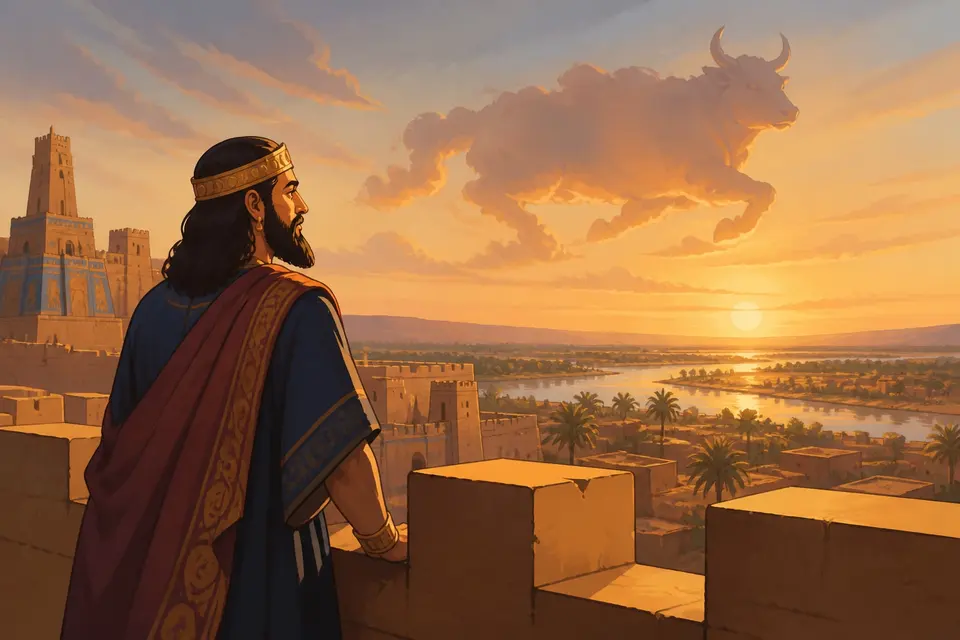
Marduk stepped forward. He was young, brilliant, and, the poem tells us, he had four eyes and four ears and flames shot from his mouth when he spoke. He told the gods he would fight Tiamat, but on one condition: that if he won, he would be declared king of the gods, and his word would be law. The gods were so desperate that they agreed. They held a banquet, got drunk and gave him the throne.
The fight
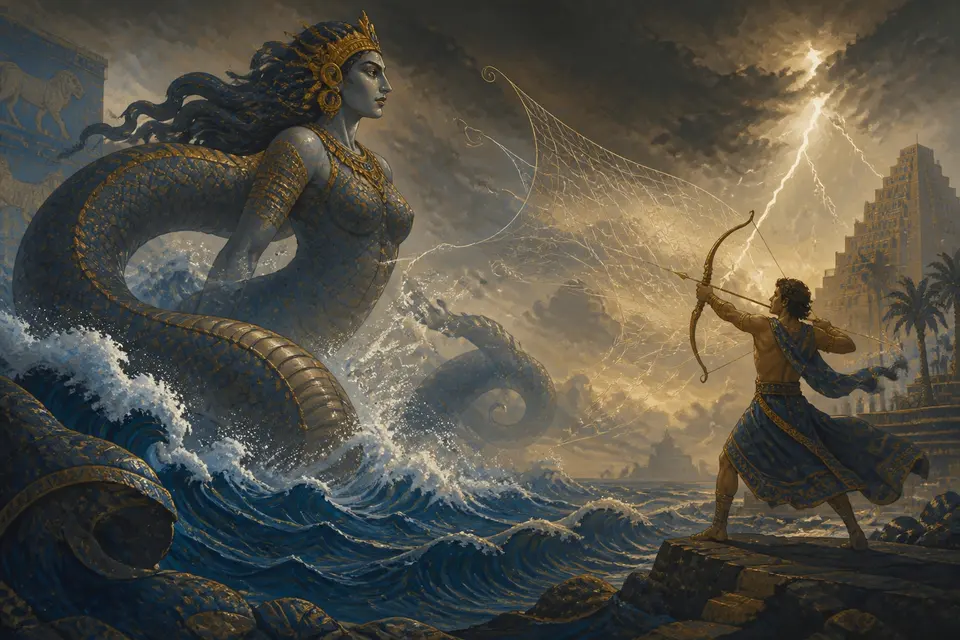
Marduk armed himself with a bow, a mace, lightning, a net made by his grandfather to encircle her, and four winds, which he attached to his chariot. He also created seven more winds, including an “evil wind,” the imhullu. He rode out on a storm chariot to meet Tiamat.
She opened her mouth to swallow him. He drove the evil wind into it, so that she could not close her lips. The wind swelled her belly. He shot an arrow that split her insides, and cut through her heart. He bound Kingu and took the Tablet of Destinies back.
Making the world
What he did next is what the poem is really about. He split Tiamat’s body in two, “like a shellfish,” one half becoming the sky and the other the earth. He pinned her eyes into the ground, and from them flowed the Tigris and Euphrates. Her breasts became mountains. He set the stars in the sky as constellations, marked out the year and the months, and established the moon and sun.
The gods, who had been doing all the hard work, demanded to be relieved. Marduk, with Ea’s advice, made humans from the blood of Kingu, the rebel god, mixed with clay. Their job was to serve the gods, to build temples and make offerings, so that the gods could rest. Grateful, the gods built Babylon for Marduk and gave him fifty names.
Why it was written
The Enūma eliš was a political document as well as a myth. In the earlier stories, other gods, such as Enlil, were the chiefs. By the time of the poem, Babylon had become the greatest city in Mesopotamia, and Marduk, its patron, needed an origin story that put him at the top. The poem was recited each year, on the fourth day of the New Year festival, the Akitu, in the temple of Marduk at Babylon. The festival lasted twelve days in spring, and it reenacted the renewal of the cosmos and the king’s authority. The king was humbled before the god’s statue and then confirmed in his office.
The rediscovery
The tablets were found in the library of Ashurbanipal in Nineveh in the nineteenth century, and the British scholar George Smith, who also found the flood tablet of Gilgamesh, published a translation in 1876 in a book called The Chaldean Account of Genesis. It caused a stir because of the parallels to the opening chapter of the Bible: a watery chaos, a separation of waters and sky, the creation of the heavenly bodies, and the making of humans on the final day. Some scholars have noted that the Hebrew word for “the deep” in Genesis, tehom, is related to the name Tiamat. Others warn against exaggerating the connection. Genesis presents a single god who creates by speaking, without a fight.
A chaos monster everywhere
The motif of a god defeating a monster of chaos and building the world out of her body is found across the ancient world: Apep in Egypt, the serpent Python at Delphi, Leviathan and Rahab in the Hebrew Bible, the Norse giant Ymir. Order is not given. It has to be won.
Today, Tiamat lives on in unexpected places. Since 1974, a five-headed dragon queen in the role-playing game Dungeons & Dragons has been named Tiamat, and she appears in many other games and novels. It is a long journey from a clay tablet to a dice game, but the first dragon-slayer story is still being told.