Imagine sitting down to a meal with the king of the gods and asking him a direct question: can you change what is going to happen? In the Iliad, Zeus asks himself exactly that, at the worst possible time. His son Sarpedon is about to be killed in battle. Zeus looks down from Olympus and says aloud that he is torn: should he snatch Sarpedon out of the fight and put him safely back in his homeland, or let the man die?
Hera is quick to answer. Do whatever you like, she says, but the rest of us will not approve. If you save him, other gods will want to save their own sons too. And he is a mortal man, long since fated to die. Would you really let him go free from the grim terror of death?
Zeus gives way. He lets Sarpedon die, and, in his grief, rains drops of blood on the earth. It is a scene that has made readers wonder for two and a half thousand years about the power of Fate in Greek myth, and about who, exactly, was in charge.
Three sisters and a loom
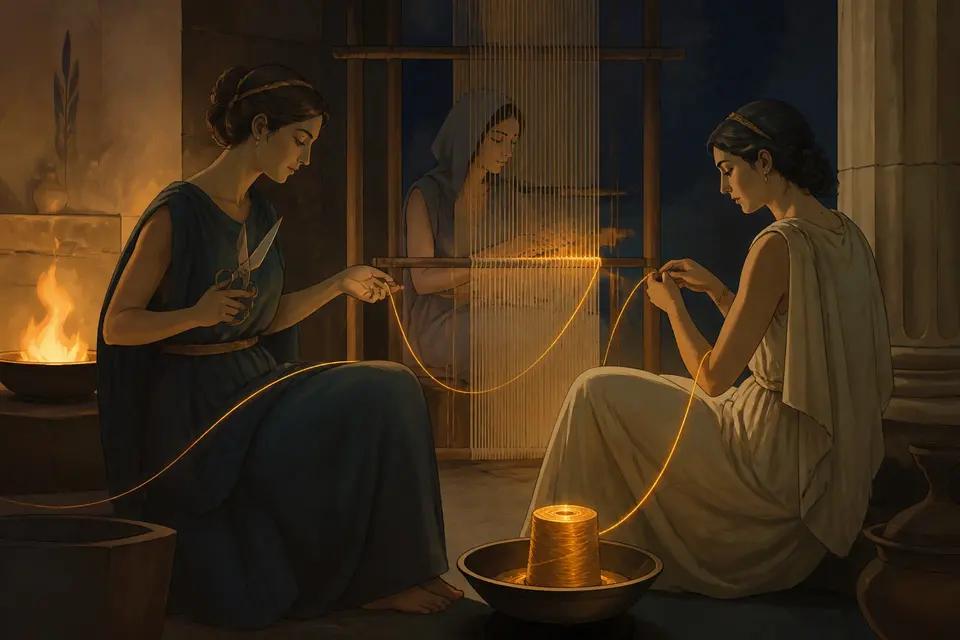
The Greeks gave Fate a face, or rather three. The Moirai, whose name means something like “shares” or “portions,” were three female figures who determined what each person’s life would hold. Later writers gave them names and jobs. Clotho, “the spinner,” spun the thread of a life. Lachesis, “the allotter,” measured how long it would be. Atropos, “the unturnable,” cut it with her shears.
Who their parents were is not settled. In one passage of Hesiod’s Theogony, they are daughters of Night, together with Death, Sleep and Doom. In another passage of the same poem, they are daughters of Zeus and the goddess Themis, a few lines after he lists the Seasons. It could be that Hesiod, who collected old traditions, was just recording both versions. It could also be that it reflects an unease about whether the Fates are above Zeus or subject to him. The Greeks themselves never fully agreed.
A limit, or a loophole?
The Sarpedon scene suggests that even Zeus tends to defer. Elsewhere, Greek authors are less sure. The tragedian Aeschylus, in Prometheus Bound, makes Prometheus say that Zeus himself cannot escape what is fated, and that the Fates guide the helm of necessity. In other places, Zeus seems to weigh the fates of men on a golden scale, a kind of cosmic accountant who consults the scale but does not set the outcome.
There is also a good story of a hero who cheats the system. In the Alcestis by Euripides (438 BCE), the god Apollo, who loves King Admetus, tricks the Fates by getting them drunk. In return, they agree that Admetus can escape his death on the condition that someone else dies in his place. His parents refuse to do it. His young wife Alcestis agrees. In the end she is brought back from the dead by Heracles, who wrestles Death at her tomb.
Fates across cultures
A trio of women who spin and cut the thread of life is one of the most widespread ideas in ancient myth. The Romans had the Parcae, whose names were Nona, Decima and Morta. In Norse mythology, three women called the Norns live beside the Well of Urd at the foot of the world tree. They carve runes on wooden slats and decide the fates of all living things. Even Odin cannot overrule them. There are similar figures in Baltic, Slavic and Celtic folklore.
It may be that the image is natural. Spinning was women’s daily work in the ancient world, and a thread of yarn is a very good picture of a life: it has a beginning, a length and an end.
What it means to be fated
The Fates raise a question that is still alive: how much of life is given, and how much chosen? Greek stories play on both sides. Oedipus does everything he can to avoid his destiny and walks straight into it. Odysseus seems to improvise his whole journey. Heroes in the Iliad choose to fight, even though they know they will die.
Weird sisters and the Old English word for fate
The idea of three women controlling destiny has an unexpected afterlife in Shakespeare. The three witches in Macbeth, who foretell the future, are called “the weird sisters,” a phrase that does not mean strange. The word weird comes from the Old English wyrd, meaning fate or destiny, and the Anglo-Saxons had a goddess-like figure called Wyrd who was close to the Fates. Shakespeare took the phrase from Holinshed’s chronicle, where the witches are described as “the goddesses of destiny.” So when the witches say “the weird sisters, hand in hand, posters of the sea and land,” they are, in the old sense of the word, the Fates.
The best answer the Greeks offered may be in the way Homer’s characters speak. They do not shrug and say “it was meant to be.” They act as though it matters. That, perhaps, is the real defiance of the Fates: living as if the thread were yours to weave.