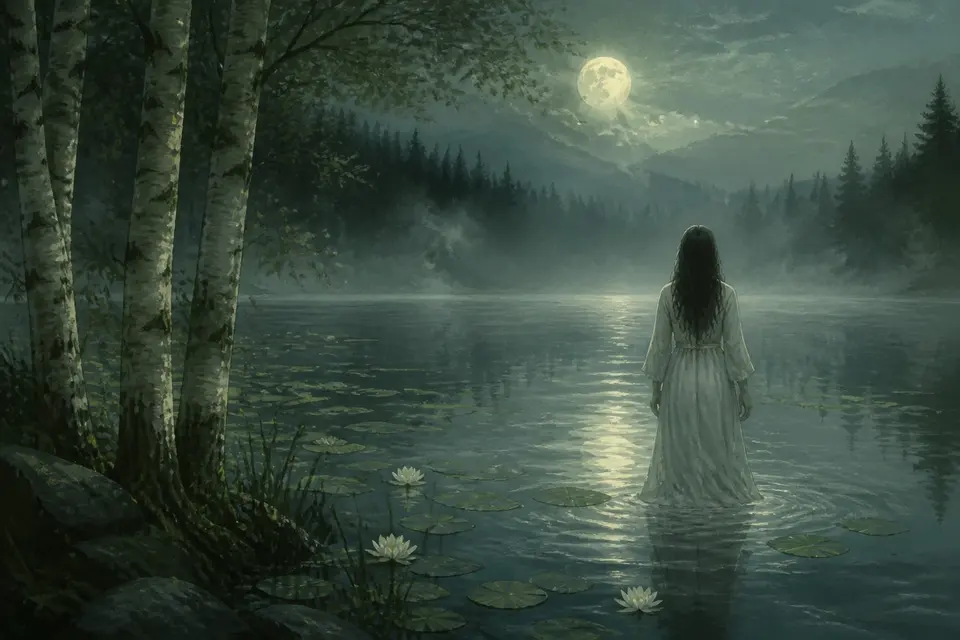
At the start of Antonín Dvořák’s opera Rusalka, which premiered in Prague in 1901, a young water nymph sits on a moonlit lake and sings an aria to the moon: “Song to the Moon,” one of the most loved melodies in opera. She is in love with a human prince who comes to swim in her lake, and she begs the moon to tell him that she is waiting. To become human, she has to give up her voice and her place in the water. The opera ends badly, as such stories do. If you think you have heard this before, you are right. The story has a lot in common with Hans Christian Andersen’s The Little Mermaid from 1837. But the creature at its center, the rusalka, comes from a very different tradition.
The folklore
In the folklore of the East and South Slavs, a rusalka is a female spirit who is associated with water and, in some regions, with fields and forests. The most common account of what she is, in Russian and Ukrainian villages, is that she is the soul of a young woman who died violently, especially by drowning. She may have been a girl who killed herself after being betrayed by her lover. She may have been murdered. She may have been a child who died before being baptized. Because she did not receive a proper burial and did not live out her life, her spirit cannot rest.
That is a very different origin from the mermaid, who is usually a creature of the sea from the start. The rusalka was a human being. Her story begins with a death.
Pale, with green hair
In the tales, she appears as a pale, beautiful young woman with long, loose hair, often green or wet, who sits on riverbanks and combs it. She sings to travelers, and anyone who follows her voice can be pulled into the water, tickled to death or drowned. Some descriptions give her a fish’s tail, but this seems to be a later influence from western European mermaids. Earlier accounts, in Russia and Ukraine, have her as an ordinary-looking woman with unusual hair.
Not every story is menacing. In a number of tales she is a more pitiful figure, a lonely spirit who longs for the life she lost. In some Ukrainian stories, she is called a mavka, a similar figure from the forest. The Ukrainian poet Lesya Ukrainka wrote a famous play in 1911, The Forest Song, in which a mavka falls in love with a human boy.
The rusalka week
One of the most interesting customs was connected with the calendar. In the week after the Christian feast of Trinity (the seventh Sunday after Easter, in late spring or early summer), people held a festival, called Rusalia or Rusalnaya Nedelya, “the Rusalka Week.” According to belief, in these days, the rusalki came out of the water and walked through the fields, swung from the branches of birches and sang. They could harm anyone they met: people who were out alone at night, especially young men, risked being tickled or danced to death.
Villagers took precautions. They did not swim in rivers during that week. They carried wormwood, a bitter herb that was believed to ward off spirits. Some women wore it in their belts. A traveler who met a rusalka could, according to some accounts, save himself by answering her riddle correctly: she would ask, “Wormwood or parsley?” and the right answer was “Wormwood.” Say “parsley” and she would tickle you to death. On the last day of the festival, people performed a ritual to send the rusalki back to the water, with songs and the burning or drowning of an effigy.
Folklorists link the Rusalka Week with older spring and fertility rites, including offerings for the dead. The word rusalka itself may come from the Latin rosalia, a Roman festival of roses at which graves were decorated, which spread to the Balkans and was reinterpreted by the Slavs. That is a plausible theory but not certain.
From folk spirit to stage
The rusalka was a favorite of nineteenth-century writers. Alexander Pushkin began a verse drama about a miller’s daughter who drowns herself after being abandoned by a prince and becomes a rusalka, and who takes revenge on him. He never finished it, but the composer Alexander Dargomyzhsky made it the basis of an opera in 1856, which was a great success in Russia. Dvořák’s Rusalka is a more romantic, Czech version, in which the water nymph is not a vengeful ghost but a young woman who wants to be human.
Why she lasts
The rusalka sits on the border between several things: water and land, the living and the dead, innocence and danger. She is a way for communities to talk about uncomfortable realities, such as the deaths of young women, betrayal and the danger of rivers. She is also a figure of sympathy. The lesson of the folktale is not always “be afraid.” In many tellings, it is “remember her.”
It is a long way from the bright, cheerful mermaid of modern cartoons. But there is a family resemblance. They both belong to a very old kind of story, about a girl at the edge of the water who wants something she cannot have.