In 1874, the Russian composer Modest Mussorgsky wrote a piano suite called Pictures at an Exhibition, inspired by drawings by his friend Viktor Hartmann, who had recently died. One of the pieces is called “The Hut on Fowl’s Legs (Baba Yaga).” It is stomping, brassy and slightly comic, and it suggests very well what the folklore says about her. She is something to be afraid of, and she is also a bit of a character.
The old woman in the forest
In the Russian fairy tales that were collected by Alexander Afanasyev in the mid-nineteenth century, Baba Yaga is a very old woman who lives deep in the forest. She is bony, with an iron nose and sometimes iron teeth. She is often described as having one leg made of bone. The word baba means “old woman” or “grandmother,” and it appears in various Slavic languages. The meaning of yaga is not clear. It may be related to words for “horror” or “illness” or it may be something else. Nobody knows.
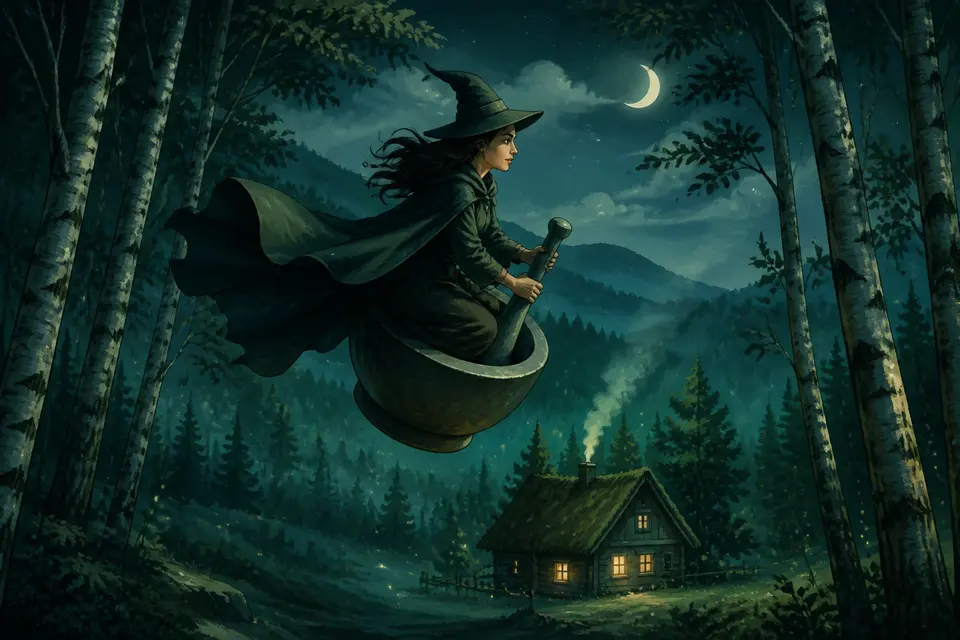
She travels in a mortar, steering with the pestle and sweeping away her tracks with a broom. Her house is a hut, an izba, that stands on giant chicken legs and spins. To make it stop and show its door, you have to say a formula: “Little hut, little hut, stand the way your mother put you, with your back to the forest and your front to me.” The fence around it is made of human bones, and on the posts are skulls with glowing eyes. The gates have locks of human hands, or in some tales they must be oiled before they will open.
Eats children, or helps them?
The most remarkable thing about Baba Yaga is that she is not consistent. In some tales she is a terrible ogress who lures children and cooks them in her oven. In others she is a helper who gives a hero advice, a magical horse or a sword, if he comes with a clean heart and the right manners.
The best-known story is Vasilisa the Beautiful. A girl’s dying mother gives her a little doll, which she must feed and which will advise her. After her father remarries, the stepmother and her daughters send Vasilisa to Baba Yaga’s hut to fetch fire, hoping she will be eaten. The old woman receives her with a threat and sets impossible tasks: clean the house, cook the meals, sort a heap of grain from the dust and separate poppy seeds from earth. With the help of the doll, Vasilisa completes them, and when Baba Yaga asks how she did it, Vasilisa says: “By my mother’s blessing.” The witch cries that there is no room for blessed ones in her house, and throws her out, but not before giving her a skull on a stick that glows with fire. Vasilisa takes it home, and the light burns the stepmother and her daughters to ashes.
In that tale, three horsemen ride past the hut, one white, one red and one black. When Vasilisa asks about them, Baba Yaga says they are her bright day, her red sun and her dark night. They are her servants. The scene has given rise to theories that she is a figure of nature, a keeper of the cycles of light and dark.
A test, not a villain
A pattern emerges across many of the stories. A young person, usually a girl or a boy in trouble, arrives at the hut. Baba Yaga demands to know whether they are there by choice or by need. The ones who are honest, polite and willing to work get help. The rude, lazy or deceitful ones are in trouble. She also seems to be at the border between worlds. Her hut stands at the edge of the forest, at the edge of death. Scholars like Vladimir Propp have seen in these stories a trace of ancient initiation rites, in which a young person is taken into a house in the forest, “dies” and is reborn. That is a speculation, but it explains why the tale has the feel of a test.
Three of her, or one?
In some stories there are three Baba Yagas, sisters, each one living further in the forest. A hero visits all three. Each helps him, in turn, giving him a better horse or a stronger weapon and telling him where to find the next one.
The afterlife of a witch
Baba Yaga has outlived the world that produced her. She appears in a vast number of modern works: in the animation by Ivan Bilibin, whose early twentieth-century illustrations gave her the look that is still copied, in the Hellboy comics, in video games and novels. In the film John Wick (2014), the main character is called “Baba Yaga,” which the people around him say, with respect, means the boogeyman, or the one you send to kill the boogeyman.
She has also found a place in feminist writing. An old woman who lives alone in the forest, who commands the wind, who is feared and who gives advice to those with the courage to ask has an obvious appeal.
That may be why the old tales still work. She does not fit anywhere. She is neither evil nor kind, neither a fairy-tale witch nor a goddess. She is something older: a force you meet at the edge of what you know, who will either feed you or eat you, and who is very interested to see which kind of person you are.