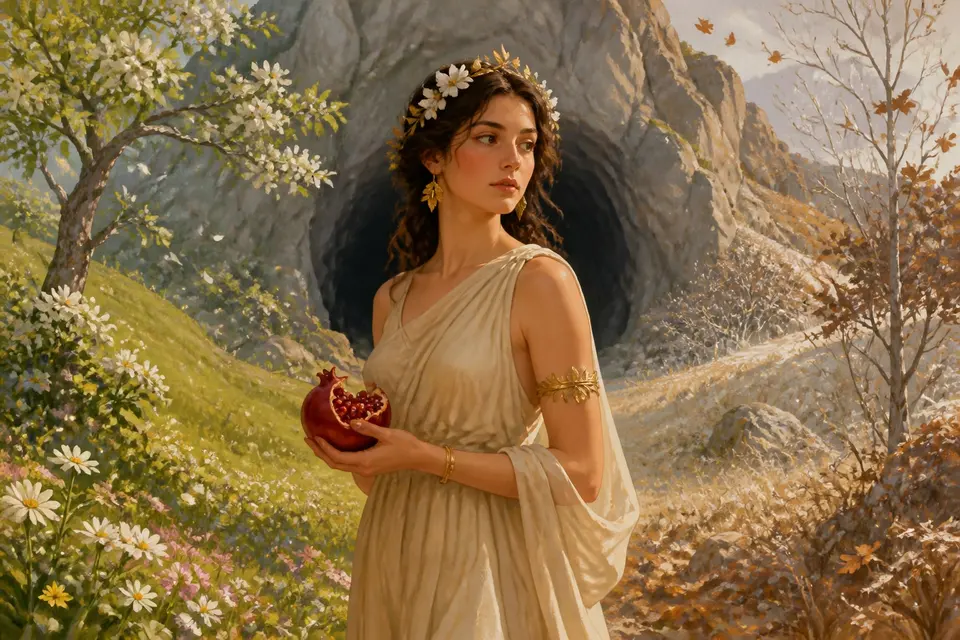
Our best version of the Persephone story is a poem of 495 lines, the Homeric Hymn to Demeter, probably composed in the seventh or sixth century BCE, and it begins with a meadow. A young girl is picking flowers with her friends, the daughters of Ocean. There are roses, crocuses, violets and irises, and then a flower that Earth grew as a trap at the command of Zeus: a narcissus with a hundred blooms, so fragrant that the whole sky smiled. When Persephone reaches to pick it, the ground cracks open and a chariot drawn by immortal horses rises out of it.
The bargain nobody told her about
Hades, Zeus’s brother and the lord of the dead, takes her down with him. She screams, and the poem says only two beings hear her: the goddess Hecate in her cave, and the sun god Helios, who sees everything. Zeus had already agreed to the kidnapping. He had promised his brother a bride, and he did not tell Demeter, Persephone’s mother. This is the key detail. The story is not about a girl who wanders off. It is about a family decision made without her.
Demeter hears her daughter’s cry echoing from the mountains. She tears her veil and spends nine days wandering the earth with torches, neither eating nor washing. On the tenth day Hecate tells her what she heard, and they go to Helios, who confirms it. He adds a sly bit of comfort: Hades, he says, is hardly an unworthy son-in-law.
A goddess goes on strike
Demeter withdraws from Olympus and disguises herself as an old woman. She becomes a nurse in the house of the king of Eleusis, a town near Athens, where she almost makes the king’s baby immortal by burning away his mortality in the fire at night. His mother screams and interrupts the ritual, and the goddess throws the baby down in fury, revealing who she is. She then demands a temple, which the people build, and sits inside it alone.
While she grieves, the earth stops producing. The poem says that the plows turned the soil in vain, that the seeds did not sprout. Humanity was in danger of starving, and the gods were in danger of losing their offerings. That is what finally moves Zeus. He sends Hermes down into the Underworld to bring Persephone back.
The seeds
Hades says yes, politely. But before Persephone leaves, he slips her a pomegranate seed to eat, and she swallows it, whether by trick or by force or by innocence. In the oldest version, it is one seed. In later tellings it can be six or seven or a handful. In every version it works the same way: whoever has eaten the food of the dead is bound to the dead.
So a compromise is struck. Persephone will spend one-third of the year below, according to the hymn, and the rest with her mother and the gods. (Later writers, especially the Romans, say half.) When she returns, Demeter lets the earth bloom. When she leaves, Demeter mourns, and winter falls.
Is it about winter?
That is the textbook answer, and it is not quite right. In the Mediterranean the dangerous season for crops is not winter. Winter is when the rain comes and the grain grows. The dead season is the blistering dry heat of summer, when the fields are bare. Some scholars have noticed that grain in the ancient Greek world was stored in underground pits, and that the story might originally have explained the months when the seed lay under the ground. Later tellers, especially in the colder north of Europe, turned it into a story of winter, which is the version most of us know.
Eleusis and the secret
The myth was not only a story. At Eleusis, where Demeter had her temple, a religious festival called the Eleusinian Mysteries took place every year for about two thousand years. Thousands of people were initiated, from slaves to emperors. What they saw and did inside the hall, the Telesterion, was kept so secret that the penalty for revealing it was death. We know that the initiates fasted, walked in procession from Athens, drank a barley drink called the kykeon and were promised a better fate after death. We do not know much more.
In the hymn itself, the key line is blunt: happy is the mortal who has seen these rites, for whoever dies without having shared them will not have the same fate in the dark below.
Why she keeps coming back
In the last few years, Persephone has been everywhere: in novels, in the Hadestown musical, in games where she is the heroine, not the hostage. That is understandable. The story does not have to be a love story to be powerful. It can be about a family that treats a young woman as a pawn, a mother who refuses to let the world go on without her child and a girl who comes back different.
The pomegranate is the best part. It is a fruit that looks like a handful of jewels when you split it open, and nothing about it is simple. Once you have tasted it, you belong to two worlds.