In the 550s BCE, King Croesus of Lydia, who was richer than anyone alive, had a problem. A new power, Persia, was growing in the east, and he did not know whether to attack it. He was too clever to guess. So he did something he had planned very carefully: he sent envoys to seven different oracles across the Greek world and Libya, told them all to ask on the hundredth day after leaving what Croesus was doing at that moment, and wrote down every reply.
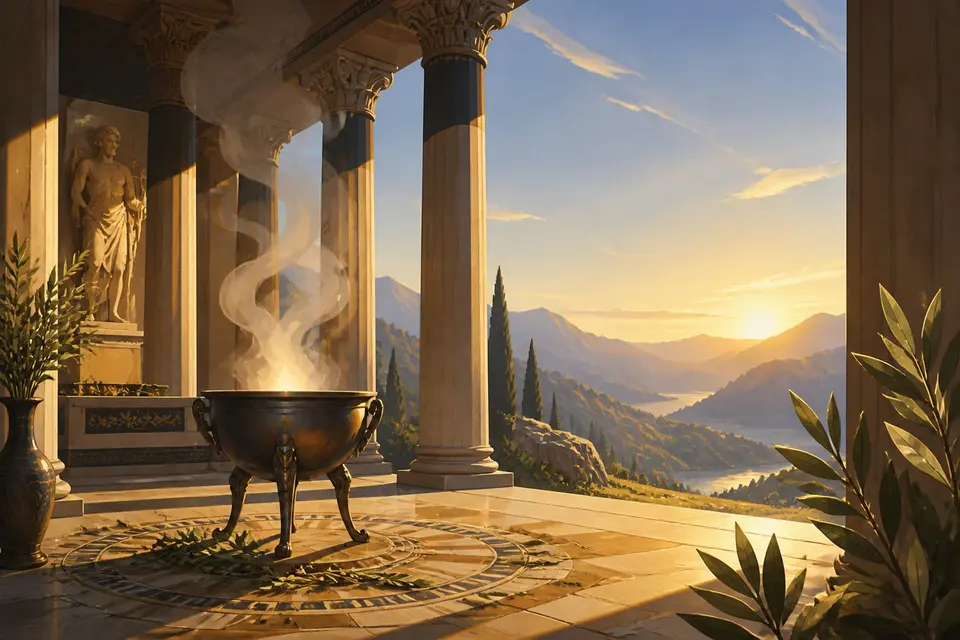
Only one got it right. The Pythia at Delphi said that she could count the grains of sand and measure the sea, that she heard the voice of the mute and the silent, and that she could smell a hard-shelled tortoise boiling with lamb in a bronze cauldron under a bronze lid. That was exactly what Croesus, doing something as odd as he could think of, had cooked that day.
Convinced, he sent enormous gifts and put his real question: should he go to war against Persia? The answer came back: if you cross the River Halys, you will destroy a great empire. Croesus crossed. The empire that fell was his own.
Herodotus, who tells the story in his Histories, clearly loved it. It contains everything about Delphi: the real prestige, the real money, the unreliable oracle and the person who hears what he wants to hear.
The woman on the tripod
The oracle’s mouthpiece was a woman called the Pythia, named for the serpent Python that Apollo killed to take over the site. She was chosen from the local women of Delphi, and by Plutarch’s time, who served as a priest at Delphi himself around 100 CE, she was typically an older woman of simple background who dressed as a young maiden. There was often more than one on duty.
A consultation began with a fee, an animal sacrifice and a check on whether the omens looked favorable (a goat sprinkled with cold water had to shudder). The petitioner would then wait. The Pythia sat on a tripod in the innermost chamber, the adyton, and gave the answer. Priests, the prophetai, interpreted it and sometimes put it into verse.
We have a rough idea of what was asked: Should I marry? Will I have sons? Should we found a colony? Many cities consulted Delphi before they sent settlers overseas. That means the oracle was involved in the founding of cities across the Mediterranean and the Black Sea, a quiet influence that nobody could really measure.
Know thyself
The temple of Apollo carried short inscriptions that Greeks credited to the Seven Sages. The two best known are “Know thyself” and “Nothing in excess.” A third, “Make a pledge and trouble is near,” is less famous and more fun. Visitors also saw the omphalos, the “navel stone,” which marked what the Greeks believed was the exact center of the world. According to the story, Zeus released two eagles from opposite ends of the earth and they met at Delphi.
A clever answer to an impossible question
Not every response was ambiguous. The one most often cited for its good sense was given to the Athenians as Xerxes’s Persian army invaded in 480 BCE. The oracle said that a wall of wood would not fall. Some Athenians took that to mean the wooden fence on the Acropolis. The general Themistocles argued it meant their ships. He was right, and the Greek fleet won the battle of Salamis soon after.
Whether the Pythia was being deliberately vague or the priests were politically canny is a question historians still ask. Many modern scholars think that Delphi worked partly as an information center. Envoys from every part of the Greek world came with news and went away with advice, and a priesthood that knew who was winning where had good reason to give shrewd answers.
Was it really the gas?
Ancient writers, including Plutarch, said the Pythia’s inspiration came from a vapor rising from a crack in the rock under the temple. For a long time modern archaeologists could not find any crack. In the late 1990s and early 2000s the geologist Jelle de Boer and the archaeologist John Hale argued that two geological faults cross under the temple, and that gases, possibly including ethylene (which in small doses causes a trance-like state), may have escaped through water there.
The idea made headlines and has been argued over ever since. Many scholars doubt that ethylene was present in the amounts needed, or that the evidence for it is strong. What remains true is that Delphi sits in a seismically active valley, and that the ancient writers described a smell and a vapor that visitors apparently noticed.
The end
Delphi’s fortunes declined as Rome’s power grew and as Christianity spread. A famous story says that the last Pythian response, given to the emperor Julian around 362 CE, said that the hall was fallen, the god had no home and the spring was silent. Whether the story is exact or not, the site was closed in the late fourth century by a Christian emperor. Its mottos outlived it. Two and a half thousand years later, anyone who tells you to know yourself is quoting a temple wall.