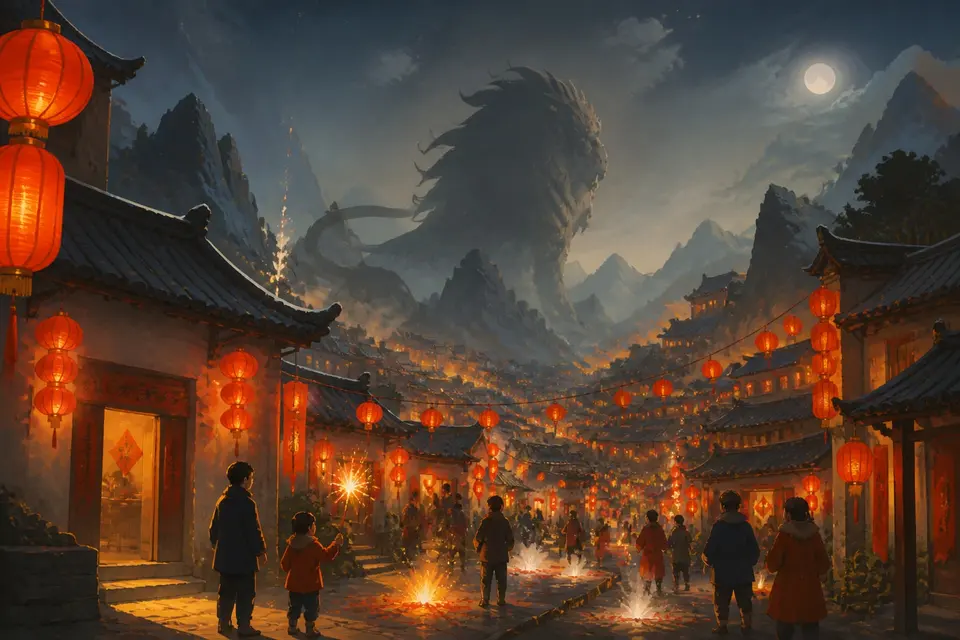
On the evening of Lunar New Year’s Eve in a typical Chinese neighborhood, the whole street turns red. Red lanterns hang from doorways. Red paper couplets, with good-luck phrases in black or gold calligraphy, are pasted on either side of every front door. Children get red envelopes of money. Firecrackers go off, sometimes for hours. People stay up late, eat a big meal and wait for midnight. The question is why red, why noise, and why staying up. A folk tale has an answer. It is the story of a monster called Nian.
The beast
The story goes that in ancient times, there lived a monster called Nián. Some tellings say it lived at the bottom of the sea, others deep in the mountains. It had the body of a beast, with sharp horns and a great mouth. Once a year, on the eve of the new year, it came out and ravaged the villages, eating livestock, crops and, sometimes, people, especially children. Every year, when the dreaded night approached, the villagers fled to the mountains with their families and their animals.
The old man
One year, as everyone was getting ready to leave, an old man with a white beard and a walking stick arrived in a village. He asked for a place to spend the night. An old woman told him to leave, since the beast was coming, but he smiled and said that if he were allowed to stay, he would drive it away. Nobody believed him, but they left him there.
When the monster arrived at midnight, it found the old man’s house lit with candles, with red paper on the door. He was wearing a red robe. When the monster came near, he set off bamboo firecrackers. The beast, terrified by the crackling and the sight of red, ran away. In the morning, the villagers returned and found their village untouched. The old man had disappeared, but they understood that he had shown them how to defend themselves.
From that time on, every year, people put up red decorations, burn lanterns, make loud noises and stay up all night. The beast never came back.
A tale that explains
The story is a classic example of what folklorists call an aetiological tale, one that explains the origin of a custom. Many scholars note that the customs of New Year are older and more varied than the story that explains them. Firecrackers began as bamboo that was thrown into a fire and exploded with a crack, believed to scare away evil spirits and the cold. Red has long been a color of luck, vitality and protection in China. Door decorations, chunlian, developed over centuries from earlier practices of hanging peach-wood charms on doors.
There are many versions of the Nian story, and it is hard to trace it in this form before the twentieth century. But it is a good story, and the details fit the customs so well that it is easy to see why it became popular.
A word game
There is also a pleasing coincidence of language. The word for “year” in Chinese is nián (年), which is also the name of the monster. The character originally showed a person carrying a stalk of grain, and the word meant “harvest.” The common phrase for celebrating the New Year, guò nián, literally means “to pass the year,” and, in the light of the tale, can be read as “to get past Nian.” It is very likely a folk etymology, but it gives the story a sense of rightness.
The biggest trip in the world
The festival is at the heart of the most extensive human migration in the world. In the weeks around Lunar New Year, known as chunyun, “spring migration,” hundreds of millions of people travel back to their hometowns, by train, bus, car, plane and motorcycle, to be with their families. The total number of trips counted in China in recent years reaches into the billions. Train stations are packed, tickets sell out in minutes, and tales of people who spend a day on a train to spend a few days at home are common.
The family meal
The reunion dinner on New Year’s Eve is the most important meal of the year. Dishes often have symbolic meanings: fish, because the word for fish sounds like the word for surplus; dumplings, shaped like old gold ingots; long noodles for long life; sweet rice cakes for a higher year. After dinner, the family stays up to see the year out, an old custom called shǒusuì, “keeping the year.” In the monster’s story, that is the vigil that kept the village safe.
Why it still feels right
Whether or not anyone really believed in Nian, the story does something that good folk tales do: it gives people a reason to do what they were going to do anyway. A household, standing in front of a bright red door, listening to the firecrackers and waiting for the new year to arrive, is acting out a very old idea: that together, with noise and light and a good meal, we can keep the dark away for another year.