On January 3, 2019, a Chinese spacecraft called Chang’e 4 touched down on the far side of the Moon, in a huge, ancient crater called Von Kármán. No probe from any country had landed there before. The far side faces away from Earth and cannot be reached by direct radio contact, so the mission needed a relay satellite, Queqiao, “Magpie Bridge,” parked beyond the Moon. A few hours after landing, a small six-wheeled rover rolled onto the surface. Its name was Yutu-2, “Jade Rabbit 2.” The names are not random. They come from a very old story.
The ten suns
The legend of Chang’e, in its best-known form, begins with a disaster. In ancient times, there were ten suns, the children of a sun goddess, who took turns crossing the sky, one each day. One day, all ten rose together. The Earth began to burn. Crops withered, rivers dried up and people suffered. A skilled archer named Hou Yi was called on to save the world. He shot down nine of the suns with his arrows, leaving one in the sky. A grateful people honored him, and he became a king.
The elixir
Hou Yi was married to a woman named Chang’e. As a reward for his deed, he was given a potion that would confer immortality. The story differs on who gave it. In some versions it came from a heavenly queen who lived in the mountains. In others, it was a wandering immortal. The elixir was strong enough that, if one person drank all of it, they would live forever and ascend to heaven. If two people shared it, they would live a long life on Earth together.
Hou Yi did not want to leave his wife, or become immortal without her. He hid the potion at home and planned to share it. But he had an apprentice, a man named Peng Meng, who was jealous. One day, when Hou Yi was out hunting, Peng Meng broke in and demanded the elixir at sword-point. Chang’e could not fight him. To keep it from falling into his hands, she drank it all.
The ascent
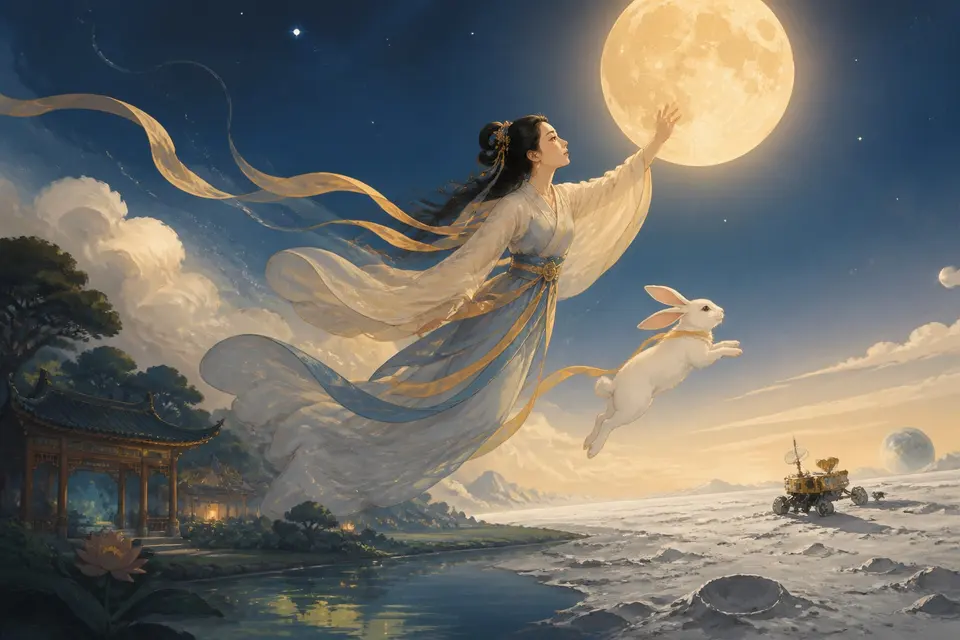
Chang’e’s body grew light and she began to float. She flew out of the window and up into the sky. Wanting to stay as near to her husband as she could, she stopped on the Moon. When Hou Yi returned and learned what had happened, he looked up and saw a figure on the Moon and cried out. He set out food for her on a table, her favorite fruits and cakes, and people have done so ever since.
A companion on the Moon
On the Moon, Chang’e is said to live in a palace, the Guanghan Gong, “Palace of Vast Cold.” She is accompanied by a rabbit, the Jade Rabbit, which pounds the herbs of immortality in a mortar. In East Asia, many people see not a man in the Moon, but a rabbit with a mortar and pestle, in the shapes of the dark patches. The rabbit is known in China as Yutu, and in Japan the same figure is said to be making rice cakes, mochi.
There is also a woodcutter, Wu Gang, who has been condemned to chop at a cassia tree on the Moon. Each time he cuts it, the tree grows back. He is the Chinese equivalent of Sisyphus.
The Mid-Autumn Festival
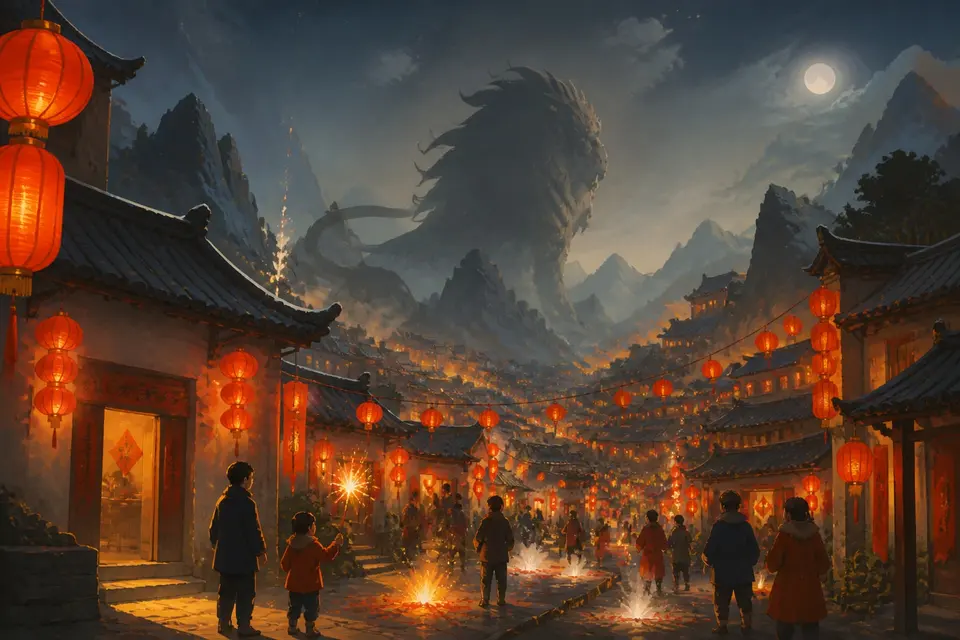
The story is connected with the Mid-Autumn Festival, held on the fifteenth day of the eighth lunar month, usually in September or early October, when the Moon is full and, traditionally, at its brightest. Families gather in the evening, eat mooncakes, round pastries filled with sweet lotus paste or salted egg yolk, and look at the Moon. Lanterns are lit. Children carry them. Many people also leave an offering to Chang’e. It is a holiday of reunion, and the story’s theme of separation, of a woman on the Moon and a husband on Earth, who look at the same light, gives it a bittersweet note.
A popular legend says that mooncakes were used during the Yuan dynasty, in the fourteenth century, to pass secret messages to Chinese rebels, who planned an uprising against the Mongol rulers on the night of the festival. Historians doubt it, but it is a good story.
From legend to lunar landing
China’s lunar exploration program, which began in the 2000s, is named after the goddess. The first orbiter, Chang’e 1, launched in 2007. Chang’e 3 landed in December 2013, with a rover named Yutu, the first soft landing on the Moon by any nation since the Soviet Union’s in 1976. Chang’e 4 followed in 2019 with the far-side landing. In December 2020, Chang’e 5 returned about 1.7 kilograms of lunar soil to Earth, the first lunar samples brought back since 1976. In June 2024, Chang’e 6 collected samples from the far side and brought them home, a first in human history.
The program is deliberately aimed at an old story: the mission names evoke the Moon goddess and her rabbit. For many Chinese people, the idea that a legend they heard as children is now a rocket program is a source of pride.
What the myth is about
The legend of Chang’e has been read in many ways. For some, she is a figure of sacrifice, a woman who gave up her life on Earth to protect a precious thing. For others, she is a woman who chose her own destiny. The poem “Chang’e,” by the Tang poet Li Shangyin, imagines her sitting alone in the Moon palace, regretting the elixir. He imagines her regretting the elixir, gazing night after night across the blue-green sky. The old tale has been told as a story of love, of loneliness and of ambition.
Looking up at a full Moon, you can imagine it is all of those things. And if you look at the bright, dark patches, you might even see a rabbit.