In the year 629 CE, a young Buddhist monk named Xuanzang left the Tang capital of Chang’an, now Xi’an, in secret. The emperor, Taizong, had just closed the borders, because of war with the Turks, and had forbidden foreign travel. Xuanzang had a question that had troubled him for years: the Chinese translations of Buddhist scriptures were full of contradictions. He wanted to read the originals, in India. So he went, alone, on foot, through the Gobi desert, across the mountains of Central Asia and into northern India. He was gone for about sixteen years. When he came home in 645, the emperor, who had been angry, received him as a hero.
The real journey
We know a good deal about what Xuanzang did, because he wrote it down. After his return, at the emperor’s request, he and a disciple compiled an account of the lands he had visited, called the Great Tang Records on the Western Regions. It is a rich description of the geography, customs and religions of more than a hundred kingdoms. A biography by his disciples gives more of the story: he survived being lost in the desert without water for days, was nearly killed by bandits, crossed the Hindu Kush and met kings who tried to keep him. He spent several years studying at the great monastic university of Nalanda in India, and he returned with hundreds of Buddhist texts, usually counted as 657, carried back on a train of horses.
He spent the rest of his life translating them. A great pagoda, the Giant Wild Goose Pagoda, still stands in Xi’an, built in 652 to house the scriptures he brought back.
A legend grows
It did not take long for stories to gather around him. Within a few centuries, popular tellers were adding miraculous episodes: he was protected by a monkey, he fought demons, he was helped by gods. The tales were told by storytellers in marketplaces, performed in plays and written into popular books. In the sixteenth century, a writer, traditionally identified as Wu Cheng’en, organized the material into a hundred-chapter novel, Journey to the West, or Xiyouji. It was published anonymously, around 1592. It is one of the four great classic novels of Chinese literature.
The monkey
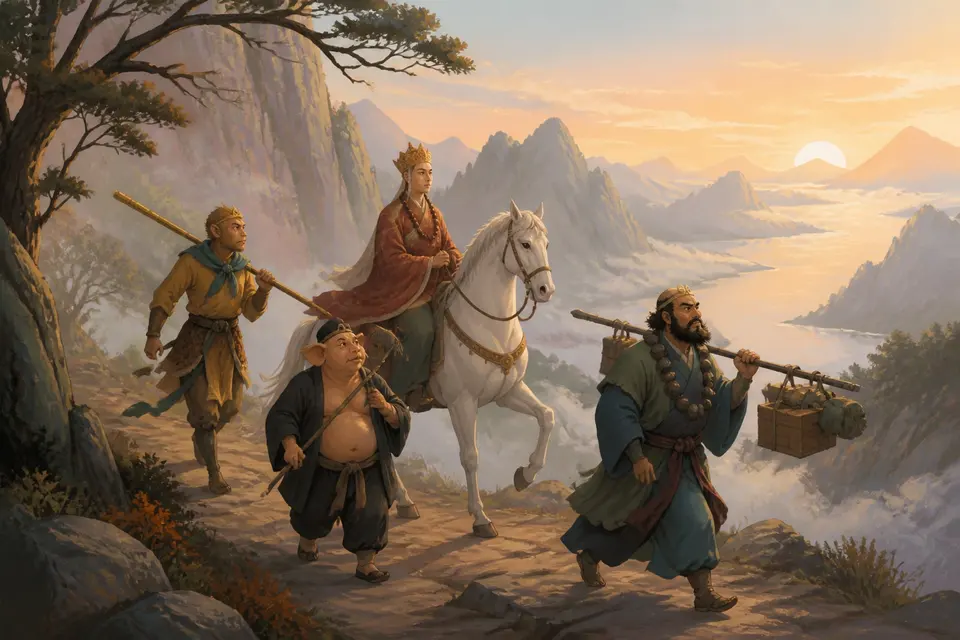
In the novel, the monk is Tang Sanzang, a gentle, rather timid man. The real star is his disciple, Sun Wukong, the Monkey King. He is born from a stone on Flower Fruit Mountain and becomes the king of a troop of monkeys. He studies with a Taoist master and learns seventy-two transformations, and a cloud-somersault that carries him 108,000 li, about 54,000 kilometers, in a single bound. He steals a magic staff from the Dragon King of the Eastern Sea, an iron pillar that can shrink to the size of a needle, and tucks it behind his ear.
He is also a spectacular troublemaker. He crashes the banquet of the heavenly court, eats the peaches of immortality and drinks the wine, and fights the entire celestial army. In the end, he is trapped by the Buddha under a mountain for five hundred years. He is released by Tang Sanzang, who takes him on as a disciple, though he has to put a golden band around his head that tightens when the monk recites a spell.
The rest of the party
The monk’s other companions are Zhu Bajie, “Pigsy,” a greedy, lazy former marshal of heaven who was reborn as a pig because he flirted with a goddess, and Sha Wujing, a former celestial general turned river monster, who is quiet and dutiful. The monk rides a white horse, who is really the son of a dragon.
The journey takes fourteen years and involves eighty-one trials, usually in the form of demons who want to eat the monk, because eating him will grant them immortality. The comedy of the book comes from the dynamic of the group: Wukong is clever and arrogant, Bajie is lazy and self-interested, and the monk is naive. Wukong is constantly saving them and being scolded for it.
The ending
When they finally arrive at the Western Heaven, the Buddha gives them scriptures, but they find the first batch is blank. Wukong complains, and he is told that the scriptures without words are the best, but that the people of China are not ready for them. They are sent back for a second set, with writing. In the end, each of the four is rewarded. Wukong becomes a Buddha, “Victorious Fighting Buddha,” and the story ends with a sense that the journey, not the destination, was the point.
An influence that hasn’t stopped
Few Chinese stories have traveled as far. In Japan, it was adapted as Saiyūki, and a popular television series, Monkey, ran in 1978 and was dubbed in English. The manga artist Akira Toriyama based his hero Goku in Dragon Ball (1984) on Sun Wukong, and borrowed the staff and cloud. The 2024 video game Black Myth: Wukong, from the Chinese studio Game Science, sold more than ten million copies in its first days and set records on Steam.
The monkey, in all those versions, has the same qualities: he is rebellious, funny, loyal and impossible to hold down. He is a trickster who becomes a hero, and the people who love him love him because he refuses to behave.
A real man and a legend
It is nice to remember the real monk. Xuanzang’s trip was one of the great feats of the age: a man who walked across deserts and mountains to find out what the sacred books really said. The stories gave him a monkey, but the man did not need one. His persistence was the miracle.