The most popular version of Mulan’s story in the world today features a wisecracking dragon, a lucky cricket and a song about making a man out of you. The original has none of them. It is a poem of about 300 Chinese characters, brisk, spare and unexpectedly sophisticated, that was probably composed in northern China sometime between the fourth and sixth centuries CE, and it is still memorized by schoolchildren. It is called “The Ballad of Mulan.”
Where it comes from
The poem is anonymous. It seems to have been sung in the north of China during the Northern Wei dynasty (386 to 534 CE), when a nomadic people, the Tuoba Xianbei, ruled the region. It was written down in an anthology of folk songs, compiled around the sixth century, though the version we know best, with a few later additions, comes from a collection put together in the twelfth century. The original text is believed to be from the north because it mentions the khan, the Turkic and Mongolic title for a ruler, and the use of horses and local geography.
Whether Mulan was a real person is unknown. Some later writers gave her a surname, Hua, and a hometown, but the ballad itself gives only her given name. It is almost certainly a folk tale, though perhaps based on stories of real women who fought.
The story
The ballad begins with a woman at a loom, but she is not weaving. She is sighing. She is a young woman, and she is troubled. When asked what she is thinking about, she says she is not thinking of anything in particular. Then she explains: the emperor is drafting soldiers, and her father’s name is on the list. Her father is old, and she has no older brother, and her younger brother is a child.
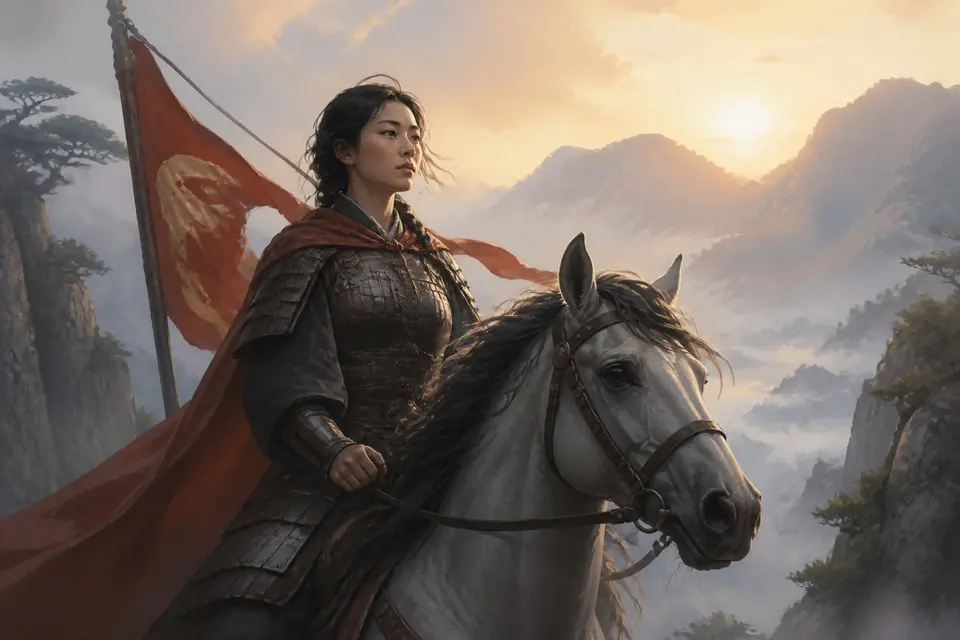
Mulan decides to take her father’s place. She buys a horse in the east market, a saddle in the west market, reins in the south and a whip in the north. She leaves home at dawn, and at night she camps by the Yellow River, hearing, not her parents calling her, but the sound of the water. She travels thousands of miles, crossing mountains “as if flying.” For ten years, the poem says, the general fought a hundred battles. Some of the soldiers died; Mulan came back after twelve years.
The emperor and the camel
The emperor gave her an honor and offered her a high post. She asks for neither. She says she only wants a swift camel to carry her home. Her parents hear she has returned and come out to the edge of town to meet her. Her sister puts on her makeup. Her brother sharpens a knife for the pig and the sheep. Mulan opens the door of her old room and puts on her old clothes. She combs her hair and puts on makeup, then steps out to meet the comrades who had traveled with her for twelve years. They are amazed. They had never realized that Mulan was a girl.
The famous couplet
The poem ends with one of the best-known lines in Chinese literature. The male hare, it says, goes with its feet kicking, and the female hare has eyes that are bleary. But when the two hares run side by side, who can tell if I am a he or she? It is a witty, almost playful ending, and a way of saying that, in action, there is no difference. It has been quoted in debates about gender for centuries.
What the poem is not
The ballad does not mention a love interest. It does not feature a dragon. And, unlike some later versions, it does not end in tragedy. In a seventeenth-century novel, Sui Tang Yanyi, Mulan is summoned to the court as a concubine by the emperor, and kills herself rather than submit. It is a darker version, and it reflects later, more constrained ideas about women’s roles.
Disney and after
Disney’s animated Mulan (1998) and its live-action remake (2020) took the outline and added a good deal of material. The film’s portrait of loyalty, family honor and being true to oneself resonated worldwide, and Mulan became one of the most popular Disney heroines. Chinese audiences were, unsurprisingly, mixed in their reactions, appreciating the attention but often noting the liberties taken with the story.
Why it lasts
The ballad is not about a woman rebelling against her family. Mulan acts out of filial piety, a duty to her father, which is the highest virtue in Chinese tradition. She does not renounce her femininity, either: when she returns, she puts on her makeup and her dress. That balance has made her a figure that people of different views can claim.
Above all, it is a story about a person who acts because someone must. She does not say it is brave. She just buys a horse. The poem seems to understand that, sometimes, the most remarkable things in life are done by people who simply did what needed to be done.