When a Russian family moved house in the nineteenth century, there was one thing it could not forget, and it was not the furniture. According to folk custom, the household had to bring the domovoi, the spirit of the home, along. The family would take an ember from the old stove in a pot, or an old shoe, or a piece of bread, and carry it to the new house. At the door, they would speak to the empty air: “Grandfather domovoi, we invite you to the new home.” If they forgot, the new house would be unlucky. If they were rude, it could be much worse.
The little old man
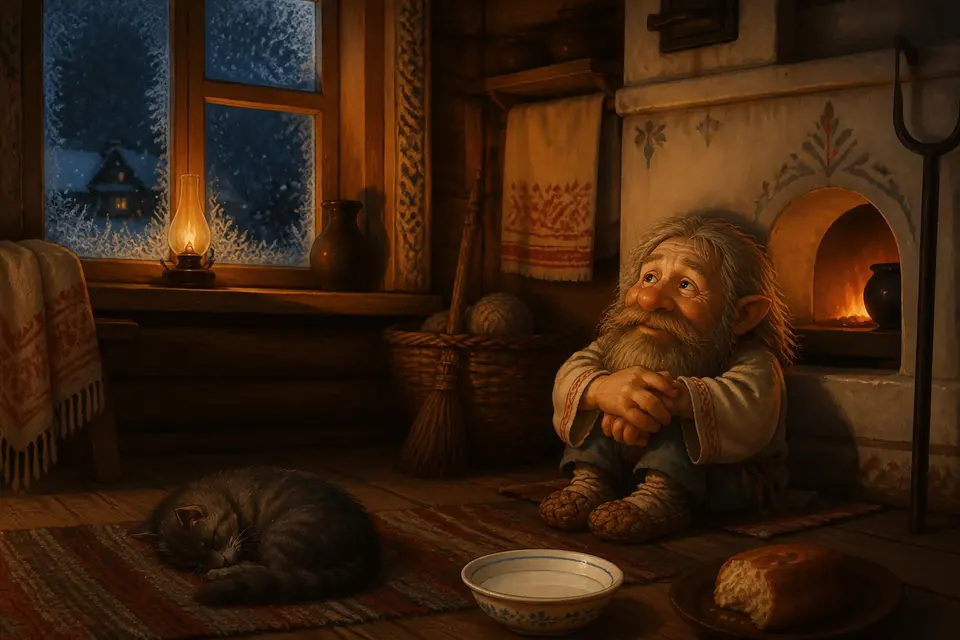
The domovoi, from the Slavic word for “house,” was one of the most beloved and feared spirits of folk belief in Russia, Ukraine and Belarus, and similar figures exist in Poland and the Balkans. He was usually imagined as a small, hairy old man, covered in gray fur from head to foot, sometimes looking like the master of the house. He lived behind the stove, under the threshold or in the cellar, wherever it was warm and out of sight. He took care of the household, the animals, the children. But he was also an ancestor, in some beliefs the spirit of the founder of the family, and as such he deserved respect.
Feed him
Offerings were made to keep him happy. On certain days, families would leave a bit of porridge, bread or salt, or a saucer of milk, behind the stove. In some regions, a first spoonful of a new dish was thrown into the corner for him. A lazy household that never put anything out might find him angry.
People paid attention to the omens he sent. At night, the domovoi could be heard moving about: creaks, bumps, footsteps in the attic. A gentle sound was a good sign. If something was going to happen, he might stroke someone in their sleep. A soft, warm, furry touch meant good luck. A cold, rough hand meant misfortune. Animals might also react, since he was especially fond of certain horses and was thought to braid their manes at night. Farmers took the colors of their cattle and cats into account to please him.
The female spirit
The domovoi had a counterpart, the kikimora, a female house spirit who lived under the floor or behind the stove. She could be helpful, spinning at night, but she could also be spiteful if the house was untidy, tangling threads and making noises. People said that a kikimora bothered women who neglected their work.
The lord of the woods
If the domovoi guarded the home, the leshy, from the Russian les, “forest,” ruled the woods. He was a spirit of the forest, lord of the trees and animals, who could change his size at will, growing as tall as the highest pine or shrinking to the height of a blade of grass. He was said to appear as an old man with a long beard, wearing his clothing on the wrong side, with his left side wrapped over the right. His eyes glowed green, and he cast no shadow.
Travelers who met him could easily get lost. The leshy loved to lead people astray, to make them go in circles, to imitate the voices of friends and call them deeper into the forest. A familiar bit of advice, still repeated in village lore, was to take off your clothes and put them on again inside out, with your shoes on the opposite feet. That confused the leshy, who was himself dressed backward, and the spell would break.
Hunters and shepherds made offerings of bread, salt or the first game they caught, to keep on his good side. Shepherds even made contracts with him, giving him a portion of the flock in return for his protection against wolves.
Why these spirits persisted
Russia converted to Christianity in 988, but belief in the domovoi and leshy survived for centuries, in what historians call dvoeverie, “dual faith.” Peasants went to church and also left milk behind the stove. Orthodox priests tended to consider them demons, but people continued to treat them as part of the family. Folklorists who traveled to Russian villages in the nineteenth and twentieth centuries still recorded accounts of encounters.
A modern echo
Some of the habits are still around. Some Russians still say a word to the domovoi when they move house. A saying that the house “has its own character” would sound familiar to anyone. And in the Witcher video games, drawn from Polish and Slavic folklore, the leshen, a forest guardian, is one of the most memorable monsters.
What they were for
These were spirits made for places. The domovoi was the feeling of a house at night, the creak of a floorboard, the warmth that lingers by the stove. The leshy was the feeling of a forest where it is easy to lose your way. The stories gave names and manners to these feelings. In a sense, they taught people how to behave: be polite to your home, respect the woods, and do not forget to say thank you.