A company name has to do several things at once: be short, be pronounceable in many languages, look good on a box, and not already belong to someone else. Greek and Roman myth is an enormous free dictionary of short, memorable names with stories attached. That is why so many brands have reached into it. Some did so deliberately and with great care. Some got there by accident, and a few got there by a story that is told more tidily than it happened.
Nike
The sportswear company began in 1964 as Blue Ribbon Sports, importing Japanese running shoes. In 1971, with the first shoes of its own about to launch, it needed a brand. The name Nike was suggested by an early employee, Jeff Johnson, who said it came to him in a dream. The Greek goddess Nike personified victory; she is usually shown with wings, running or landing, and she appears on the temple of Athena on the Athenian Acropolis. The famous Winged Victory of Samothrace in the Louvre shows her alighting on the prow of a ship. The swoosh logo, designed by a graphic design student, Carolyn Davidson, was bought in 1971 for 35 dollars and is often described as a stylized wing.
Pandora
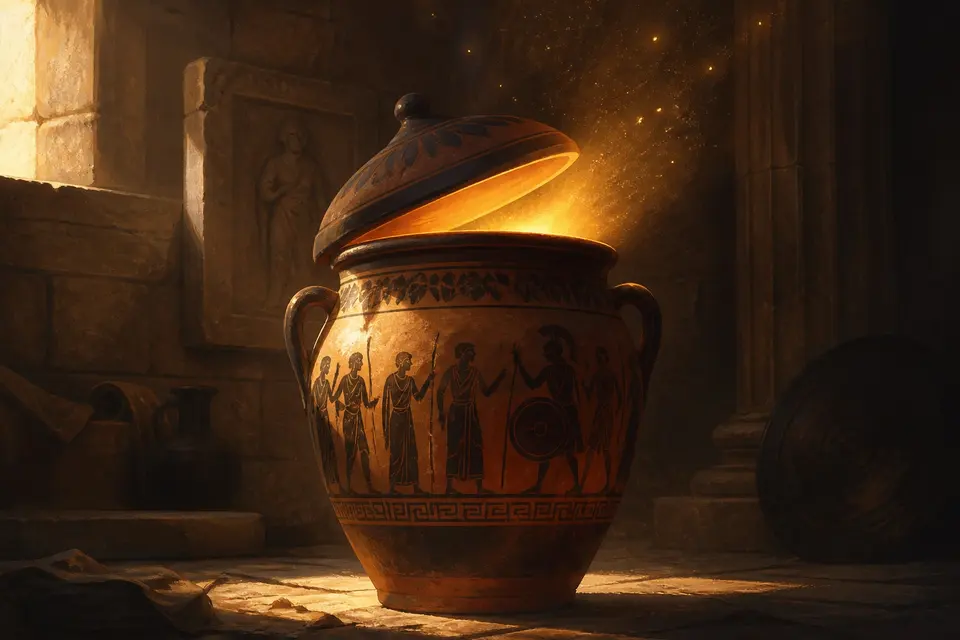
The Danish jewelry company was founded in 1982 by Per Enevoldsen and his wife Winnie in Copenhagen. Its name echoes Pandora, the first woman of Greek myth, whose name means “all gifts.” Whatever the intention, the irony is hard to miss, given that the original story is about a jar of troubles. Marketing departments are happy not to mention it.
Versace
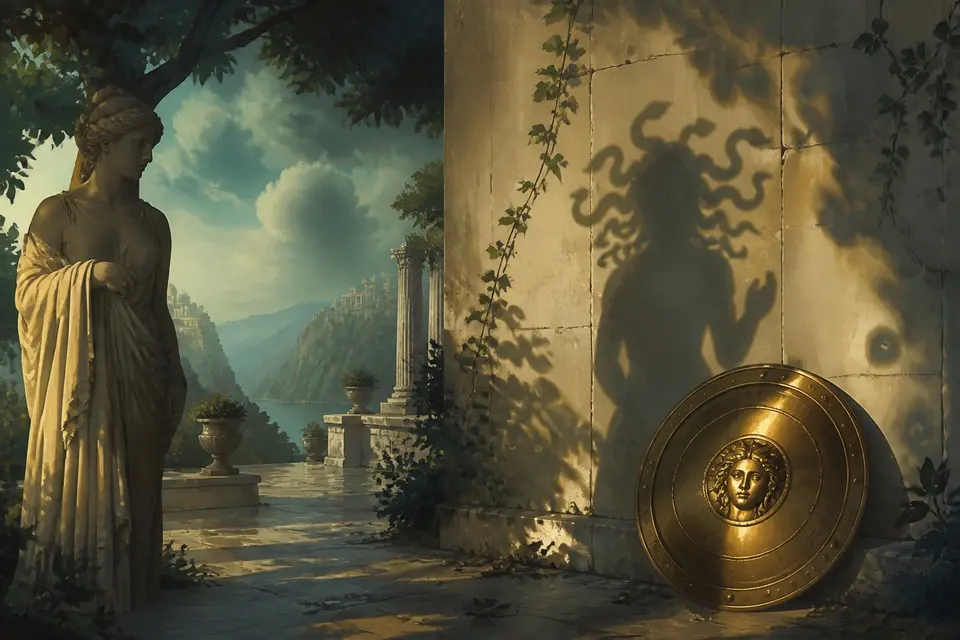
Gianni Versace founded his house in Milan in 1978 and chose the head of Medusa as its emblem. He grew up in Reggio Calabria in southern Italy, a region full of Greek ruins, and he later said he chose her because a person who falls for Medusa cannot go back. The face on the logo is the classical beautiful Medusa, not the tusked monster of the oldest art.
Starbucks, with a caution
The coffee company’s logo shows a siren with two tails. The story the company tells is that its first logo, from 1971, was based on a sixteenth-century Norse woodcut of a twin-tailed mermaid, and that she was chosen to evoke the seafaring history of coffee traders. In Greek myth the Sirens were bird-bodied women who lured sailors with song, and the twin-tailed siren is a medieval invention, so this one is a mixed heritage. The name Starbucks itself comes from a character in Moby-Dick.
Trojan, Oracle and a few others
- Trojan condoms, introduced in 1920 by Youngs Rubber Corporation, borrowed the name from the people of Troy, famous for resisting a ten-year siege, and likely suggesting strength. Computer security later borrowed the other half of the story, the horse, for software that arrives disguised as something harmless.
- Oracle began as a code name. When Larry Ellison and his colleagues were working on a database for the CIA in the late 1970s, the project was called “Oracle.” The company kept it. The word goes back to the oracles of Delphi.
- Atlas, Titan, Apollo, Artemis and Orion are names of rockets, space programs and spacecraft. NASA’s Apollo program (1961 to 1972) was named at the suggestion of Abe Silverstein, then NASA’s head of spaceflight development, who liked the image of the sun god in his chariot. The Artemis program, which aims to return astronauts to the Moon, is named for Apollo’s twin sister, the goddess of the Moon.
The risk of a good name
Using mythology has downsides. Brands inherit the story along with the name, and the stories are not always flattering. Nike is about winning. Pandora is about a jar of misery. The Trojans lost.
The name nobody liked
Nike’s name has an unexpected story. In 1971, Phil Knight, the co-founder, wanted to call the new shoe line Dimension Six. His employees disagreed, and Jeff Johnson, who had been a runner and a college classmate, said the name Nike had come to him in a dream. Knight was not enthusiastic about it. He is reported to have said, “I don’t love it, but maybe it’ll grow on us.” It did.
A bookshop called Cadabra
Amazon’s name also came after a false start. When Jeff Bezos incorporated his online bookstore in 1994, he called it Cadabra, as in abracadabra. A lawyer on the phone misheard it as “cadaver,” and Bezos decided to change it. He searched the dictionary and settled on Amazon, which he liked because it was exotic and the world’s largest river, a good image for a company that planned to be the largest bookstore. The river itself was named after the mythical women warriors whom the first European explorers claimed to have fought, so the company is named after a nation that, in the stories, no man could conquer.
Venus, Mars and the razor aisle
If you look closely at supermarket shelves, you will see that the habit is everywhere. Gillette launched a razor for women called Venus in 2001. A chocolate bar sold as Mars is named for its founder, Frank Mars, not for the god. The old gods are free to use, and everyone recognizes them, which is why they keep turning up.
But the point of a mythic name is not literal meaning. It is a shortcut. A name like Nike or Apollo arrives with centuries of images attached, and the brand does not have to explain them. When the Greek and Roman gods are used well, they work like a good logo: you recognize them before you have decided what they mean.