The first thing an ancient visitor to Olympia noticed was not the stadium. It was the smell. Hundreds of oxen were slaughtered on the great altar of Zeus during the festival, and thousands of spectators camped in the open with little water, no real toilets and, in the heat of August, a great many flies. The Greeks joked that the flies were the one thing at Olympia that got their own sacrifice, to Zeus the Fly-Averter. It was not a gentle sporting event. It was a religious festival with a very loud sports component.
Zeus first, athletes second
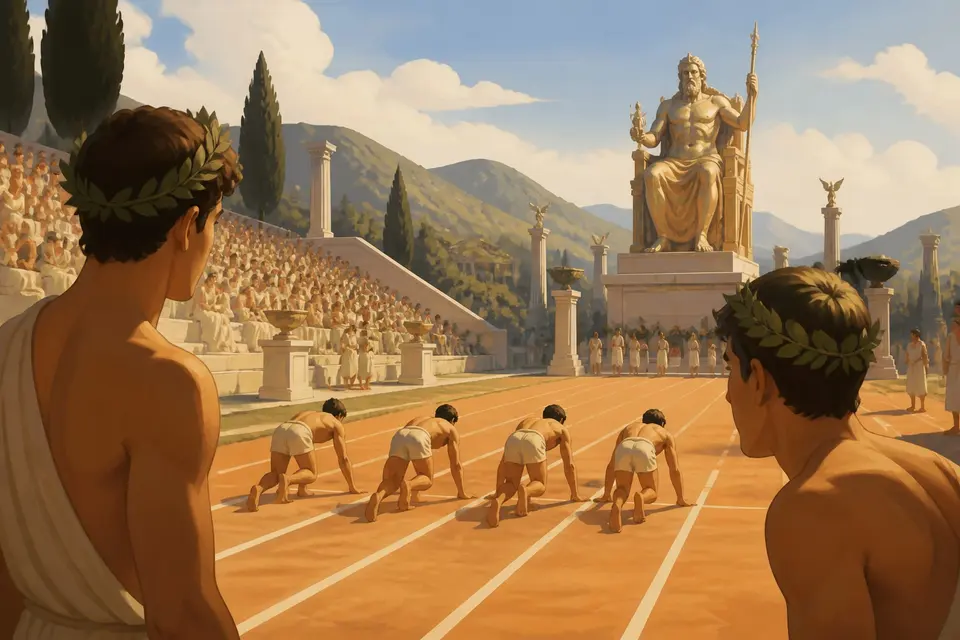
Olympia was a sanctuary, a sacred precinct in the western Peloponnese in the valley of the river Alpheios. The center was the temple of Zeus, which held a giant statue of the god in gold and ivory made by the sculptor Phidias around 435 BCE. The ancient world counted it among its Seven Wonders. The games were held in the god’s honor every four years.
The traditional starting date is 776 BCE. It comes from a list of victors compiled by a fifth-century scholar, Hippias of Elis, and it is the earliest date that Greek historians used for dating events. Archaeologists find signs of activity at Olympia that look earlier, so the real origins may be older and blurrier. The games went on for more than a thousand years, until a Christian Roman emperor ended pagan festivals in the late fourth century CE.
The truce
Before each festival, heralds called spondophoroi traveled from Olympia to the cities of the Greek world to announce the ekecheiria, the sacred truce. During the festival and the weeks around it, hostilities were supposed to pause so that athletes and spectators could travel safely. A city that broke it could be fined or excluded.
The truce did not stop wars, and it did not always hold. But it was taken seriously enough that, in 420 BCE, Sparta was banned from the games for attacking a nearby town during the truce, and its athletes were not allowed to compete.
The events
The oldest event, and for the first thirteen Olympiads the only one, was the stadion, a sprint of one length of the track, about 192 meters. The word survives as “stadium.” Over the centuries, they added longer races, then wrestling, boxing, the pentathlon (running, jumping, discus, javelin and wrestling) and chariot races in the hippodrome.
The most feared event was the pankration, a mix of boxing and wrestling with almost no rules. Biting and gouging were forbidden. Almost everything else was allowed. A famous story tells of a champion, Arrhichion, who was being strangled in a final and, while dying, dislocated his opponent’s toe. The opponent gave up in pain, and the corpse was crowned.
Athletes competed in the nude. The Greek word gymnos means naked, and that is where “gymnasium” comes from.
No gold
The prize was a wreath of wild olive, cut with a golden sickle by a boy from a sacred tree behind the temple of Zeus. There was no silver or bronze. A second-place finisher got nothing at all. But a victory carried huge prestige, and winners got a stream of rewards in their home cities, from free meals for life to statues and poems. The poet Pindar made a living writing odes for them.
Who could take part
Competitors had to be free Greek men. Slaves and foreigners (the Greek word for non-Greek, barbaros, is where we get “barbarian”) were excluded, though they were allowed to watch. Married women were not allowed to attend, on pain of being thrown off a nearby cliff, though we know of at least one case where a woman was excused. Unmarried girls could attend, and at a separate event called the Heraia, held in honor of Hera, they ran footraces of their own.
The modern echo
Milo and his calf
The most famous athlete of the ancient Games was Milo of Croton, a wrestler from southern Italy who won the boys’ wrestling at the Games of 540 BCE and then took the men’s event five times in a row, from 532 to 516 BCE. A popular story says that he built his strength by picking up a newborn calf every day and carrying it, until it was a full-grown bull. He was also supposed to be able to burst a cord tied around his forehead by holding his breath. His death, the ancient writers say, was a fitting one for such a man: he tried to split an old tree with his hands, the trunk closed on them and he was eaten by wolves.
The first woman to win
Women were not allowed to compete, but a rich woman could enter a team of horses in the chariot race, and the owner, not the driver, was the winner. In 396 BCE, a Spartan princess, Kyniska, daughter of King Archidamos, entered a four-horse chariot and won. She won again in 392 BCE, and had her victory commemorated with a statue and an inscription at Olympia: “My fathers and brothers were kings of Sparta. I, Kyniska, victorious with a chariot of swift-footed horses, set up this statue. I say that I am the only woman in all Greece who won this crown.”
The emperor who fell off his chariot
In 67 CE, the Roman emperor Nero toured Greece and entered the Games, which were postponed for two years to accommodate him. He competed in a ten-horse chariot race. According to the Roman biographer Suetonius, he fell off, was helped back on and did not finish. The judges awarded him the victory anyway. After he died, the Greeks quietly removed his name from the list of winners and ruled that the Games of that year had not counted.
Buried and found
After the Games ended in the late fourth century, Olympia was damaged by earthquakes and flooded repeatedly by two nearby rivers. Over the centuries, the whole site was buried under several meters of silt and sand. German archaeologists began excavating in 1875, and they found the foundations of the temples, the stadium and hundreds of statues. The head of the giant statue of Zeus is lost, but the workshop of its sculptor, Phidias, was found, with a cup inscribed “I belong to Phidias.”
The idea of reviving the games was pushed by the French aristocrat Pierre de Coubertin, who organized the first modern Olympics in Athens in 1896. The ritual of lighting a flame at Olympia and carrying it to the host city was not invented by the Greeks. It was introduced for the 1936 Berlin Games. Today the flame is still lit at Olympia with a parabolic mirror and the rays of the sun, a gesture that is an invention of the modern age and feels completely ancient.