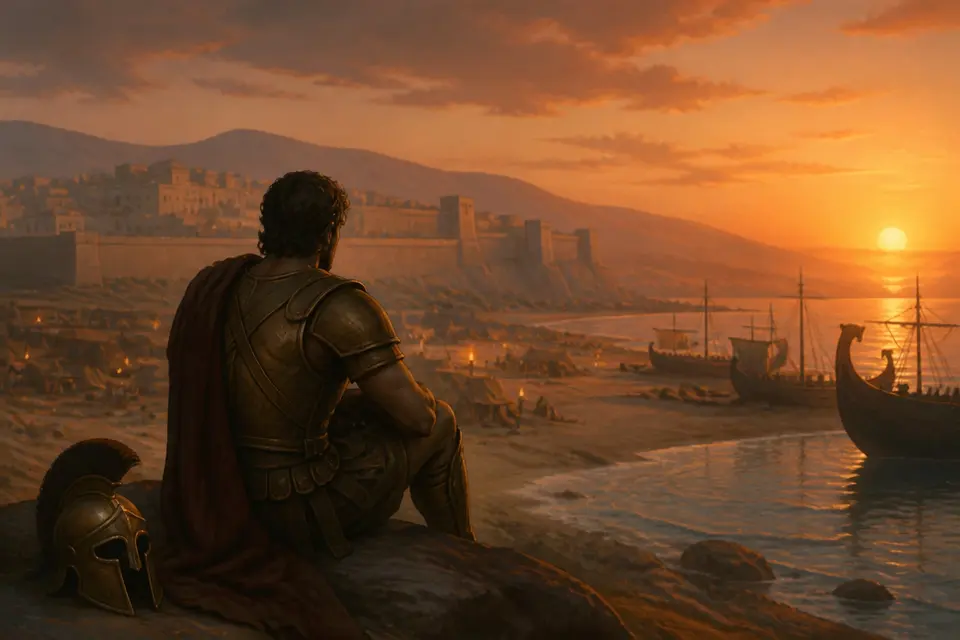
Alexander the Great, it is said, slept with two things under his pillow: a dagger and a copy of the Iliad, annotated by his teacher Aristotle. When he crossed into Asia in 334 BCE, one of his first acts was to visit the ruins of Troy, lay a wreath on the tomb of Achilles and run a ritual race around it. He wanted to be what Achilles was: the greatest of all warriors, and a man who would be remembered. He seems to have understood the bargain, too.
The first word
The Iliad begins, in Greek, with one word: mēnin, “rage.” “Sing, goddess, the rage of Achilles, son of Peleus.” The poem is not the story of the whole Trojan War. It is about a few weeks in its tenth year, and it is about what happens when the greatest warrior on the Greek side is insulted by his own commander.
The commander is Agamemnon, who has been forced to give up a captive woman, Chryseis, and takes Briseis, Achilles’s prize, as compensation. Achilles, humiliated, withdraws from the fighting. He sits in his tent, plays the lyre, and refuses to fight. The Greeks start losing.
The choice
In book nine, when the Greeks send an embassy begging him to return, Achilles says something astonishing. His mother, the sea goddess Thetis, has told him that he has two possible fates. If he stays and fights at Troy, he will die young, but his glory, his kleos, will never be forgotten. If he goes home, he will live to old age, but his name will fade. Now he says that he is thinking of going home. No honor, he says, is worth a life.
That is a very modern doubt, expressed in a poem composed about 2,700 years ago. And it is one of the reasons why readers have loved the poem: the greatest hero is not sure that glory is worth it.
Patroclus
What brings him back to the war is a death. His closest companion, Patroclus, puts on Achilles’s armor to rally the Greeks, and is killed by the Trojan prince Hector. When Achilles hears the news, he lets out a cry that his mother hears from the bottom of the sea. He covers his head with ashes and rolls on the ground.
The relationship between Achilles and Patroclus has been argued about since antiquity. Homer does not say they were lovers, but he presents a bond of extraordinary intensity. Later Greek writers, among them Aeschylus and Plato’s speakers in the Symposium, discuss the two as a couple. Madeline Miller’s novel The Song of Achilles (2011) takes up that reading.
Rage and what it costs
Achilles returns to battle and kills Hector. Then he does something that the poem treats as a crime: he ties Hector’s body to his chariot and drags it around Patroclus’s tomb every morning for twelve days. Even the gods are disgusted. The poem makes it clear that his grief has turned into something monstrous.
The most moving scene in the poem
In the last book, Hector’s father, King Priam of Troy, an old man, makes his way across the battlefield at night, guided by the god Hermes, to the tent of the man who killed his son. He kneels, takes Achilles’s hands and kisses them. “I have endured what no one on earth has ever done,” he says, “to put to my lips the hands of the man who killed my son.” He asks for the body. He asks Achilles to think of his own father.
Achilles weeps. The old king weeps for Hector, and Achilles weeps for his father and for Patroclus. They sit together and share a meal. Achilles agrees to give back the body and to hold a truce for twelve days so that Hector can be buried. The poem ends not with the fall of Troy or the death of Achilles, but with the funeral of Hector, “tamer of horses.”
It is a remarkable choice. An epic about a war ends with the grief of the enemy and the shared humanity of the two sides.
The heel, and the tendon
The story of Achilles’s heel is not in Homer. The idea that his mother dipped him in the river Styx and held him by the heel appears in later sources, notably in the Roman poet Statius, in the first century CE. In the Iliad, he is a warrior who can be wounded, and in the tradition, he dies from an arrow shot by Paris, guided by Apollo. The Achilles tendon is named for him, and the name goes back to a Dutch anatomist, Philip Verheyen, who used it in 1693.
Achilles today
Achilles has been a constant presence in popular culture. The 2004 film Troy starred Brad Pitt, and Madeline Miller’s The Song of Achilles became a bestseller. Both versions make a point of the hero’s ambivalence: he is a killer and a man of tenderness, a prince of glory and a boy who misses his mother.
That may be the true lesson of the poem. The Iliad is the greatest war story in Western literature, and it is a story about how much war takes from everyone. At the end, the winner has lost his best friend, the loser has lost his son, and the only comfort they find is in sitting down together, for one night, to eat.