Of all the Egyptian gods, Anubis is the one people recognize at a glance: a man’s body with the sleek black head of a canine, ears pointing up. He is on tomb walls, in museum cases and in a thousand pieces of fan art. His Egyptian name was Inpu, and Anubis is how the Greeks said it. His animal is usually called a jackal. But as it turns out, the animal behind the god is a more interesting question than it looks.
A very Egyptian solution
Before the Egyptians built stone tombs and pyramids, they buried their dead in shallow pits in the desert. The hot dry sand preserved the bodies naturally, which is how the idea of mummification may have begun. But there was a problem: wild dogs and jackals prowl the edges of the desert, and they dig. An early Egyptian who visited a graveyard might well have seen a lean canine disturbing a grave.
One way to deal with a threat, in a religious sense, is to take it into your service. The Egyptians made the scavenger a guardian. If the jackal-god was in charge of cemeteries, he could keep an eye on the bodies. Anubis is the god of “the one who is upon his mountain,” overlooking the necropolis, and “the one who is in the place of embalming.” A very early title was “He who is before the divine booth,” another way of saying he watched over the tomb.
The color of rebirth
Anubis is nearly always painted black. In Egyptian thought, black was not the color of evil. It was the color of the rich soil along the Nile, the black land, Kemet, from which the country took its name. It was the color of life that could be renewed. It was also the color of the dried and treated skin of a mummy. So, for the Egyptians, black meant fertility and resurrection.
Jobs of the god
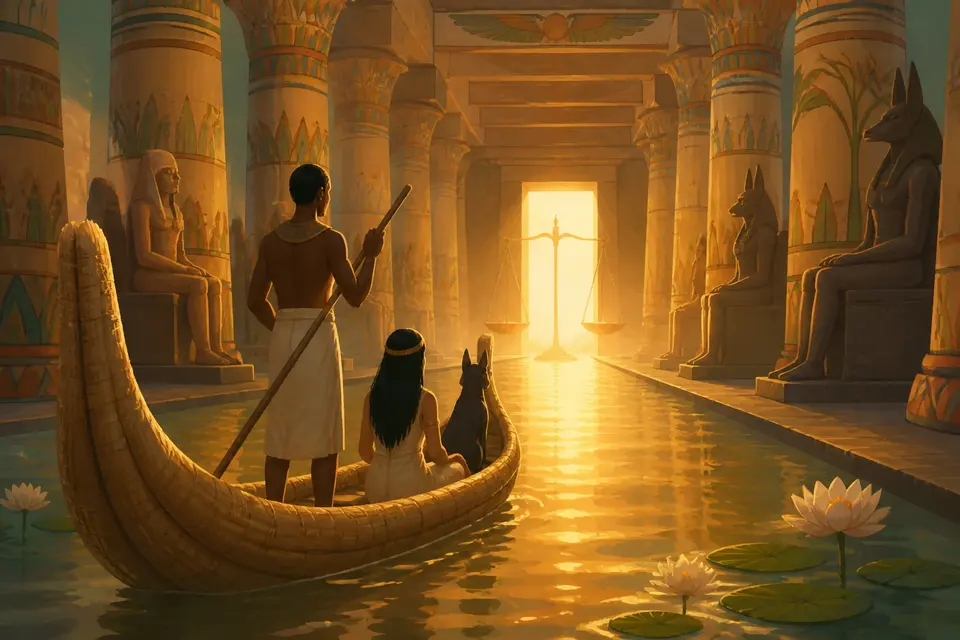
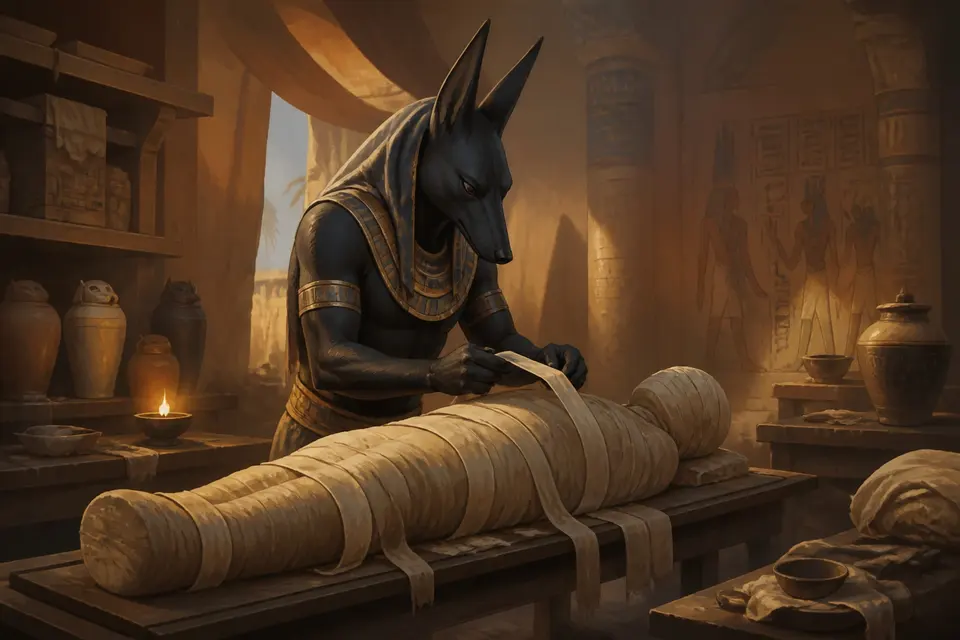
Anubis had several roles. He was the patron of embalmers, and the priest who performed the embalming sometimes wore an Anubis mask. In one scene from a tomb, an embalmer in a jackal mask leans over a mummy. He was also the guide of the dead, leading souls through the underworld to the hall of judgment. And at the judgment he is the one who handles the scales, adjusting the balance and making sure the heart is weighed fairly against the feather of Maat.
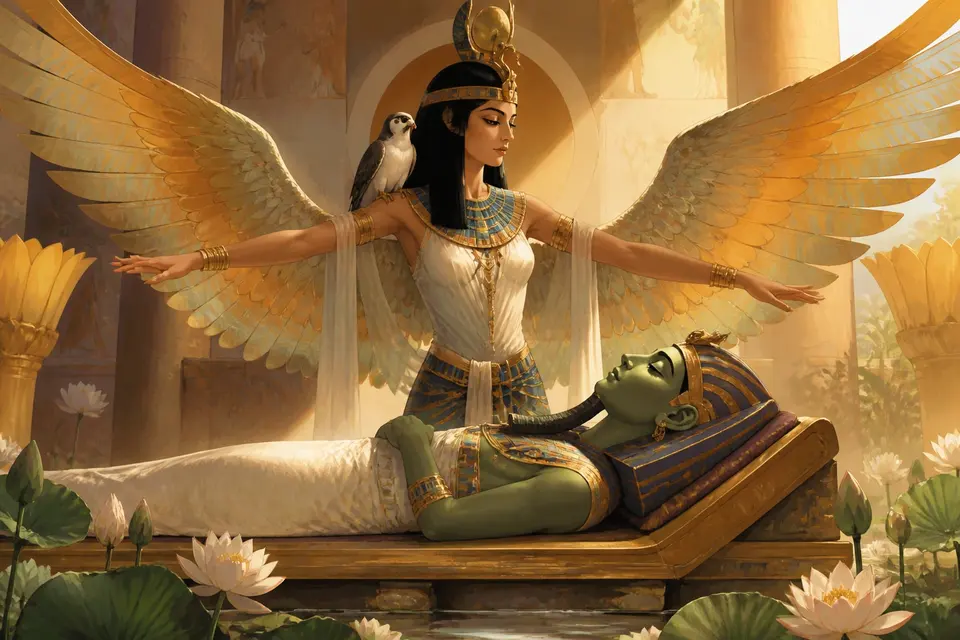
In the earliest periods, he was the main god of the dead, and was invoked in funerary offerings long before Osiris took over that role. In the story of Osiris, Anubis helps Isis embalm the body of the murdered king. That is a good way of explaining why he stayed important even after the newer god appeared.
The surprise
For a long time, Egyptologists have called the animal a jackal, specifically the golden jackal. But in 2015, a team of researchers led by the French geneticist Philippe Gaubert studied the DNA of golden jackals from Africa and came to a surprising conclusion. African golden jackals are not the same species as the Eurasian golden jackal, as everyone had assumed. They are a separate species, closely related to wolves, and they now go by the name African golden wolf, Canis lupaster.
Some Egyptologists have noted that the mummified canids found in Egyptian temples may include this species. If so, then strictly speaking, Anubis is a wolf-headed god. The Egyptians would have shrugged. Their word, sab, covers various canines. They were not classifying animals. They were describing a quality: a watchful creature that lived at the edge of the cemetery and knew where the dead were.
Anubis in a famous tomb
One of the most striking images of the god comes from Tutankhamun’s tomb. In the treasury room, a wooden figure of a black jackal lies on top of a gilded shrine, ears pricked, as if he were awake. It was found in 1922 with a linen scarf still tied around its neck. When Howard Carter first looked into the room, he saw the shape of the animal in the lamplight, guarding the tomb’s most precious objects.
The other canine god
Anubis was not Egypt’s only canine god. A second, called Wepwawet, “opener of the ways,” was shown as a wolf or a jackal with gray or white fur. His main center was a city in Upper Egypt, which the Greeks, who identified the animal as a wolf, called Lycopolis, “wolf city,” the modern Asyut. He led armies in war, clearing the path, and he also led the dead. The two gods were sometimes confused, and it seems to be a good fit with the finding that the Egyptian “jackals” may have been a kind of wolf.
Anubis in popular culture
In modern entertainment, Anubis is shown as an intimidating figure. He is a villain in the film The Mummy Returns and a menacing foe in the TV series Stargate SG-1, and a more benevolent figure, Mr. Jacquel, an undertaker in a small Illinois town, in Neil Gaiman’s novel American Gods. The most accurate depiction is probably the quieter one: a patient, rather kind guide of souls, with a steady hand on the scales.
It is a good picture of what the god was for. The Egyptians did not make a monster out of the thing they feared. They made it a guardian and put it at the door.