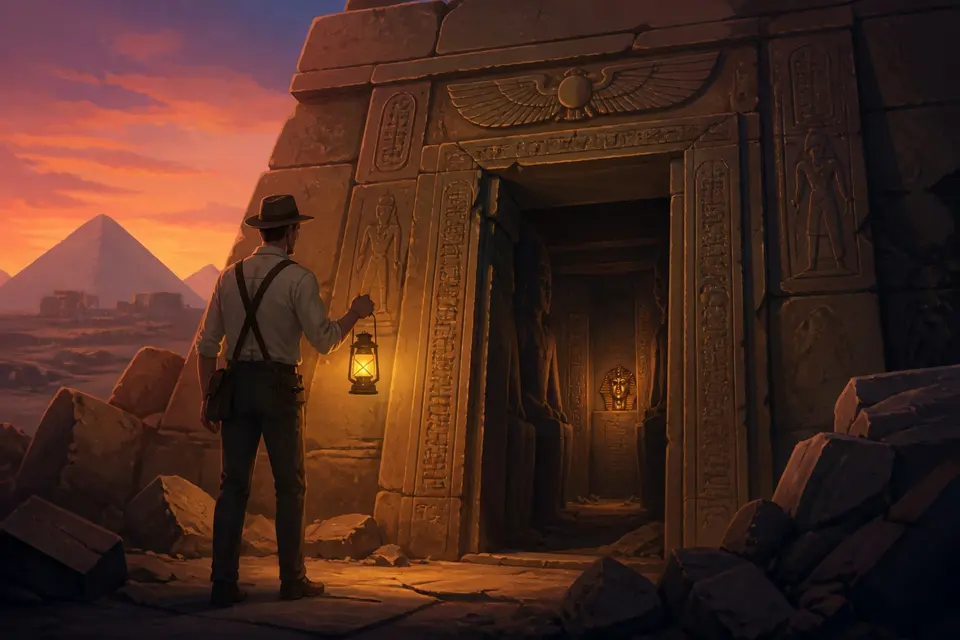
On the evening of November 26, 1922, Howard Carter made a small hole in a sealed doorway in the Valley of the Kings, held a candle up to it and peered in. His patron, Lord Carnarvon, standing behind him, asked if he could see anything. Carter answered with what may be the most famous line in archaeology: “Yes, wonderful things.” He had found the tomb of Tutankhamun. What he had not found, despite everything you may have heard, was a curse.
The man who died
The excavation was financed by George Herbert, the fifth Earl of Carnarvon, a rich Englishman who had been coming to Egypt for his health and who had a hobby of antiquities. He was fifty-six, and he had never been robust: a car accident in 1901 had left him with lasting breathing problems. In March 1923, a few months after the discovery, he was shaving in Cairo when he nicked a mosquito bite on his cheek. The cut became infected. Blood poisoning followed, and, on April 5, 1923, Carnarvon died in the Continental-Savoy Hotel.
That was all the newspapers needed. There were already tensions. Carnarvon had given an exclusive contract for coverage of the dig to The Times of London, which annoyed rival papers and Egyptian officials. Now, with a convenient death, the other papers had a story they were free to tell. The idea of a curse on those who disturbed the king began to circulate.
A very well-known novelist
The press got a boost from Sir Arthur Conan Doyle, the creator of Sherlock Holmes, who was a committed spiritualist. When Carnarvon died, Conan Doyle said it might have been caused by “elementals” created by priests to guard the tomb. That was quoted widely. Another writer, Marie Corelli, had earlier warned that “dire punishment” awaited anyone who disturbed a tomb, and her quote was also dug out.
As the years passed, journalists compiled lists of people who had been connected to the excavation and who died within a few years: Carnarvon’s half-brother, an American railway magnate who visited the tomb, a radiologist. The lists got longer. Few of them mentioned the people who lived on.
The checks
There is no known inscription in Tutankhamun’s tomb that threatens those who enter. Some tombs from other periods do carry warnings, written to deter robbers or people who might disrespect the dead. A famous story about a curse tablet on Tutankhamun’s tomb was invented, and nobody has ever produced it.
Howard Carter, who spent ten years working in the tomb and who handled the king’s mummy, lived until 1939. He died of lymphoma at the age of sixty-four, nothing to do with kings.
In 2002, an Australian researcher, Mark Nelson, published a study in the British Medical Journal examining the lives of the people who had been present when the tomb or the sarcophagus was opened. He compared Westerners who had been present when the tomb or sarcophagus was opened with Westerners who were in Egypt at the same time but were not there. There was no difference in how long they lived.
A few people have suggested that Carnarvon and others might have been affected by mold spores or bacteria in the sealed tomb. This has never been demonstrated. Carnarvon’s own infection is easily explained by the ordinary dangers of an early twentieth-century shave.
A curse that was already in the stories
The notion of a mummy’s curse did not start in 1922. Fiction had already got there. In 1869, Louisa May Alcott, who is famous for Little Women, wrote a short story called “Lost in a Pyramid; or, The Mummy’s Curse.” In 1890, Arthur Conan Doyle himself wrote “The Ring of Thoth,” about a mummy and an immortal. In 1903 Bram Stoker published The Jewel of Seven Stars. The 1932 film The Mummy, starring Boris Karloff, followed after Carnarvon’s death and gave the idea its enduring face.
The best part of the story
It helps to remember how unusual the discovery was. Most royal tombs in the Valley had been robbed in antiquity, often within a few generations. Tutankhamun’s had been looted at least twice soon after burial, but the thieves had been disturbed, and the tomb was resealed and then buried under the debris of a later king’s tomb. It survived almost intact: more than five thousand objects, including a gold mask, three coffins nested one inside the other, a chariot and a shrine in the form of the jackal god Anubis.
The real mystery is why a boy king who ruled for about nine years, died at around nineteen and was barely mentioned in later records should have had the best-preserved burial of his dynasty. That is a question archaeologists are still working on. It does not need a curse to be interesting.