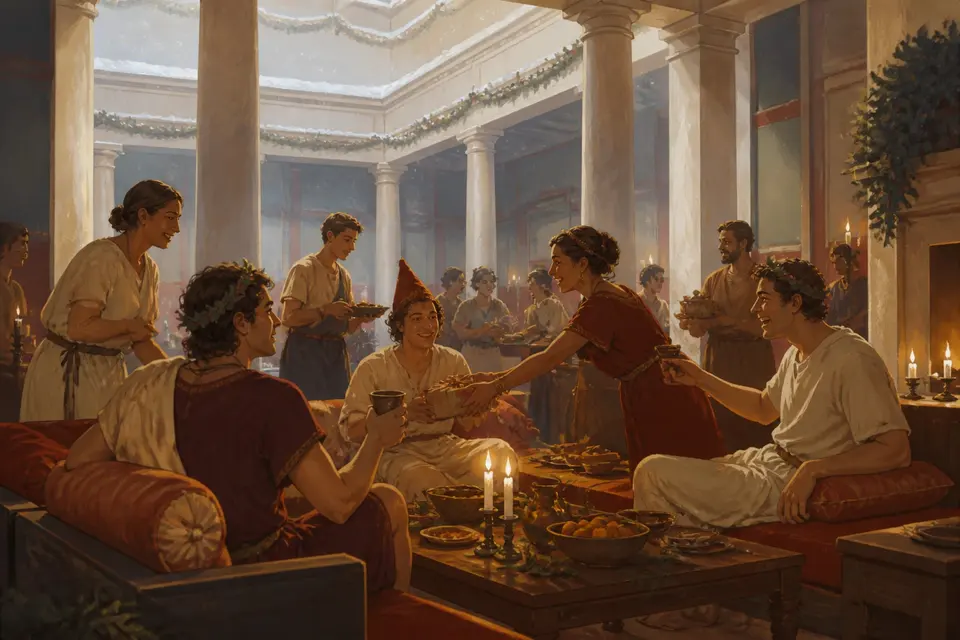
Imagine the week before Christmas. Offices are shut, schools are closed, everyone is shopping for presents, there are parties every night, and the whole world seems to have agreed that normal rules are suspended. Now imagine it in the year 100 CE, in Rome. The shout in the streets is “Io Saturnalia!” People are wearing colorful clothes instead of togas, rich men are serving dinner to their slaves, and nobody is working. The Roman writer Pliny the Younger complained about the noise and retreated to a quiet room at the back of his villa, shut the doors and let the rest of the household run wild. Even he understood that you cannot fight a festival like this. You can only hide from it.
The god of time
Saturnalia honored Saturn, an old Roman god of agriculture and the harvest, who was said to have ruled Italy in a legendary golden age, when everyone was equal, there was no private property and the earth gave food without work. The festival, held in December, recalled that time, and the main idea was that for a few days the normal order of society was turned upside down.
It began on December 17, with a sacrifice at the Temple of Saturn in the Forum, and a public banquet. In the early days, it lasted a single day. Over the centuries it grew to a week, from December 17 to 23, and Roman writers complained that it kept getting longer. The Emperor Augustus tried to limit it to three days. Caligula extended it to five. Everyone ignored them.
How it worked
- Masters and slaves swapped places. Slaves were allowed to speak freely, to gamble and to eat at the table with their owners. In some households, the master served the meal. The Roman writer Lucian, in his satirical Saturnalia, written in the second century, has a character deliver a set of rules for the holiday, including the idea that nobody should be punished during its days.
- A mock king. In some households, a “king of the Saturnalia” was chosen by lot, and for the duration of the party he could order everyone to do silly things: sing naked, carry a flute player on their back, dance. The tradition seems to have lived on in medieval Europe as the “Lord of Misrule.”
- Gifts. People exchanged small presents. The most common were wax candles, called cerei, and little clay figurines, sigillaria, sold in a market near the Forum. The poet Martial wrote a whole book of verses, the Xenia and Apophoreta, to go with gifts: two-line jokes to tuck into a present, which might be a toothpick, a cheap book or a pet bird.
- Gambling. Dice games, usually banned, were allowed.
- A hat. People wore the pileus, a soft felt cap, which was the headgear of freed slaves, and a sign of liberty.
- No work, no war. Law courts closed. Schools shut. Public business stopped. Declaring war during the festival was supposed to be bad luck.
Grumbling about the fun
Not everyone was charmed. The philosopher Seneca wrote to a friend that the whole city had gone mad with pleasure, and wondered whether a wise man should join in or stand apart. His conclusion was that one should take part without giving up one’s principles. Pliny’s retreat is a similar story. And Macrobius, a writer of the early fifth century, wrote a long dialogue also called Saturnalia, set at a gathering of learned men, which is one of the most important sources for later Roman religion and literature.
So is Christmas a stolen Saturnalia?
This is one of the most popular claims in the history of religion, and it is a good example of something that is partly true and partly overstated. Here is what we know.
The earliest evidence for Christians celebrating Jesus’s birth on December 25 comes from a document called the Chronograph of 354, a Roman almanac. Before that, the Gospels give no date. Some early Christian writers calculated that Jesus was conceived on March 25, the supposed day of his death, and therefore born nine months later, on December 25. That is called the “calculation hypothesis.”
The other theory is the “history of religions hypothesis”: the church chose the date to compete with or absorb pagan festivals. On December 25, Romans celebrated the birthday of the sun, Dies Natalis Solis Invicti, a festival associated with the emperor Aurelian, who established the cult of the Unconquered Sun in 274. And a few days earlier was Saturnalia.
Scholars still debate which came first. It is likely that several influences converged. What is clear is that the customs that grew around Christmas in the Middle Ages, such as feasting, gift-giving, the mock “Lord of Misrule” and a general suspension of rules, look a lot like the ones from Saturnalia, though they may also draw on other midwinter festivals in northern Europe.
What survives
Modern life has plenty of Saturnalia in it. Think of the office party where the boss serves drinks. The gift swap with a funny present. Secret Santa. The pre-holiday week in which nothing seems to get done. The Roman festival answers a human need that has not changed: in the darkest week of the year, people want to eat, give presents and laugh together at the idea that the usual order of things is only temporary.
Next December, when someone shouts “Happy holidays,” you can quietly answer, “Io Saturnalia.”