In 29 BCE, Rome had just come out of nearly a century of civil war. Augustus, the adopted son of Julius Caesar, had defeated Mark Antony and Cleopatra and was in the process of becoming the first emperor, though he would never use that word. The city needed a story about itself. Augustus asked the finest poet of the day, Virgil, to write one. The result, the Aeneid, is a poem about a man who loses everything and keeps going.
Leaving Troy
Aeneas is a minor hero in Homer. In the Iliad, he is a Trojan prince, the son of the mortal Anchises and the goddess Aphrodite (Venus to the Romans), and the gods save him from several fights. Virgil takes him and gives him a destiny: he is the one who will escape the fall of Troy and found a new city in Italy.
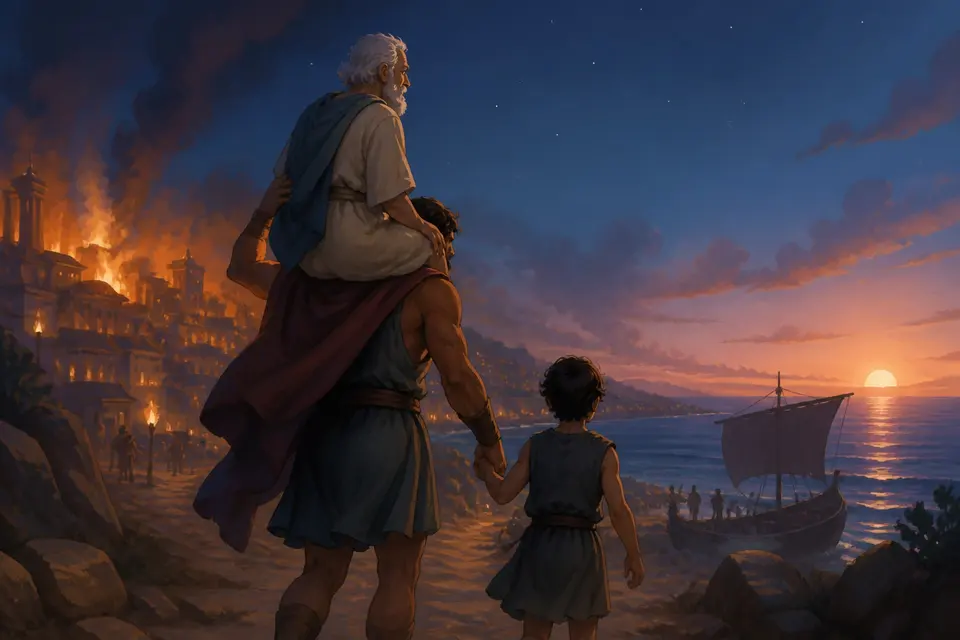
The second book of the Aeneid is a firsthand account of Troy’s last night, told by Aeneas himself. He wakes to the sound of the city burning. He tries to fight, and is told by his mother to take his family and run. His old father refuses to leave. Then a sign appears, a small flame on the head of his young son Ascanius, and Anchises is persuaded.
The image that has stuck is what Aeneas does next. He puts his father on his shoulders. He holds his small son by the hand. He tells his wife Creusa to follow behind. And he carries the household gods, the Penates, wrapped in his arms, because his hands are too stained with blood to touch them. In the confusion, Creusa is lost. When Aeneas goes back to look, her ghost appears and tells him not to grieve, because he is destined for a kingdom and a new wife in a land called Hesperia.
The long voyage
The next six books follow the wanderings of the Trojan survivors. They try to settle in Thrace and discover that the ground bleeds. They try Crete and are driven away by a plague. They meet harpies on an island. They sail past Sicily and the monster Scylla. They are beaten by a storm sent by Juno, who hates the Trojans, and wash up on the coast of North Africa.
There they are welcomed by Dido, the queen of Carthage, who has herself fled a murderous brother. She falls in love with Aeneas. He is tempted to stay. But Jupiter sends Mercury to remind him of his mission, and he sails in secret. Dido, heartbroken, builds a pyre and stabs herself. As he sails away, Aeneas sees the glow of the flames on the horizon. It is one of the most famous and sad scenes in Latin literature, and it is also the mythical origin of the later enmity between Rome and Carthage.
Down below
In Italy, Aeneas visits the Underworld, led by the Sibyl of Cumae. There he sees the ghost of his father, who shows him a parade of the unborn souls who will become the great men of Rome: Romulus, Julius Caesar, Augustus. It is the poem’s way of saying that this suffering has a purpose. At the end of the vision, Anchises gives Aeneas a quote that became a motto of Roman identity: other nations may excel in sculpture, in oratory, in astronomy, but the Roman’s art is to rule and to “spare the conquered and war down the proud.”
The war for a home
The last six books are a war. Aeneas lands in Latium, where King Latinus welcomes him and offers his daughter Lavinia. But she was promised to a local ruler, Turnus, who goes to war. In the final scene, Aeneas has Turnus at his mercy, and is about to spare him, when he sees on Turnus’s shoulder the belt of Pallas, a young ally whom Turnus had killed. In a rage, Aeneas kills him. The poem ends abruptly, as Turnus’s soul flees “with a groan, indignant, to the shades.”
A poem with an agenda
The Aeneid is a work of propaganda, and also something much more. Augustus’s family, the Julians, claimed descent from Aeneas’s son Iulus, and therefore from Venus. The poem fused the Roman past with the new regime. At the same time, it is full of doubts about the cost of empire. Aeneas weeps. He is frequently afraid. He makes mistakes. When he abandons Dido, he is shown as a man who is doing what he must and who knows what it costs.
When Virgil was dying in 19 BCE, he asked that the unfinished poem be burned. Augustus overruled him and had it published. We owe the Aeneid to an emperor’s refusal to follow a poet’s last wish.
A founder who arrives with nothing
The most unexpected thing about Rome’s foundation myth is its hero. Rome, the superpower, chose to describe its origins in terms of a refugee: a man whose city was destroyed, whose wife was lost, who traveled the sea for years and who arrived in a foreign land with his household gods in his arms. The poem is not subtle on the point.
For modern readers the echo is hard to miss. But the Romans knew what they were doing. They wanted to tell the story of a people who survive, rebuild and make a home from loss.