It is one of the best-loved stories of the conquest of Mexico: the Spaniards arrive in 1519, the great Aztec emperor Moctezuma, who is nervous and superstitious, believes that their leader, Hernán Cortés, is the returning god Quetzalcoatl, and the empire falls without a fight. It has been told in schoolbooks, documentaries and novels for centuries. A growing number of historians think it is mostly a story told afterward.
The god and the king
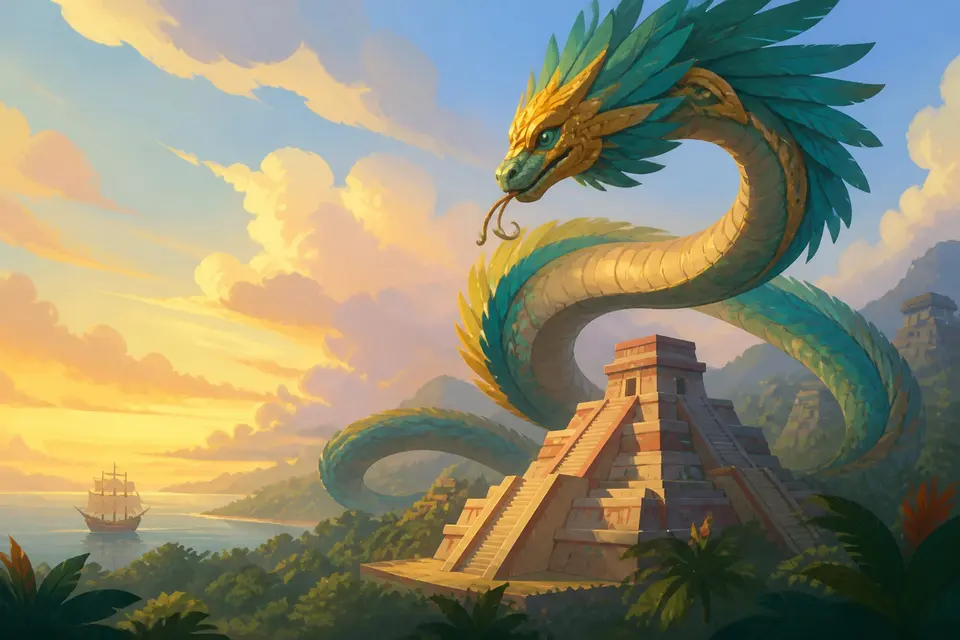
Quetzalcoatl, the “Feathered Serpent,” was a major god in the central Mexican world. He was associated with wind, learning, the morning star and the creation of humankind. Another figure shares his name: Topiltzin Quetzalcoatl, a priest-king of the city of Tula, who according to legend was driven out by a rival and left, promising to return. In some accounts he sailed east on a raft of serpents. In others he burned himself and became the morning star.
A calendar sign also figures in the story. Quetzalcoatl was linked to the day sign Ce Acatl, “One Reed.” The year 1519 in the Aztec calendar was a One Reed year. Cortés landed in that year. The coincidence, in the popular account, is what convinced Moctezuma.
Where the story comes from
The first thing to notice is when the story was written. The earliest detailed Nahua accounts of the conquest come from the Florentine Codex, a huge encyclopedia of Aztec life compiled between the 1540s and the 1570s by the Spanish friar Bernardino de Sahagún with the help of Nahua students and elders. That is a generation after the events. By then the empire had fallen. Many of the informants were people who had lost their world. They may well have wanted to explain how it happened, and the idea that the gods or omens had predicted the arrival of the Spanish offered a way of making sense of defeat.
In the Florentine Codex, Moctezuma does receive the Spaniards with offerings and does at some points speak of them as teteo, a word usually translated as “gods.” But, as the historian Camilla Townsend and others have pointed out, the Nahuatl word teotl could be used for anything that inspired awe, including powerful strangers, and it did not necessarily mean a deity in the Christian sense. Another point is that the book was written under Spanish supervision. The friars were pleased by an account in which Indigenous people recognized the arrival of a superior power.
What the historians say
In 2003, the historian Matthew Restall published Seven Myths of the Spanish Conquest, in which he argued that the story of Moctezuma mistaking Cortés for a god is one of the most persistent myths of the conquest. He pointed out that the earliest Spanish accounts, those of Cortés himself and his men, do not mention it. Cortés describes Moctezuma as a ruler who tried to keep the Spaniards at a distance, then to control them, and eventually to understand them. Some of the earliest versions of the “god” story appear in accounts written decades later by Spaniards who had not been present.
Restall’s argument is not that Moctezuma was not afraid. There were omens, and the Aztec ruler had every reason to be careful: he faced strangers with horses, steel and cannon. But careful is not the same as divinely convinced.
What actually happened
The Spaniards landed on the Gulf coast in 1519 with about 500 men. They did not conquer a vast empire by themselves. They marched inland, made deals and fought battles with local peoples, especially the Tlaxcalans, an independent state that had long resisted the Aztecs and decided to join Cortés. When the Spaniards finally fought their way into Tenochtitlan in 1521, they were accompanied by tens of thousands of Indigenous allies. In between, a smallpox epidemic in 1520, brought by the Spanish, killed a large share of the population, including a new emperor.
Moctezuma died in 1520, in circumstances that are still disputed. Spanish sources say he was killed by stones thrown by his own people. Nahua sources suggest he was killed by the Spaniards.
Why the myth is so useful
The story of the god who came back is appealing to many people. To some Europeans it made the conquest look natural and almost inevitable. It flattered the Spanish. It also made Indigenous people look credulous. It is hard to make a more condescending claim than to say that a whole civilization was undone by a misunderstanding.
The truth is both more ordinary and more interesting. People on both sides were making political decisions in a very tense situation, using the information they had. They made mistakes. They also had real choices. The legend of the returning god helped turn that complicated story into a tidy one.