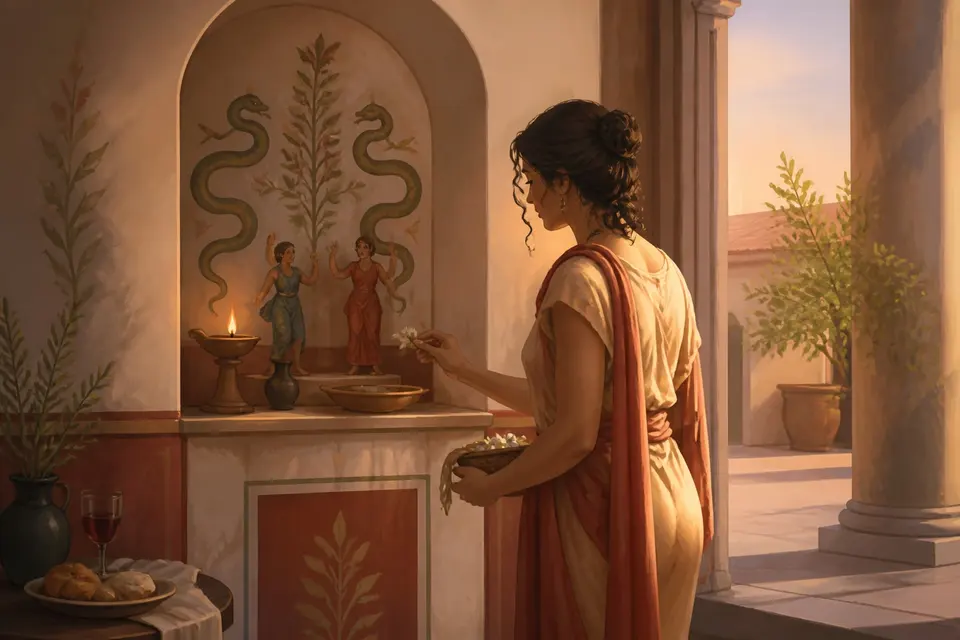
Walk into almost any house in Pompeii, and somewhere near the kitchen or in the atrium, the central hall, you will find a small niche in the wall, or a little painted shrine that looks like a miniature temple. Above it, there is often a painting: two young men in short tunics, dancing, each holding a drinking horn and a bucket, with a man in a toga between them, and, below, a pair of snakes sliding toward an altar. It is a lararium, a household shrine, and it was the center of the Roman home’s religious life. Hundreds have been found at Pompeii and Herculaneum alone. Almost everyone in the Roman world had one.
The Lares
The Lares were protective spirits of the household. Their origins are debated, and the Romans themselves had several theories. Some said they were the spirits of dead ancestors. Others thought they were guardians of the land or the crossroads. In houses, they were represented as the two dancing youths. They protected the family, the property and the household’s fortunes, and they were present at all the milestones of life: births, weddings, coming of age and deaths.
There was also a collective version. The Lares Compitales looked after crossroads, and each neighborhood had a small shrine at its intersection. Augustus reorganized the cult of these Lares, adding his own Genius, or guardian spirit, so that, as a result, the household gods of the whole city were tied to the emperor.
The Penates
The Penates were the gods of the pantry. The name comes from penus, the inner store of food in a house. They made sure that the family had enough to eat, and they were associated with the hearth, which Vesta oversaw for the whole community. In practice, the Lares and Penates were often mentioned together, and many people understood them as a single idea: the gods of the home.
These are the gods that Aeneas carries out of burning Troy in Virgil’s epic, wrapped in his arms because his hands are too bloodstained to touch them. For the Romans, the Penates were what made a household a household. If you took them with you, you took the family with you.
The Genius
Between the dancing Lares in the paintings stands a figure in a toga, usually pouring a libation. That is the Genius of the head of the family, the paterfamilias. The Genius was a kind of divine spirit that represented the family’s vitality, passed from father to son. A woman had a corresponding spirit, her Juno. We still use the word “genius,” though we use it differently. For a Roman, you did not have a genius. You had a Genius that looked after you.
The snake
The painted snakes are curious. In Roman belief, a snake could be a good sign. It stood for the spirit of the place, genius loci, and for fertility and protection. A snake at the altar was a welcome guest. In some houses, it seems, real harmless snakes lived in the walls and were treated well.
A daily routine
The shrine was not just decoration. The family’s head, or sometimes its women or slaves, made offerings at least once a day, usually at mealtimes. A bit of food was put on the altar or in the fire: a pinch of salt, a crust of bread, a few grains of incense, a libation of wine. On the first day of the month (the Kalends), the ninth day (the Nones) and the mid-month day (the Ides), garlands were put on the shrine. On family occasions, such as a birth, a wedding or the return of a traveler, there was a special offering. Cato the Elder, in his handbook on farming, tells the estate manager’s wife to put a garland on the hearth on the Kalends, Nones and Ides and to pray to the household god.
It is a gentle, constant form of religion, practiced in the kitchen rather than in a temple. It made the divine part of everyday life.
The phrase today
The words have survived in English, oddly. “Lares and penates” has been used since the eighteenth century to mean the household goods and treasured possessions of a home. It is a nice case of a religious idea shrinking into a joke about furniture.
Why it feels familiar
The idea of a small altar in the home is not at all strange. In many cultures people keep shrines, whether to saints, to ancestors or to deities, with a candle, a photograph or a small offering. A candle lit for a dead relative, a bowl of fruit placed in front of a picture, a quiet word said before eating: all these are descendants of the lararium, or at least relatives of it.
What the Romans understood is that a house needs more than walls. It needs a small, regular act of attention, a way of saying “this place, and these people, matter.” A little dance on a wall, two snakes and a crust of bread will do.