In 1890, a ship docked in Liverpool carrying an unusual cargo: nineteen tons of cat mummies. They had been discovered two years earlier by a farmer at Beni Hasan, in Middle Egypt, who stumbled on a huge burial ground containing hundreds of thousands of them, wrapped in linen. Nobody knew what to do with them. Most were sold by weight and sent to England to be ground into fertilizer. A few survive in museums, including one in the British Museum. It is the most undignified end that any religion has ever visited on its sacred animals.
From lioness to cat
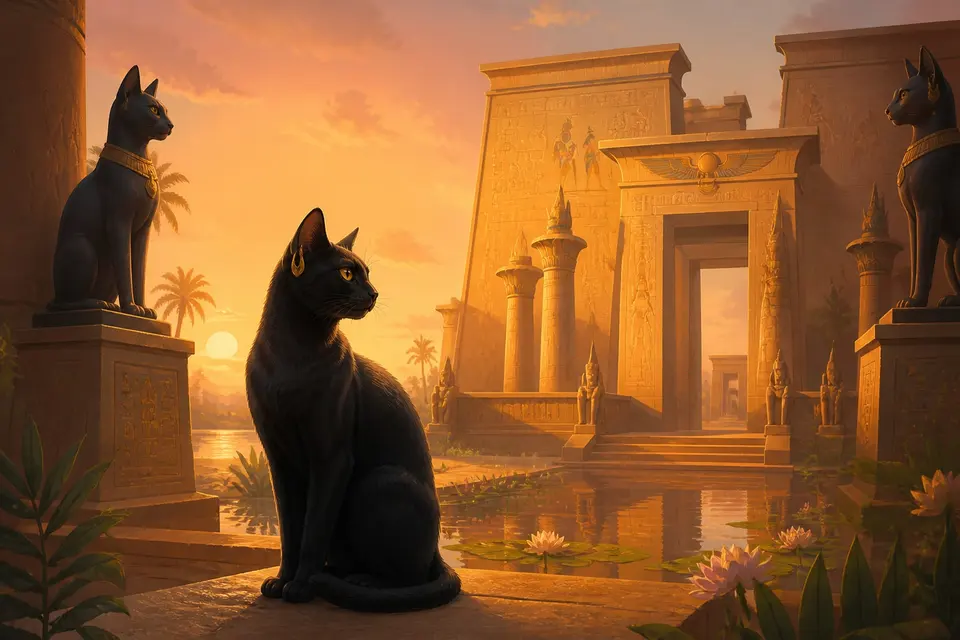
The goddess Bastet began as a fierce lioness. She is attested in the Old Kingdom, more than 4,500 years ago, as a protective goddess in the northern Nile Delta, and her main center was Bubastis, a city whose name is Greek for “House of Bastet.” Early images show her with the head of a lioness. Over the centuries, as cats became more important in Egyptian homes, her image softened, and by around 1000 BCE she was usually shown as a woman with the head of a cat, often holding a sistrum, a ceremonial rattle, and carrying a small basket.
She was a goddess of protection, of the home, of pregnancy, music and joy. She guarded against disease and evil spirits. And, being a cat, she also guarded against mice and snakes.
Why cats?
Cats had been living with humans in the Near East for at least 9,000 years, since early farmers stored grain and found that cats killed the rodents that ate it. In 2004, archaeologists on Cyprus found a human grave about 9,500 years old with the skeleton of a cat buried beside it, the earliest evidence of a close relationship. In Egypt, with granaries to protect from mice and snakes, cats must have been valuable from very early on.
The Egyptians appreciated them in other ways too. Tomb paintings show cats sitting under chairs, hunting birds in the marshes and eating fish. The Egyptian word for cat, miu, is probably imitative of the sound they make, a charming link to the modern “meow.”
The festival
The great festival at Bubastis was described by the Greek historian Herodotus in the fifth century BCE. According to him, hundreds of thousands of pilgrims traveled to the city by boat, men and women together, with some of the women playing castanets and the men flutes. As the boats passed towns on the river, the women shouted insults at the townswomen and lifted their skirts. Herodotus says that more wine was drunk at this festival than in all the rest of the year, and he claims that 700,000 people attended, a number that is probably exaggerated.
The cat laws
Other writers describe the Egyptians’ attitude to cats with astonishment. Herodotus says that if a house caught fire, the Egyptians would stand guard around the cats rather than put out the fire, and that when a cat died a natural death in a house, the family would shave off their eyebrows in mourning. The historian Diodorus Siculus, who traveled in Egypt around 60 BCE, claimed that anyone who killed a cat, even by accident, was put to death. He says he saw a Roman visitor killed by a mob after accidentally killing one, though Egypt was by then allied to Rome and the authorities were trying to keep the peace.
There is also a story, told by later writers, that in 525 BCE, the Persian king Cambyses defeated the Egyptians at Pelusium by having his soldiers carry cats, dogs and other sacred animals before them, so that the Egyptians would not dare to shoot. Historians treat that as legend, but it suggests how strange the Egyptian attitude toward cats appeared to outsiders.
The mummies
Cats were mummified on a vast scale, especially in the Late Period (after about 664 BCE). Pilgrims could buy a mummified cat from a temple as an offering to Bastet. Breeders raised the animals specifically for this purpose. X-rays of cat mummies have shown that many were very young, and some had broken necks, showing that they had been killed for the trade. Not all cat mummies contain a cat: some turn out to hold only a few bones, or even bundles of cloth. The cat industry was big, and, as in any big industry, some cheating went on.
Bastet’s later life
The cult of Bastet was widespread for more than two thousand years. When Egypt became Christian and then Muslim, the temples closed, but the memory of the cat goddess survived in art and imagination. In the modern world, she has appeared in comics and popular fiction. In the Marvel universe, the Black Panther’s patron deity is the panther goddess Bast, a direct borrowing.
And then the internet
It is hard not to notice that, 4,000 years later, much of the internet is devoted to pictures of cats. The Egyptians would have understood completely. They loved cats for the same reasons we do: they are beautiful, mysterious, independent, affectionate when they choose to be and good at killing mice. We do not worship them, exactly, but we feed them, photograph them and let them sleep on our laptops.
Bastet, one imagines, is quite pleased.