In 1544, a delegation of Maya nobles from Guatemala traveled to Spain to meet the future king Philip II. Among the gifts they brought were jars of beaten chocolate. It is one of the earliest recorded cases of chocolate arriving in a European court. The Spanish had met it a few decades earlier. They found the drink bitter, red-brown and oddly frothy, and at first they were not sure what to make of it. Within a century, they would be unable to do without it.
A tree from the rainforest
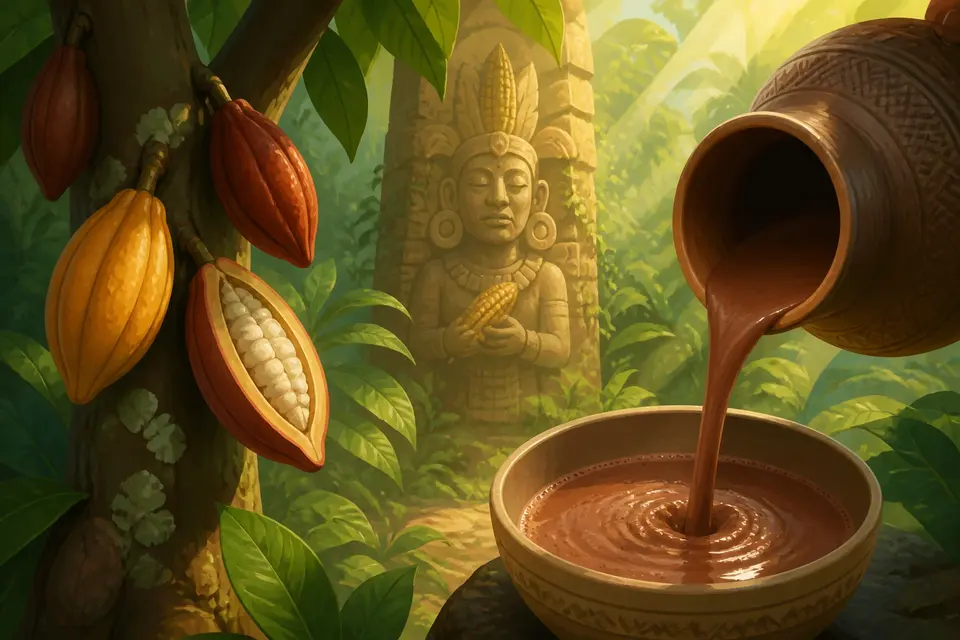
The cacao tree, Theobroma cacao, grows in the shade of tropical rainforest, and it is fussy. It needs heat, humidity and shelter from wind. Its pods grow straight out of the trunk and branches, each holding about forty seeds in a sweet white pulp. For a long time, it was assumed that the plant was first domesticated in Mesoamerica. In 2018, a team of archaeologists reported that they had found traces of cacao on pottery from a site in southeastern Ecuador, from the Mayo-Chinchipe culture, dated to around 3300 BCE. That is about 5,300 years ago, and it suggests that cacao was first used in the upper Amazon, thousands of kilometers from the Maya.
It seems to have reached Mesoamerica later, and was well established among the Olmec by about 1500 BCE. The Maya adopted it with enthusiasm.
The Maya drink
Maya chocolate was not a sweet bar. It was a drink, often served at feasts and ceremonies. The beans were fermented, dried, roasted and ground on a stone, then mixed with water and sometimes with chili, vanilla, honey or ground maize. To make the froth that was considered essential, the liquid was poured from one vessel to another from a height.
We know this from glyphs. The Maya word for cacao was kakaw, and it appears on painted ceramic vessels that held the drink. One famous vessel from a tomb at Río Azul in Guatemala, dated to about the fifth century CE, still had traces of chocolate when it was analyzed. Another painted scene shows a woman pouring the drink from a pitcher into a cup, with the froth rising.
Cacao was a drink for the elite. It was served at royal banquets, at weddings, in the funeral rites of kings, and offered to the gods.
Money you could eat
To the Aztecs, who conquered much of Mesoamerica in the fifteenth century, cacao was a currency. In the sixteenth-century records, a turkey hen cost about 100 beans, a rabbit 30, an avocado three. Tribute from conquered regions was paid in cacao. There was even counterfeiting: dishonest traders made fake beans out of clay or by emptying real ones and filling them with dirt.
Chocolate was a drink for the ruling class and warriors. The Spanish soldier Bernal Díaz del Castillo described the emperor Moctezuma being served cups of it. Cortés is often quoted as telling the king of Spain that a cup of it let a man walk all day without food.
A gift from the gods
In Aztec stories, cacao was a gift to humans from the god Quetzalcoatl, who brought it from the place where the gods lived. Some accounts say he stole it, others that he shared it. The Maya had a god of merchants, Ek Chuah, who was also associated with cacao, and cacao groves had their own rituals and offerings. In the Popol Vuh, the K’iche’ Maya book of creation, cacao is among the foods in the mountain where the gods found the maize from which the first people were made.
The tree itself was sacred. Maya texts mention the “cacao tree” as a symbol of life and abundance. In some paintings it appears as a world tree.
The name
In 1753, the Swedish botanist Carl Linnaeus, who classified plants, gave the cacao tree its scientific name: Theobroma cacao. The first word is Greek, from theos, god, and broma, food. It means “food of the gods.”
How it changed
The Spanish took cacao home and started adding sugar and cinnamon. By the seventeenth century, hot chocolate was a fashionable drink in Madrid, Paris and London, a luxury for the rich. The solid bar was invented in England in the nineteenth century.
So when you eat a piece of chocolate, you are eating something that was a sacred offering, a coin and the drink of kings, and that crossed an ocean and a few thousand years to reach your hand. It does taste a little divine.